 Luvinci
September 30, 2026
Counting Activities for Kindergarten: 10 Number Sense Ideas (Free PDF)
Free printable · PDF · 888 KB
Counting Activities for Kindergarten: 10 Number Sense Ideas (Free PDF)
No signup needed. Just print it.
Download PDFThese counting activities for kindergarten use a die, a cup, a handful of buttons, things already in the house, and each one builds number sense for 0 to 10. Number sense is knowing what numbers mean and how they fit together, beyond saying them in order. They are hands-on number sense activities, following the order a US Department of Education practice guide recommends. See small amounts, count one by one, compare, label amounts with numbers, then solve small problems.
Our free number sense mats PDF sits with those activities. You get a no-cut chart for 0 to 10, a mat for every number from 0 to 10 and a Race to 10 board. 8 pages, US Letter, black-and-white friendly. You don’t sign up or leave an email. If you’re looking for easy kindergarten math activities to do at home this week, start here.
The 5-minute version: Put the 7 mat on the table. Build 7 on the ten frame with small counters, color 7 fingers, then fill the boxes. Check the ten frame, fingers and make-10 box with page 1. Any two parts that make 7 are right.
Jump to: the free mats · the 10 activities · what is number sense · what’s next · FAQ
Free printable number sense mats 0 to 10 (PDF)
Three parts make up the PDF.
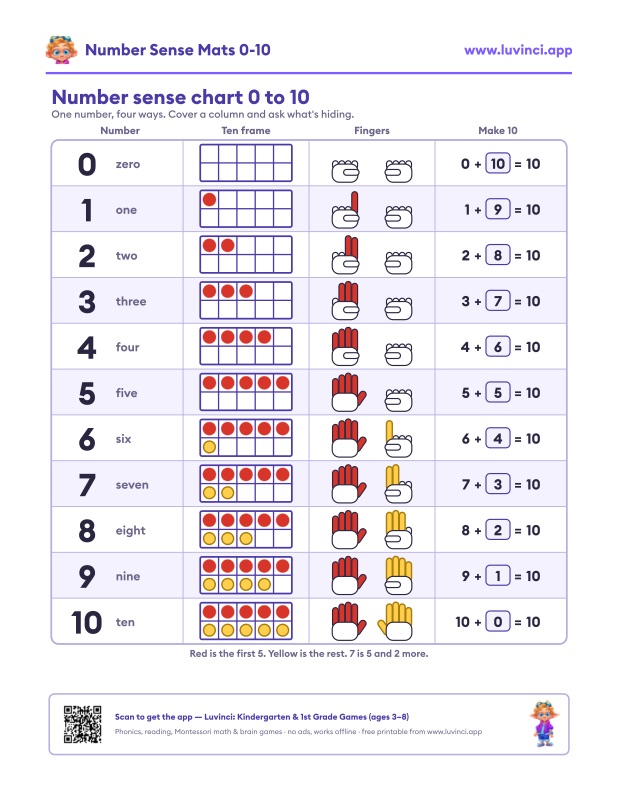
- Number sense chart 0 to 10 (page 1). No cutting, no prep. Every number four ways: numeral and word, a ten frame (red for the first 5, yellow for the rest), fingers, and its partner to make 10. Cover a column and ask what’s hiding. This page lives on the fridge, and it is the answer key.
- Mats 0 to 10 (pages 2 to 7), two per page. Each mat has the number, its word and its dots; a ten frame to build it on and how many more make 10; two hands to color; two parts to break it into; and the numbers next door. Cut on the line or keep the page whole. Zero gets its own mat, and page 7 has a blank mat for any number.
- Race to 10 (page 8). A straight 1-to-10 board with a 1-or-2 spinner, plus all 10 activities on one list.
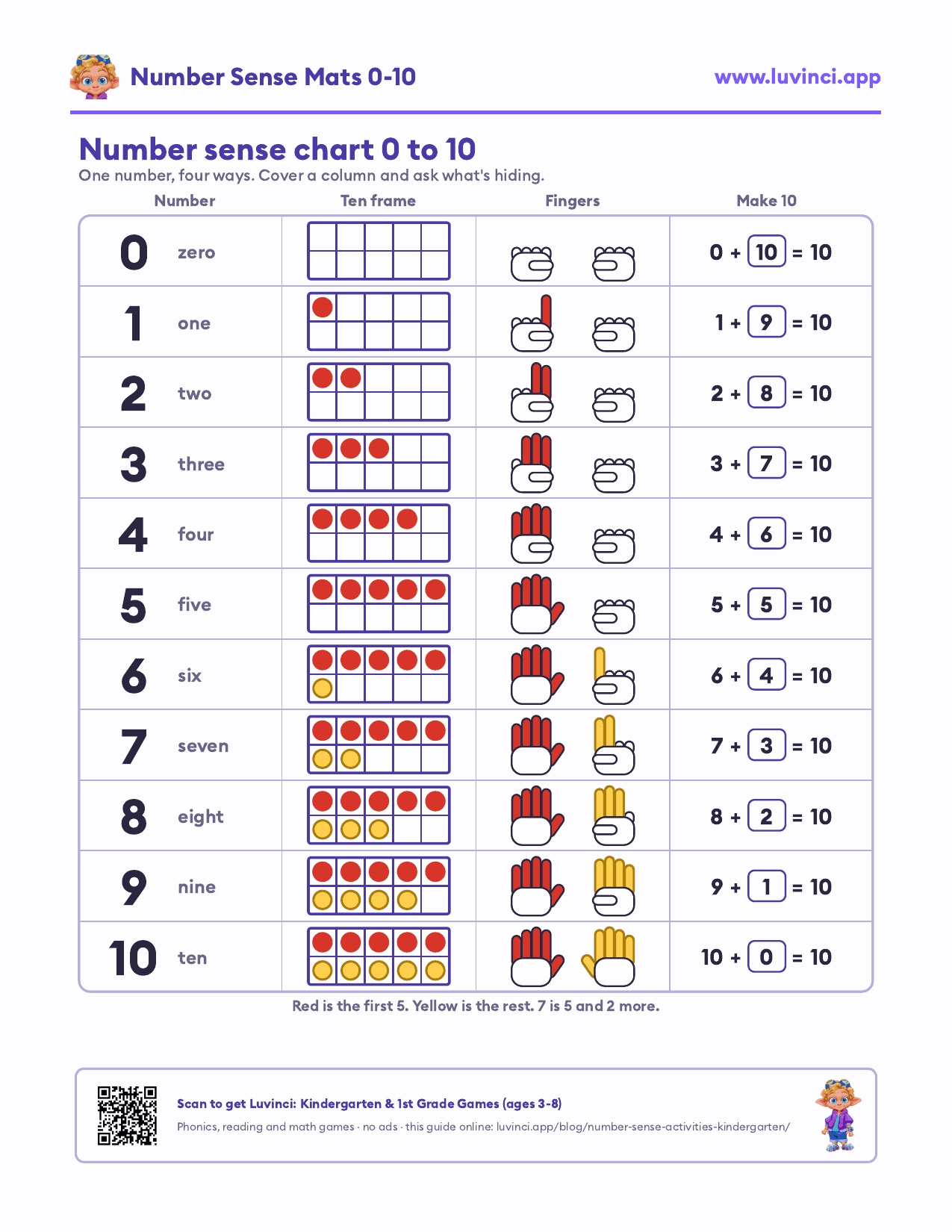
Page 1: the no-cut chart. Cover a column, then check.
The mats leave the answers blank. Check the ten frame, fingers and make-10 box with page 1. Any two parts that make the number are right.
Cereal O’s, small buttons or dried beans fit the boxes, or draw a dot in each box. Buttons, dried beans and cereal are choking hazards, so a grown-up stays close.
Prefer a pencil page? The count and circle cards in our touch and count mats cover that.
10 number sense activities, in teaching order
Number sense activities are short, hands-on games that help a child see what numbers mean. They cover how many, which is more, and how numbers fit together. These counting activities for kindergarten take that idea one step at a time.
The order comes from a US Department of Education practice guide on teaching math to children ages 3 to 6. First recognize 1 to 3 things without counting, then count one by one, then compare amounts, then label them with numbers, then solve small problems (Frye and colleagues, 2013). Do one or two a day for 5 to 10 minutes. Stay with 0 to 5 until it’s easy, then go to 10.
1. Quick looks: how many without counting?
You need: a die, or 1 to 5 small toys and a cup.
- Show 2 or 3 things for about 2 seconds, then cover them with the cup.
- Ask “How many? How did you see it?”
- Then roll a die and say the dots without counting.
Builds: seeing small amounts at a glance, the practice guide’s first step.
Easier: 1 to 3 only.
Harder: ten-frame flash. Cover page 1 except the ten frame column, show one frame for 2 seconds, and ask how many.
More: quick looks and other subitizing games.
2. Touch and count, then “Give me 6”
You need: 10 snacks or toy cars, and a bowl.
- Move each one into the bowl as you say its number.
- Ask “So how many?” and accept the last number you said. No need to count again.
- Then, from a pile: “Give me 6.” Your child stops at 6. Then try “Give me zero.”
Builds: counting one by one, knowing the last number tells how many, and counting out a number.
Easier: line them up first.
Harder: button jar. Guess how many buttons are in a jar, then count to check.
More: 10 more one-to-one activities.
3. Fill the ten frame
You need: a mat from pages 2 to 7, or an egg carton cut to 10 cups (two rows of 5); small counters; a die.
- Fill the top row left to right, then the bottom row.
- Say it two ways: “7. That’s 5 and 2 more.”
- Roll and build: roll a die and build that number.
Builds: how many, with 5 and 10 as landmarks.
Easier: 1 to 5, top row only.
Harder: roll two dice. Build the first number with one kind of counter and the second with another, like buttons and cereal O’s. If the total is more than 10, roll again. For more like this, try dice games within 10.
More: how to use a ten frame at home.
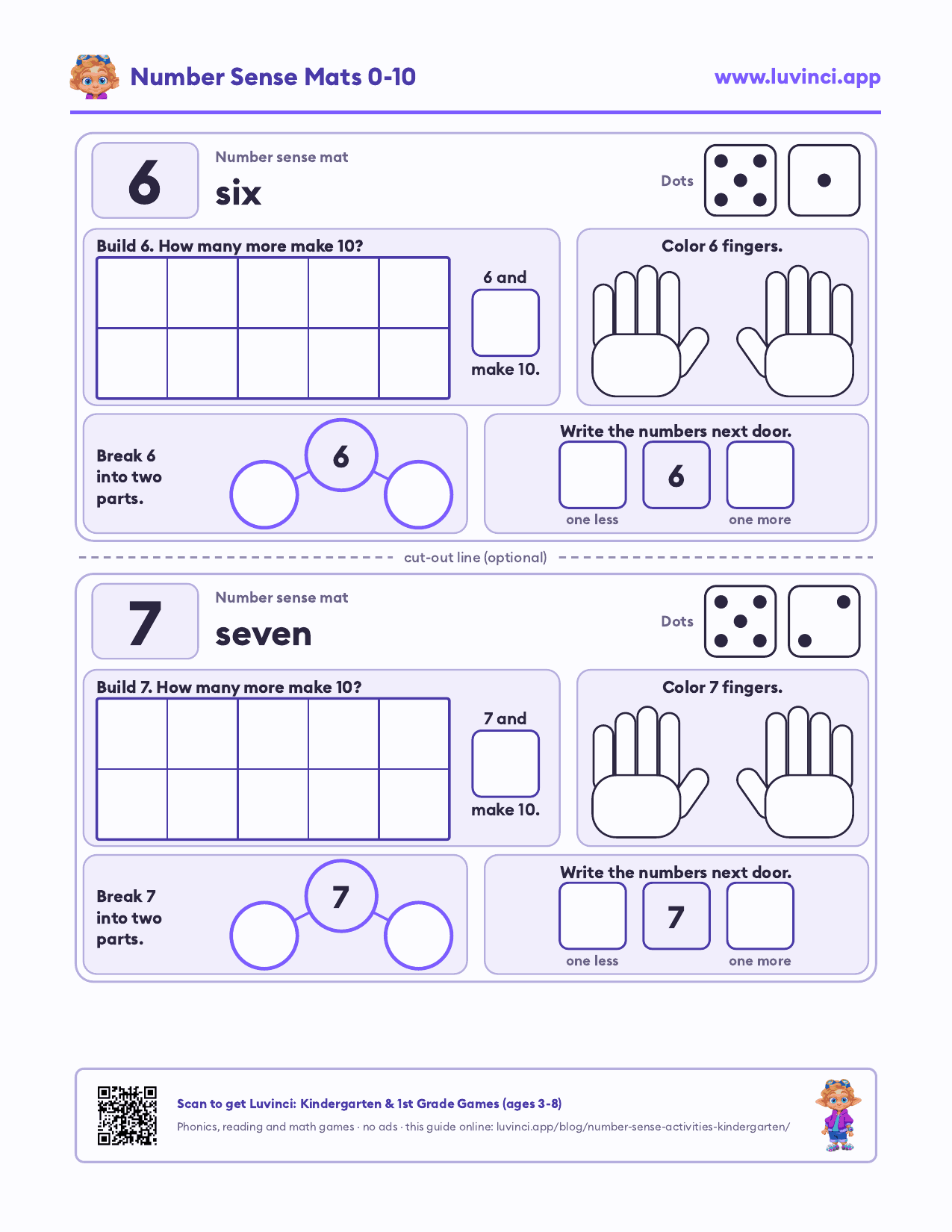
Page 5: the mats for 6 and 7.
4. Show it on your fingers
You need: hands.
- “Show me 7 without counting one at a time.” That’s a full hand and 2 more.
- Then flash fingers for your child to name.
- Check with the fingers column on page 1. Any finger order is fine.
Counting on fingers is a good thing at this age. Your child always has a set of 10 fingers.
Builds: 5 as a landmark, and 6 to 10 as “5 and more”.
Easier: 1 to 5 on one hand.
Harder: “Show 8 a different way” (4 and 4).
More: is finger counting OK?
5. Which has more?
You need: two handfuls of buttons, or two plates of crackers.
- Pair them up, one from each group, one under the other.
- The group with buttons left over, without a partner, has more.
- Then count both, write the two numbers, and ask which number is more. Use the words more, fewer and the same.
A longer line can still be the smaller group. Spread-out buttons take up more room, but the number stays the same. Pairing shows it.
Builds: comparing groups by matching and counting, then comparing two numbers up to 10.
Easier: groups far apart, like 2 and 8.
Harder: groups 1 apart, like 6 and 7.
More: greater than less than worksheets for kindergarten.
6. Build a staircase, then count back
You need: Lego or blocks.
- Build towers of 1 to 10 in order, each one block taller.
- Point: “7 is one more than 6.” Take one block off the 7 tower: “Now it’s 6. 6 is one less than 7.”
- Then walk down from 10: “10, 9, 8… blast off!”
Builds: each number is one more than the last, counting on from any number, and counting back.
Easier: stop at 5.
Harder: “Start at 4 and count to 10.” “What comes before 8?”
More: start with a number chart 1 to 10.
7. Number hunt around the house
You need: paper and a crayon.
- Find 0 to 10 around the house: the clock, the remote, the oven, book pages, your house number.
- Write each one you find.
- Then build it on a mat.
Builds: reading and writing numbers 0 to 10.
Easier: find 1 to 5.
Harder: find a number, then show it 3 ways: fingers, ten frame and dots.
More: writing numbers 0 to 10.
8. Race to 10
You need: the page 8 board and spinner, a paper clip and a pencil, two small toys.
- Spin a 1 or a 2 and move that many squares.
- Say each number as you move: “4, 5.”
- First to reach 10 wins.
It’s one of the simplest counting games for kindergarten, and one of the easiest number sense games for kindergarten to start with.
Builds: number order and size.
Easier: count every square aloud together.
Harder: play Race to 20.
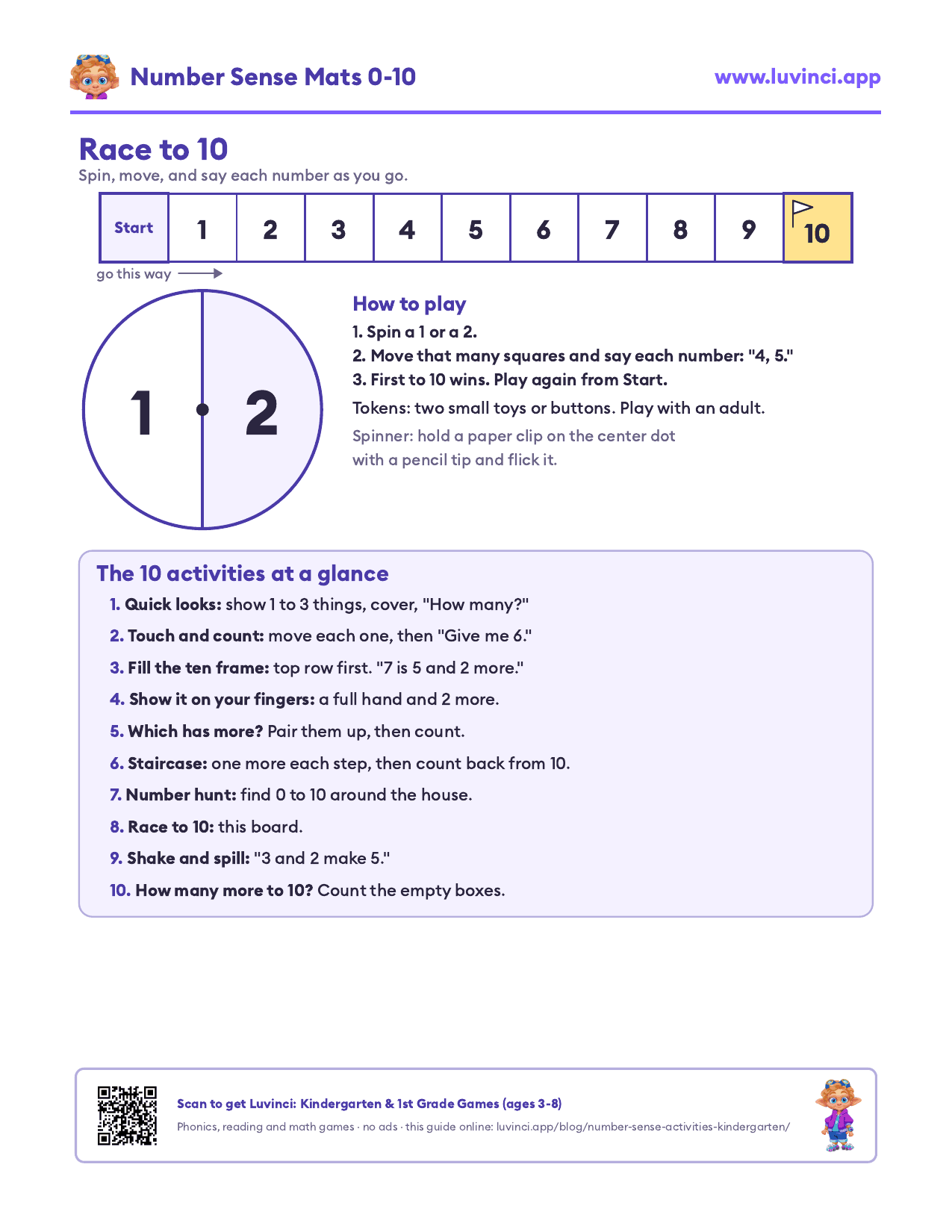
Page 8: Race to 10 and the list of all 10 activities.
9. Shake and spill
You need: 5 buttons or dried beans colored on one side with a marker, and a cup.
- Shake the cup and spill: “3 colored and 2 plain make 5.” They work like two-color counters.
- Write the parts in the mat’s part circles.
- Play hide-and-seek: “I had 5, I see 3. How many are hiding?”
Builds: breaking numbers into parts.
Easier: 3 and 4 first.
Harder: 7 to 10.
More: part-part-whole.
10. How many more to 10?
You need: a mat and counters, as in activity 3.
- Build 7, then ask “How many empty boxes?”
- That’s how many more make 10: “7 and 3 make 10.”
- Write it in the mat’s make-10 box, then check with the last column on page 1.
Builds: partners to 10.
Easier: start with 9 and 8.
Harder: say it without the frame.
More: all the ways to make 10.
What is number sense?
Number sense is knowing what numbers mean and how they fit together. A child with number sense knows that 7 is a group of seven things, that 7 is one more than 6, that 7 is 5 and 2 more, and that 7 and 3 make 10.
The National Research Council calls it “interconnected knowledge of numbers and operations” and notes that “almost no two researchers define it in exactly the same way”. For parents, the useful version is the list of skills below.
It matters because a study that began with 378 kindergartners and followed about 200 of them to 3rd grade, kindergarten number skills predicted both their 3rd grade math scores and how fast they grew (Jordan and colleagues, 2009). Across six large studies, early math skills at school entry were the strongest predictor of later achievement, ahead of reading and attention (Duncan and colleagues, 2007). These are links, not guarantees, and number sense can be taught (see the FAQ).
Number sense in kindergarten: what it includes
These are the pieces of number sense for kindergarten, with the Common Core standards (used in many states) in parentheses where one fits:
- Saying the numbers in order and counting on from any number (K.CC.1, K.CC.2)
- Counting things one by one, knowing the last number tells how many, and counting out a number (K.CC.4, K.CC.5)
- Seeing small amounts without counting (no Common Core code; the practice guide’s first step)
- Telling which group has more, then which number is more (K.CC.6, K.CC.7)
- Reading and writing 0 to 10 first, then 0 to 20 by the end of kindergarten (K.CC.3)
- Breaking numbers into parts, and finding the partner that makes 10 (K.OA.3, K.OA.4)
Kindergarten math activities to try next
When 0 to 10 feels solid, these come next:
- Adding and taking away within 10 with pictures: addition for kindergarten and subtraction for kindergarten
- Doubles like 4 and 4
- Counting past 10: the number chart 1-20, then teen numbers, then counting to 100
- A number line to 20
- Dice games when your child is ready: first grade math games
- Card games with a deck of cards: math card games
Bigger numbers can wait until 0 to 10 feel easy.
Counting in the Luvinci app
In the app’s free counting board (Counting 1, in the Early Math row), your child drags a card of 1 to 10 strawberries onto its matching number while a voice counts along. The app’s Singapore Math boards show sums within 10 on ten frames of pictures, in the full app. The rest of this list happens at the table, with real things. See how Luvinci’s math games work.
FAQ
What should kindergarteners be able to count to?
By the end of kindergarten, the Common Core standards, used in many states, ask children to “Count to 100 by ones and by tens” (K.CC.1) and to count up to 20 things. At the start of the year, counting to 10 with real objects matters most. More: our kindergarten readiness checklist, counting to 20 and counting to 100.
How do you teach a kindergartner to count?
Start by saying the numbers in order, out loud and often. Then count real things together: touch and move each one as you say its number. Ask “So how many?” and accept the last number you said. Our one to one correspondence guide has mats and more activities.
What is the best way to teach number sense?
Here’s how to teach number sense: short daily play with real things, in the order above. See small amounts, count one by one, compare, label amounts with numbers, then solve small problems. Use 5 and 10 as landmarks: “7 is 5 and 2 more”, “7 and 3 make 10.” Talk about how your child saw it, not just the answer.
Can number sense be taught?
Yes. The National Research Council notes that kindergarten number sense “is heavily influenced by experience and instruction” (2009). In a randomized trial with kindergartners from low-income communities who were at risk in math, a small-group program at school improved their number sense, and many of the gains held eight weeks later (Jordan and colleagues, 2012). At home, the version is short daily play with 0 to 10.
When do children develop number sense?
Everyday play with small amounts starts it before school. Kindergarten is where 0 to 10 gets solid and then stretches to 20, and 1st grade goes on to 120. Children vary, and this isn’t a test.
What are easy counting activities to do at home?
Three with no prep: count the stairs as you climb, count snack pieces into a bowl, and show numbers on your fingers in the car for your child to name. When those feel easy, pick any activity from the list above.
The takeaways
- Number sense is knowing what numbers mean, not just saying them in order.
- Go in order: see small amounts, count one by one, compare, label amounts with numbers, then solve small problems.
- Stay with 0 to 5, then 10. Bigger numbers can wait.
- Use 5 and 10 as landmarks: “7 is 5 and 2 more”, “7 and 3 make 10.”
- 5 to 10 minutes a day beats a long session. The best number sense activities for kindergarten use real things.
- Print the free number sense mats 0 to 10: a no-cut chart, 11 mats plus a blank one, and Race to 10.
More free math worksheets: ten frames, number charts, addition and subtraction, daily practice workbooks and more, all in one place. See the math printables →
