Luvinci
October 17, 2026
Free Valentine's Day Math Worksheets: Kindergarten & 1st Grade
4 free PDFs in this post
More PDFs (3)
Valentine’s Day math for kindergarten and 1st grade covers counting, adding and graphing with hearts. Kids use these free Valentine’s Day math worksheets to count and graph candy hearts, fill ten frames, color by number and measure with hearts. The kindergarten Valentine math worksheets stay within 10. 1st grade pages add and take away within 20, and count tens and ones to 40.
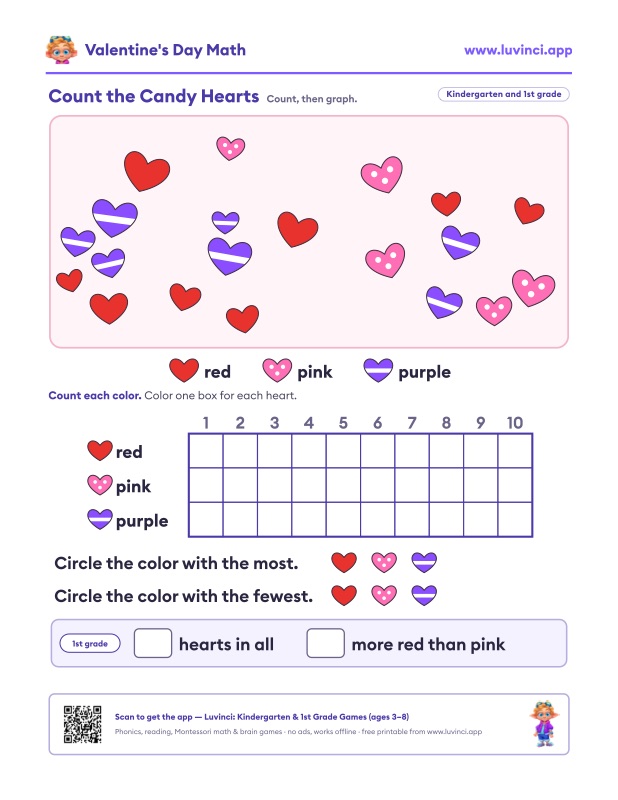
8 red hearts, 5 pink and 7 purple. Red has the most. Red has 3 more than pink.
You’ll find all of it in one free Valentine’s Day Math PDF of 9 pages. The pack holds candy heart graphing, word problems, ten frames, tens and ones, measuring and an answer key. It’s free, with no signup and no email. The six color by number pictures, the roll and cover game and the number order puzzles each come as their own free PDF, in the list at the top.
Jump to: the free PDF · candy heart graphing · kindergarten · 1st grade · color by number · games · centers · FAQ
Free Valentine’s Day math worksheets (PDF)
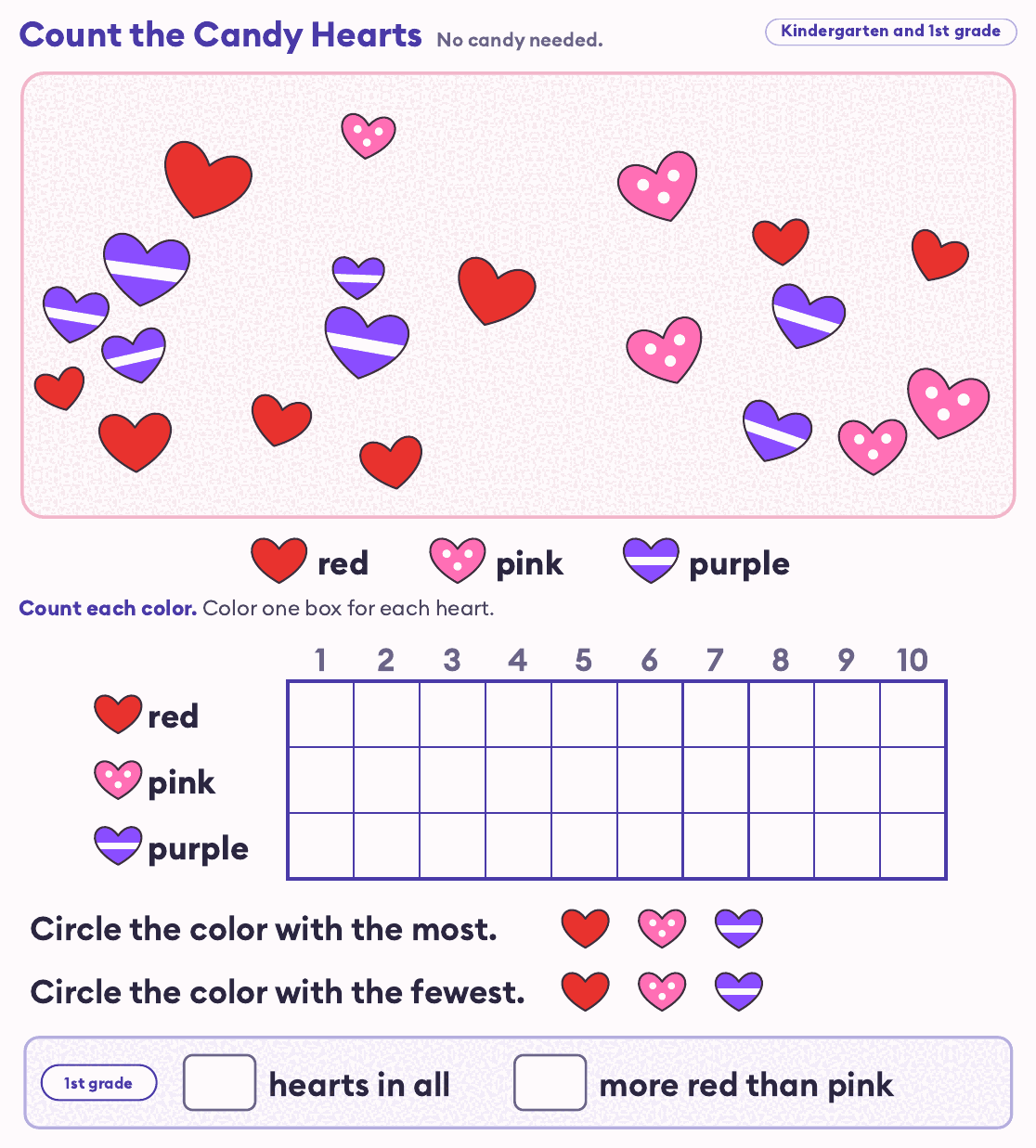
Page 1. Count, then color the graph.
The grade sits at the top of each page of the Valentine’s Day Math PDF.
| Page | What’s on it | Grade |
|---|---|---|
| 1 | Count the Candy Hearts. Count 20 printed hearts and color a bar graph | K and 1st |
| 2 | Valentine Word Problems. Four story problems within 10, with pictures to count | K |
| 3 | Valentine Word Problems. Four story problems within 20. Write a number sentence | 1st |
| 4 | Ten Frame Match. Write the sum, then match it to a heart | K |
| 5 | Make 10 with Hearts. Five ways to make 10 | K |
| 6 | Heart Strips. Tens and ones to 40 | 1st |
| 7 | Measure with Hearts. Which is longer, then a heart ruler | K and 1st |
| 8 | Helper chart. Ten frames 1 to 10 and make a ten | K and 1st |
| 9 | Answer key | Grown-ups |
The PDF is US Letter. Print at 100% (“actual size”), not “fit to page”, so the boxes stay big enough for crayons. Choose the pages that match your child’s level, and print the key for yourself.
The Valentine math printables for color by number, the game and the puzzles are in the list at the top of this post. For more, see our math games and special days printables.
Candy heart graphing
Candy heart graphing is the classic Valentine math activity. Kids sort the hearts by color, count each pile and color one box of a bar graph for each heart. Then they find the color with the most and the fewest.
Page 1 of the Valentine’s Day Math PDF is a candy heart graphing page, with no real candy needed. Kids count 20 printed hearts in three colors. Red is plain, pink has dots and purple has a stripe, so a black-and-white print still works.
Then they color the candy heart graph. One box for each heart, starting at 1. Each color gets its own row.
Kindergarten sorts, counts and circles the most and the fewest. 1st grade also finds how many in all and how many more. On the count page, that’s 20 in all and 3 more red than pink.
Some teachers call it conversation hearts graphing. The printed hearts work the same way.
Valentine’s Day math for kindergarten
Kindergarten in February works on number pairs and on adding and taking away within 10. Our Valentine math for kindergarten stays in that range.
Word problems (page 2). Read each one aloud. Your child counts the cards, balloons, hearts or cupcakes and crosses out the ones that go. Then they fill in the number sentence, like 6 − 2 = 4. The sign is printed for them.
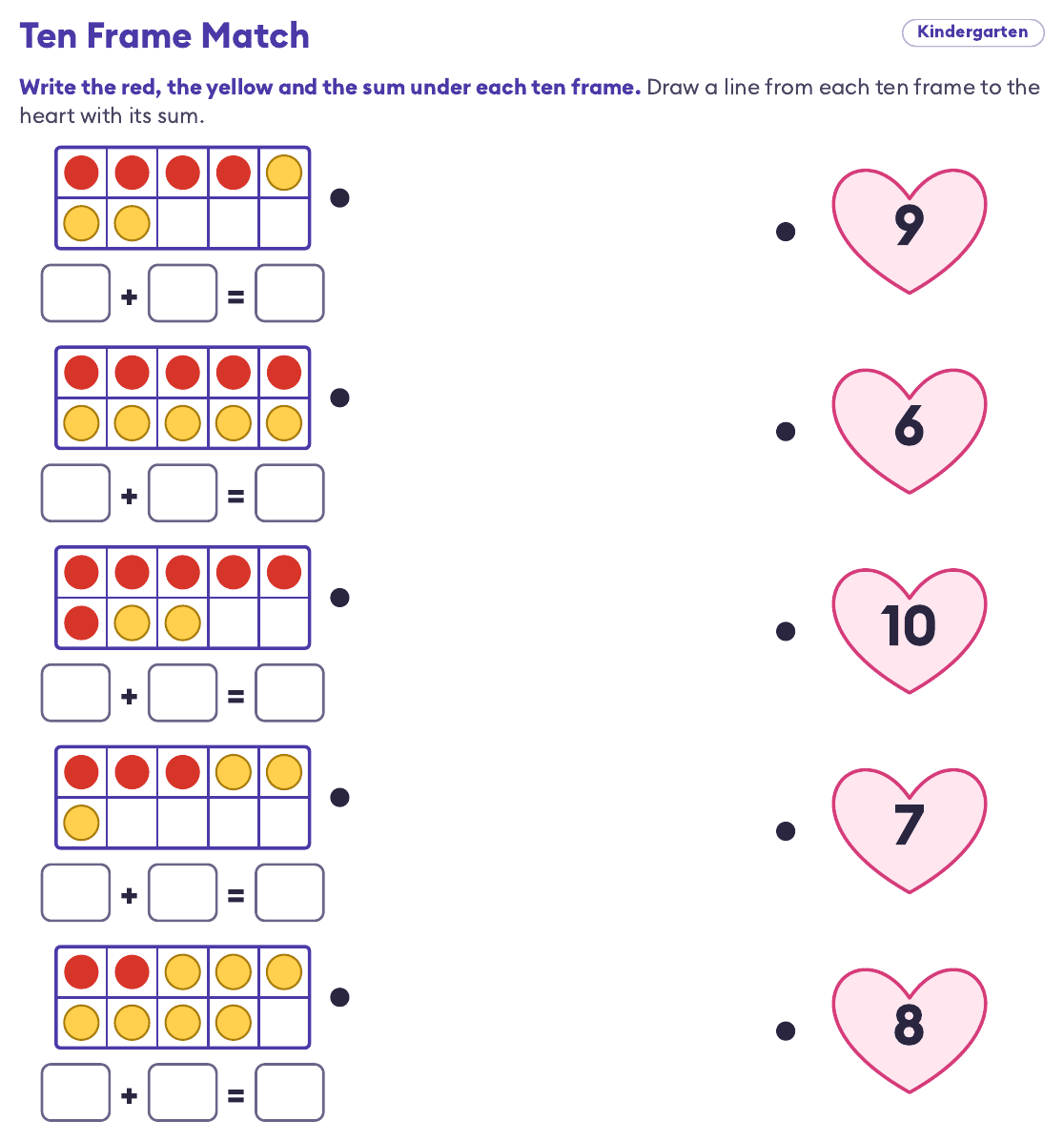
Page 4. Write the sum, then draw a line to its heart.
Ten Frame Match (page 4). Each Valentine ten frame has red counters, then yellow, top row first, the way it’s done at school. Your child writes the red, the yellow and the sum, like 4 + 3 = 7. Then they draw a line to the heart with that sum.
Make 10 with Hearts (page 5). Each ten frame is 10 hearts. The first one shows 7 red and 3 yellow, so 7 + 3 = 10. Your child colors some hearts red and the rest yellow, a new way each time. See ways to make 10 and number bonds for more.
Which is longer? (top of page 7). Your child circles the longer of two bands. Kindergartners compare side by side before they measure with units.
Color by number (pages 1 to 3 of the color by number PDF). The heart and the cupcake add within 10. The bee mixes in take-aways. Counting on fingers for every box is fine. Our ten frame printable, addition for kindergarten and subtraction for kindergarten go further.
Adding and taking away within 10 is exactly the range of the app’s addition and subtraction boards. On Luvinci’s Singapore Math boards, each sum sits on two ten frames of pictures, and take-away is one ten frame with the taken-away items crossed out.
Try the free counting board (Counting 1). The ten-frame, addition, subtraction and times-table boards are in the full app. See how Luvinci’s math games work.
Valentine’s Day math for 1st grade
1st grade in February adds and takes away within 20 and works with tens and ones. The 1st grade pages follow that.
Word problems (page 3). Each one is a different kind. Add three numbers, take away, compare, and find how many more are needed. Your child writes a number sentence, then the answer. In 7 + 4 + 6, adding 4 + 6 first makes 10. See word problems for 1st graders for more.
Color by number (pages 4 to 6 of the color by number PDF). The ladybug adds within 20. The cat and the owl mix adding and taking away. Your child meets doubles like 8 + 8, near doubles like 7 + 8 and make-a-ten facts like 9 + 4. The take-aways start in the teens and land under 10, like 15 − 6. See addition for first graders, doubles facts and subtraction for first graders.
Heart Strips (page 6). Each strip holds 10 hearts. Your child counts the strips as tens and the loose hearts as ones, then writes the number. The numbers are 14, 23, 31 and 40. Forty has no loose hearts, so its ones box gets a 0. Our teen numbers guide explains why 14 says the four first.
Measure with Hearts (page 7). Cut out the heart ruler at the bottom. Your child lines up the first heart with the end of the crayon and counts the hearts it covers. Whole hearts only. The hearts touch end to end, with no gaps, and every heart is the same size. Every object on the page lines up to a whole number of hearts, so there’s no half heart to argue over.
The make-a-ten picture (page 8). The helper chart shows 9 + 4, 8 + 5 and 7 + 6, each on two ten frames. Fill the top ten frame first. 9 and 1 more is 10. 3 more makes 13.
Valentine color by number addition
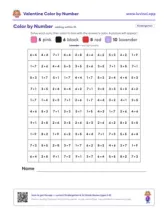
The free Valentine Color by Number PDF has six pictures, three for kindergarten and three for 1st grade, with their answer keys. Each color by number page is a grid of 100 boxes with a sum in every box. The key matches each answer to a crayon. Your child works a box, looks up the answer in the key and colors it. A picture shows up, box by box. Some teachers call it color by sum.
One color mixes different sums, and two boxes side by side never match. Kids can’t copy the box next door. They have to work each one out.
The key prints the crayon’s name next to each swatch, like “13 red”, so a black-and-white printer works fine.
These Valentine’s Day color by number addition pages also make good math coloring worksheets for a quiet table. A whole picture is a lot for a 5-year-old. Work a row or a color at a time.
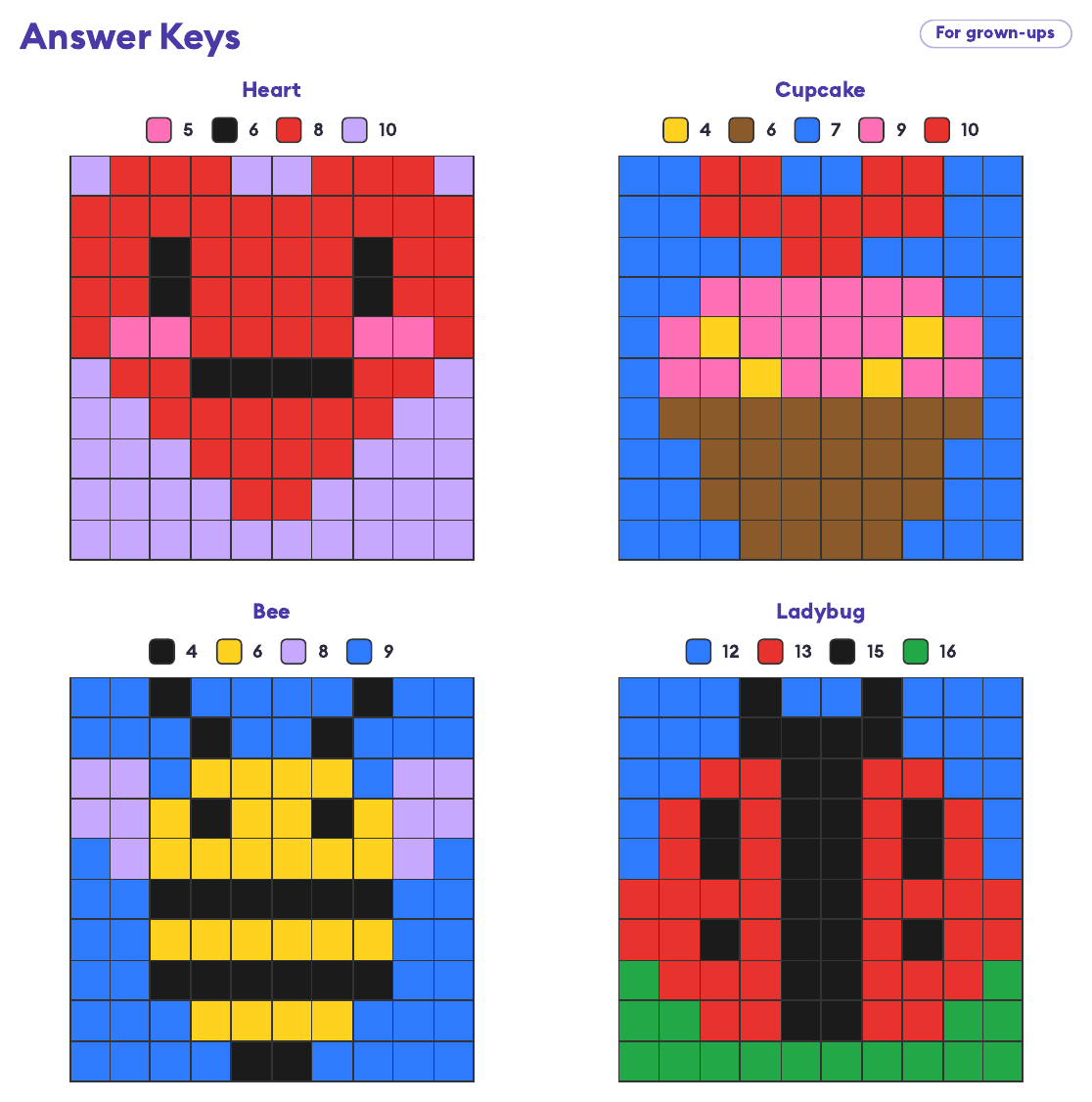
The color by number PDF, page 7, the first answer key page.
In December, our Christmas color by number pages use the same format.
Valentine math games
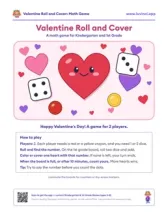
The free Valentine Roll and Cover game has two boards of 24 hearts. Kindergarten rolls one die. 1st grade rolls two dice and adds. Its board has every sum from 2 to 12, and 7 shows up most.
- Players: 2. Each player needs a red or a yellow crayon, and you need 1 or 2 dice.
- Roll and find the number. On the 1st grade board, roll two dice and add.
- Color or cover one heart with that number. If none is left, your turn ends.
- When the board is full, or after 10 minutes, count yours. More hearts wins.
- Tip: Try to say the number before you count the dots.
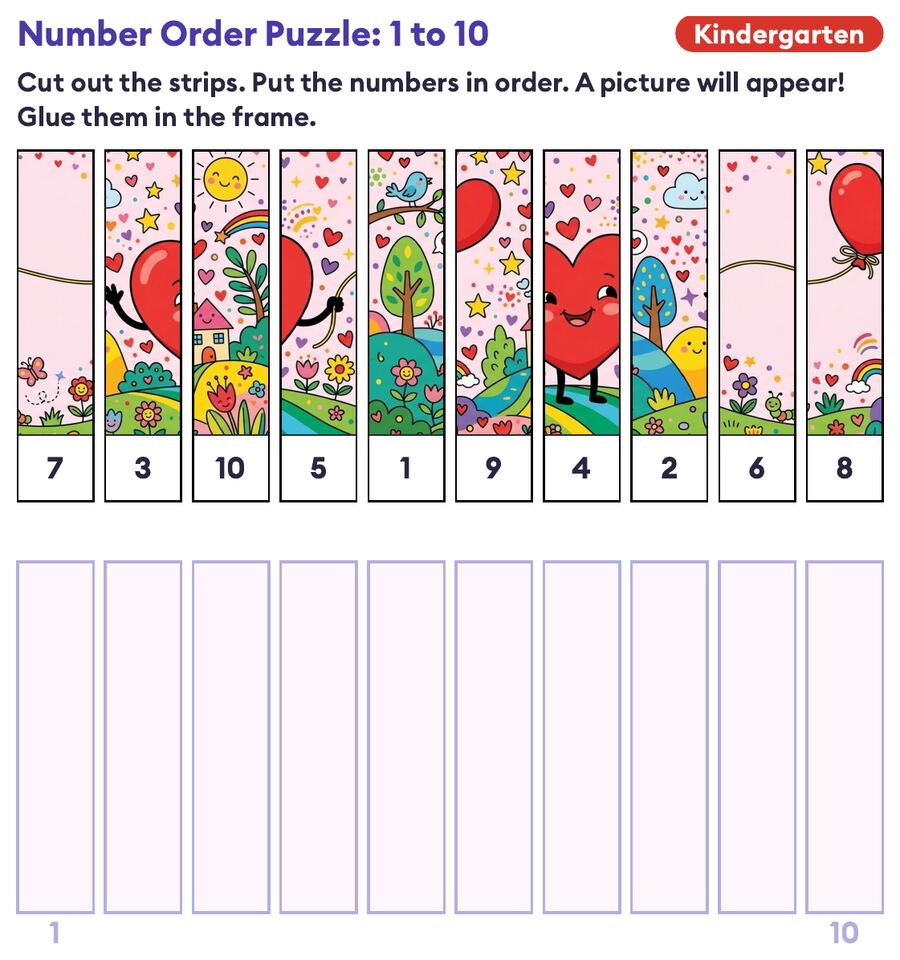
The puzzle PDF, page 1.
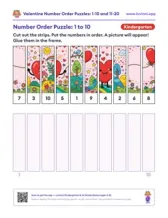
The free Valentine Number Order Puzzles are cut and paste. Your child cuts out 10 numbered picture strips, puts them in order and glues them in the frame. A picture appears. Page 1 is 1 to 10 for kindergarten. Page 2 is 11 to 20 for 1st grade. If the picture looks wrong, a strip is in the wrong place.
More dice and card games are in math games for first graders and math card games.
Valentine math centers
Set up four stations and rotate through them over the week.
- Count and graph. The candy heart graph on page 1.
- Roll and cover. Partners on the kindergarten or the 1st grade board.
- Number order puzzle. Cut, put in order, glue.
- Color by number. One picture each, a row at a time.
Laminate the game boards and the heart ruler so they last all week.
If day 100 lands near Valentine’s Day, our 100th day of school printables make a good second set that week.
FAQ
What are some fun math activities for Valentine’s Day?
Count and graph candy hearts, solve word problems, fill ten frames, color by number, measure with hearts, play a roll and cover game and do a number order puzzle.
What are some educational activities for Valentine’s Day?
Math that matches February. Kindergarten adds within 10. 1st grade adds within 20 and works with tens and ones. Sorting, graphing and measuring fit both.
What are some good graphing activities for kindergarteners?
Candy heart graphing. Sort by color, count, color one box per heart, then circle the most and the fewest. Page 1 of the Valentine’s Day Math PDF has 20 printed hearts and a graph to color.
What Valentine’s Day math games can I play in class?
Roll and cover works in pairs. The number order puzzle works as a race. Valentine’s Day 2027 is a Sunday, so most class parties land on Friday, February 12.
Do I need real candy hearts?
No. Page 1 uses printed candy hearts to count and graph.
Are these right for kindergarten or 1st grade?
Both. The page table above marks each page.
Do the pages come with answer keys?
Yes. The main PDF’s key is on page 9. The color by number PDF has its own keys on pages 7 and 8. The puzzles check themselves, and the game needs no key.
The takeaways
- Four free PDFs, no email.
- Candy heart graphing with printed hearts, no real candy.
- Kindergarten stays within 10. 1st grade goes to 20, plus tens and ones.
- Red and yellow ten frames, like at school.
- Color by number addition with keys. Boxes side by side never match.
- Color by number, a game and puzzles as their own PDFs, in the list at the top.
- Plan the party for Friday, February 12. Valentine’s Day 2027 is a Sunday.
- Print the free Valentine’s Day Math PDF.
Sources
- Common Core State Standards for Mathematics, Kindergarten and Grade 1. https://www.thecorestandards.org/Math/Content/K/ and https://www.thecorestandards.org/Math/Content/1/
- Great Minds, Eureka Math (A Story of Units). https://greatminds.org/knowledge/resources/a-story-of-units
- Illustrative Mathematics, K-5 Math scope and sequence (v1). https://illustrativemathematics.org/wp-content/uploads/2021/02/v1-IM-K-5-Math-Scope-and-Sequence.pdf
More free math worksheets: ten frames, number charts, addition and subtraction, daily practice workbooks and more, all in one place. See the math printables →