 Luvinci
September 29, 2026
Teen Numbers for Kindergarten: How to Teach 11-19 (Free PDF)
Free printable · PDF · 834 KB
Teen Numbers for Kindergarten: How to Teach 11-19 (Free PDF)
No signup needed. Just print it.
Download PDFTeen numbers are the numbers 11 to 19, and each one is ten and some more. 14 is ten and 4 more. Building them this way is a kindergarten goal in Common Core (K.NBT.1). A full ten frame plus a few extra counters is the usual way to show it.
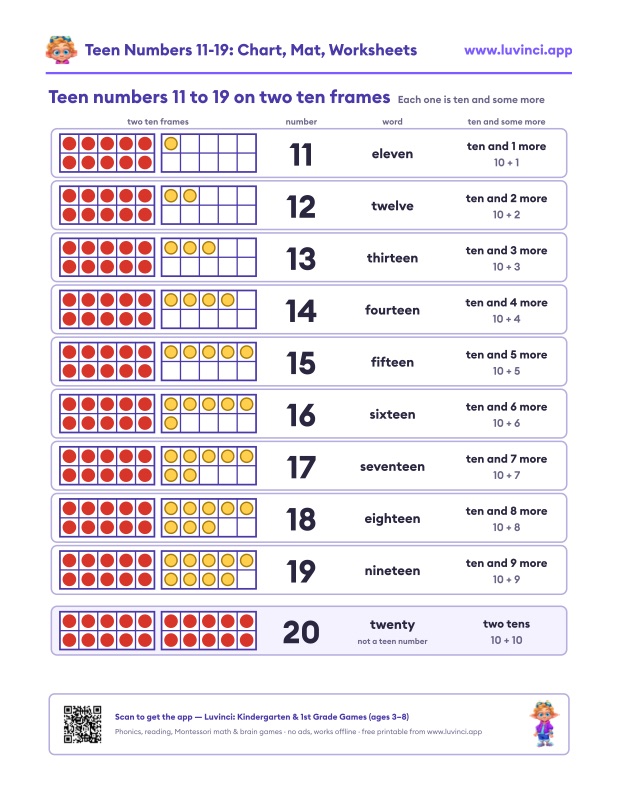
The free teen numbers PDF runs 10 pages. Inside: a chart of 11 to 20 on two ten frames, a build-it mat, three no-cut worksheets, 40 cut-out match cards and hide-the-zero cards. US Letter. You don’t need to sign up or leave an email.
Teen numbers are something kids learn during kindergarten, not something kids need on day one.
Jump to: the free PDF · what they are · how to teach · two ten frames · eleven and twelve · activities · mistakes · teen board · FAQ
Free teen number worksheets (PDF)
Each of the 10 pages of these free printable teen number worksheets covers this:
- Teen numbers chart 11 to 20 (page 1). Every teen on two ten frames, with the number, the word and “ten and N more”. There is nothing to cut, and it doubles as the answer key.
- Build-a-teen-number mat (page 2). Two big empty ten frames, a spot for a number card, and “ten and __ more is __”. It prints landscape.
- How many? (page 3). Count the two ten frames, then write “ten and __ more is __”. Every teen from 11 to 19 appears once.
- Draw it (page 4). Read the number, draw the dots with the left frame first, then write 10 + __.
- Ten and some more number sentences (page 5). 10 + 6 = __, 10 + __ = 13, 17 = 10 + __.
- 40 match cards (pages 6 to 9). Ten-frame cards, number cards, word cards and “ten and some more” cards for 11 to 20.
- Hide-the-zero cards (page 10). A big 10, plus cards 1 to 9 that cover its 0.
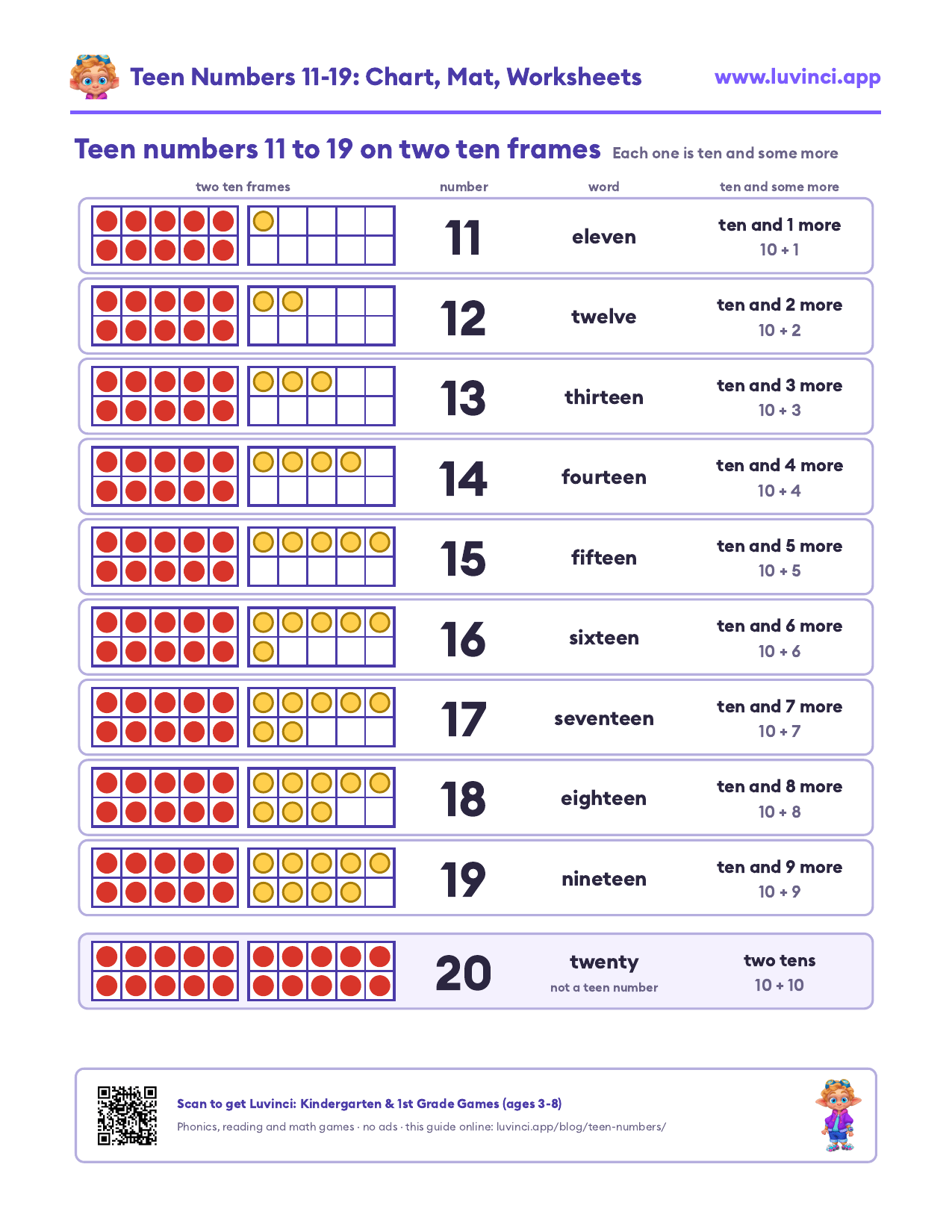
Page 1: every teen number is one full ten frame and some more.
Print tips:
- Page 2 (the mat) is a landscape page. Print the whole file as is; most printers turn it for you.
- Red and yellow print fine in black and white, because the yellow counters keep a dark outline.
- Use cardstock for pages 6 to 10.
- A sheet protector turns pages 3 to 5 into dry-erase pages. They say “Check with page 1”, so your child can check their own answers.
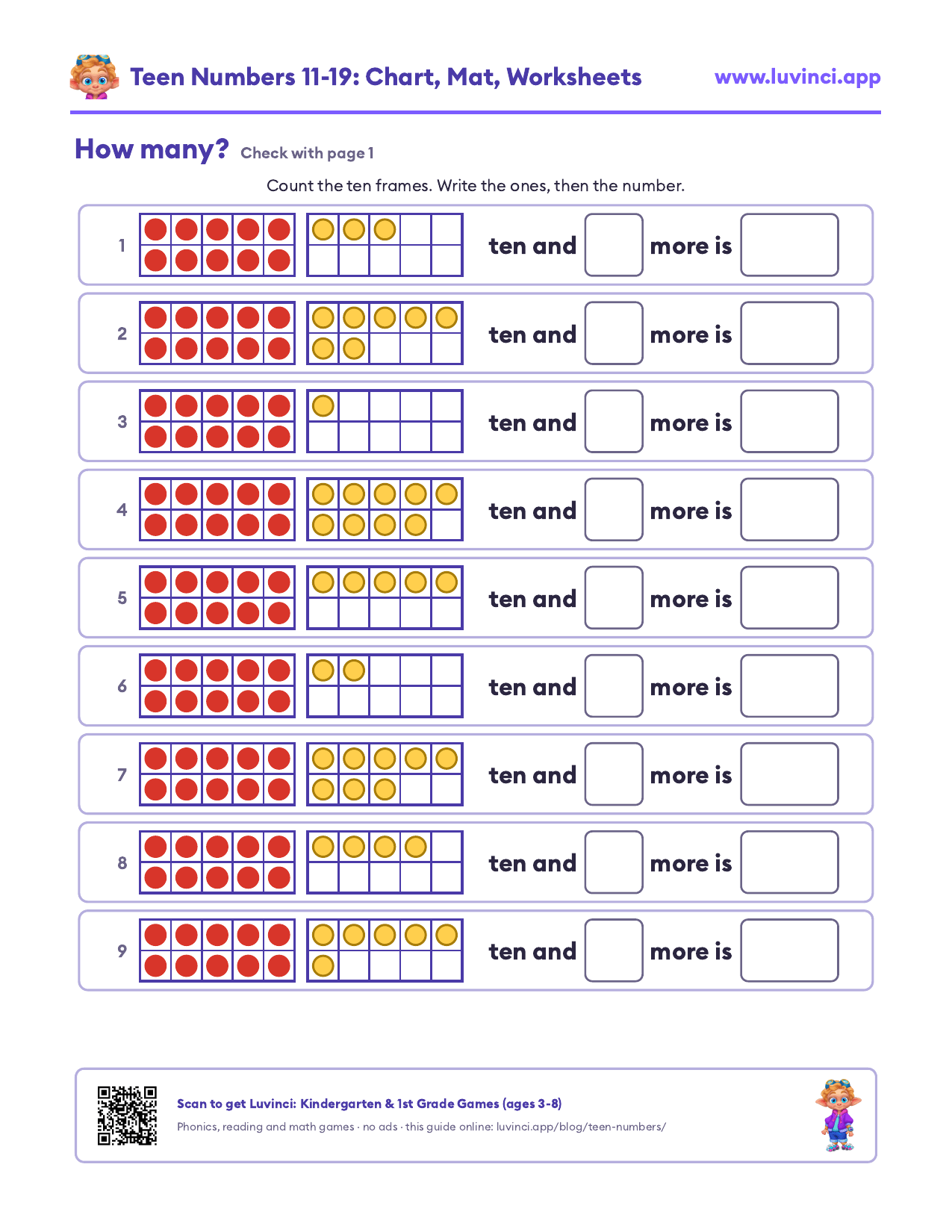
Page 3: count the ten frames, then write ten and some more.
What are teen numbers?
Teen numbers are 11, 12, 13, 14, 15, 16, 17, 18 and 19. Each one is a ten and some ones. 16 is ten and 6 more. That’s how to explain teen numbers for kids: a ten first, then the ones.
The “teen” in the name stands for ten. Fourteen is really “four and ten”, said backwards from the way we write it.
Eleven and twelve count as teen numbers even though their names don’t end in “teen”. The kindergarten standard names all of 11 to 19, and both are built the same way: ten and 1 more, ten and 2 more.
Kids practice the numbers 11-20 together, but only 11 to 19 are teens.
The teen numbers list, in words
Every teen number is listed with its name, so you can check the spelling of 11, 12, 13, 14, 15, 16, 17, 18, 19 and 20 in one place:
| Number | Word | Ten and some more | Write it as |
|---|---|---|---|
| 11 | eleven | ten and 1 more | 11 = 10 + 1 |
| 12 | twelve | ten and 2 more | 12 = 10 + 2 |
| 13 | thirteen | ten and 3 more | 13 = 10 + 3 |
| 14 | fourteen | ten and 4 more | 14 = 10 + 4 |
| 15 | fifteen | ten and 5 more | 15 = 10 + 5 |
| 16 | sixteen | ten and 6 more | 16 = 10 + 6 |
| 17 | seventeen | ten and 7 more | 17 = 10 + 7 |
| 18 | eighteen | ten and 8 more | 18 = 10 + 8 |
| 19 | nineteen | ten and 9 more | 19 = 10 + 9 |
| 20 | twenty | two tens (not a teen) | 20 = 10 + 10 |
Is 10 a teen number? Is 11? Is 20?
Most lessons mean 11 to 19, the numbers the kindergarten standard names. Some lists add 10. The Everyday Mathematics glossary puts it this way: “Sometimes 10 is considered a teen number.”
11 is a teen. It’s ten and one more. 20 is not a teen. It’s two tens. And 22 isn’t a teen either. It’s 2 tens and 2 ones.
How to teach teen numbers in kindergarten
Start with ten. Show one full ten frame and say, “This is ten.” Put 4 counters in a second frame: “Ten and four more is fourteen.” Then write it: 14 = 10 + 4. Do the same for each number, starting with 11 to 15.
Teen numbers for kindergarten take weeks, not one sitting. The five steps are below.
- Know ten first. Your child can make 10 and sees a full frame as 10 without counting. If not, spend some time on the ten frame and ways to make 10 first. Making 10 comes before the teens. The app’s ten-frame boards build the within-10 half of this: on the Singapore Math boards in the full app, sums like 6 + 4 and 7 + 3 sit on ten frames of pictures. The teens are a paper job, which is what the PDF is for. The first counting board (numbers to 10) is free; the ten-frame boards are in the full app. See how Luvinci’s math games work.
- Build ten and some more. Fill the left frame with red counters, add yellow counters on the right, and say “ten and four more, fourteen”. Page 2 of the PDF is a mat made for this.
- Say it two ways. “Ten four. Fourteen.” The notes that go with the Common Core standards (the Progressions) suggest kids can learn the “ten one, ten two” way alongside the English names. A song helps too: Harry Kindergarten’s Numbers in the Teens (Have a Group of 10) sings “eleven is a group of ten and one extra one”.
- Read and write it. The 1 is the ten. For writing the teens, kids need to know which digit goes first. Writing numbers from 0 to 20 is a kindergarten goal (K.CC.3).
- Take it apart. Once your child can build 14, take the ten away and see what’s left. More on that below.
Any small things work as counters. Buttons, dried beans and cereal are choking hazards for young children, so stay close while they’re out.
Decomposing teen numbers
Composing a teen number means building it from a ten and some ones. Decomposing teen numbers means splitting that build back apart. The kindergarten standard asks for both:
“Compose and decompose numbers from 11 to 19 into ten ones and some further ones, e.g., by using objects or drawings, and record each composition or decomposition by a drawing or equation (e.g., 18 = 10 + 8); understand that these numbers are composed of ten ones and one, two, three, four, five, six, seven, eight, or nine ones.” (K.NBT.1)
Put in plain words, fourteen is ten and four. Take the four away and ten is left. This is the groundwork for kindergarten place value. Your child doesn’t need the words “1 ten and 4 ones” yet, but that’s exactly what they’re seeing.
In 1st grade it goes one step further: “The numbers from 11 to 19 are composed of a ten and one, two, three, four, five, six, seven, eight, or nine ones.” (1.NBT.2b). The new idea is that ten ones make one ten, a single thing you can count. For the next step after that, try our place value games for 1st grade.
Teen numbers on two ten frames
In class, a teen number goes on two ten frames: the ten fills the first frame as two rows of five, and the extra ones go in the next frame (that’s the picture in the Progressions, p. 5).
Our PDF does it the same way every time:
- The left frame is always full of red counters. That’s the ten.
- The right frame gets yellow counters for the ones, top row first, left to right.
- For 20, both frames are full and red: two tens.
This works because a full frame reads as 10 at a glance, with no counting, so 16 is “a full frame and 6 more”. Kids who can see a full frame without counting skip straight to the ones.
Kindergartners are asked to show each teen number with a drawing or an equation, like 18 = 10 + 8 (K.NBT.1). That’s why the cards and the chart say both “ten and 8 more” and “10 + 8”.
The mat’s boxes are 24 mm, just under an inch, so small buttons and 3/4-inch counters fit well. Standard 1-inch school counters are a squeeze and sit a little over the lines. For paper ones, use page 3 of the ten frame printable, which has 20 red and 20 yellow cut-out counters.
Two ten frames side by side are also called a double ten frame.
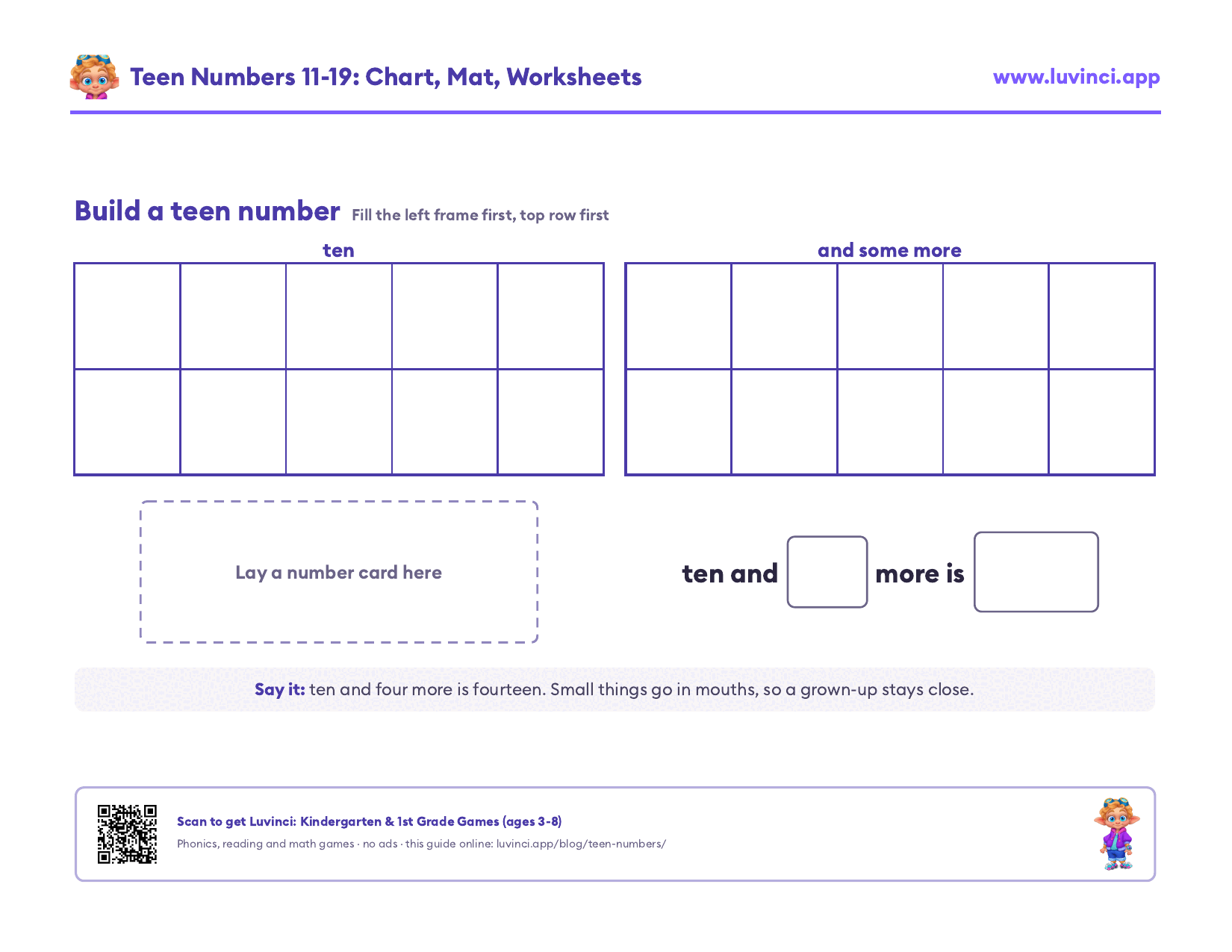
Page 2: fill the left frame first, then build the ones on the right.
Why eleven and twelve break the pattern
English teen names are hard. That is not your child’s fault. The Progressions put it simply: “‘eleven’ and ‘twelve’ do not sound like ‘ten and one’ and ‘ten and two.’”
Then thirteen to nineteen flip the order. We write 14 with the ten first, but we say the four first. And “thir” and “fif” don’t clearly say three and five, so thirteen and fifteen hide their ones too.
Many East Asian languages say the teens as “ten one, ten two, ten three”. The name tells you how the number is built, every time.
Does any of that matter for kids? In one study, English-speaking 5-year-olds in the US and England showed no sign of seeing a teen number as ten and some ones. Some Chinese-speaking 5-year-olds, whose words say “ten two” for 12, did, mostly the ones who could already count a long way (Ho and Fuson, 1998). English words hide the ten, so we show it with a full ten frame.
If the count wobbles after 12, or you hear “fiveteen”, our counting to 20 guide has tips.
Teen number activities
Eight ways to practice, and most use things you already have at home:
- Build it on the mat. You need page 2 and a number card from page 7. Pick a card, build it, say it, then write it in the boxes.
- Ten fingers and some more. You show 10 fingers (“ten”), your child shows 3 (“and three more”), then together: “thirteen!” Swap roles.
- Bundle a ten. Put a hair tie around 10 craft sticks or straws: that’s “a ten”. Add loose sticks to make 15. In class this may be a base ten rod or a bead rack; at home a bundle of sticks does the same job.
- Ten in the cup. Count 10 pom-poms into a cup and write 10 on it. Put 6 more beside it: “ten in the cup and 6 more: 16.” Your child counts on from 10 instead of starting at 1.
- Hide the zero. On page 10, lay the 4 card over the 0 of the 10 card, and 10 becomes 14. The Progressions call these “layered place value cards” (p. 5).
- Teen number hunt. Look on the calendar (days 11 to 19), page numbers and house numbers. Read each one as “ten and some more”.
- Quick look. Show a ten-frame card from page 6 for two seconds: “A full frame and 3: 13.”
- Sing it. Play the teen numbers song from step 3 of how to teach teen numbers and build each number as it comes up.
Teen number games
The 40 cards on pages 6 to 9 turn into four games:
- Find all four. Pick 3 numbers and lay their 12 cards face up. Find the 4 that go together: frame, number, word, and “ten and N more”.
- Memory. Use two kinds only (frames and numbers), 3 to 5 numbers, face down.
- Order it. Put the number cards 11 to 20 in a line. Then flip one face down: which one is missing?
- Roll ten and more. Roll a die, build 10 plus the roll on the mat, say it, then find its card.
Start with 11 to 15. The 20 cards are a bonus set (“20 isn’t a teen: it’s two tens”).
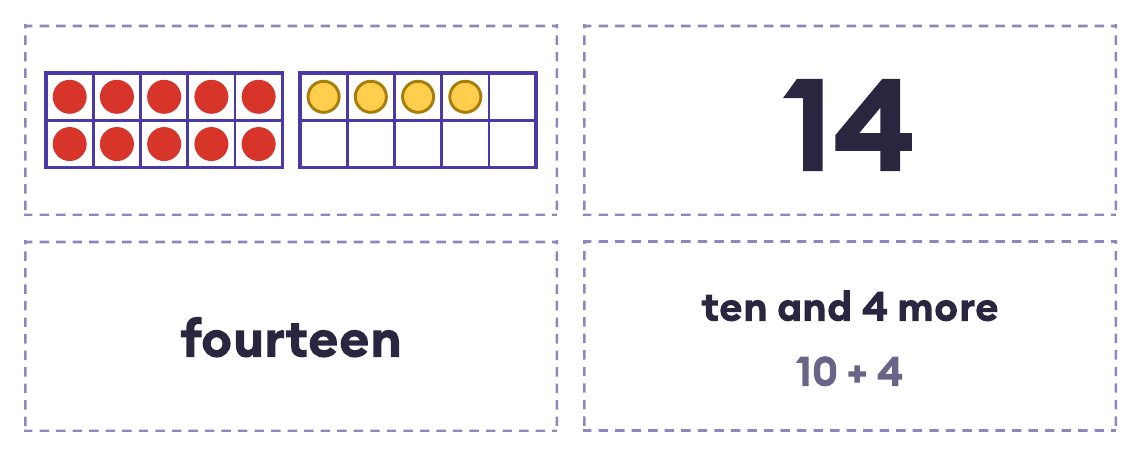
One set for 14: the ten frames, the number, the word and ten and 4 more.
Common teen number mistakes
Most of these are normal stages. They are not problems.
| What you see | Why | What helps |
|---|---|---|
| Writes 41 for 14 | “Fourteen” says the 4 first (Progressions, p. 5) | Point to the 1: “the ten goes first.” Build it with the full frame on the left. More on writing the teens |
| Reads 16 as “one, six”, or says the 1 means one | At first a teen numeral looks like “one, six”, not 1 ten and 6 ones (Progressions, p. 5) | Hide the zero (page 10): “that 1 is a whole ten” |
| Writes 103 for 13 | After building “ten and 3 more”, they write the 10 and then the 3 | Hide the zero: the 3 covers the 0 |
| Counts from 1 every time | Normal at first: the ten isn’t one thing yet | Ten in the cup, then count on from 10 |
| Mixes up fourteen and forty | They sound alike (Progressions, p. 6) | Say the end slowly: four-TEEN is ten and 4; FOR-ty is 4 tens |
| Says “fiveteen”, skips 13 or 15, or counts “twenty-ten” | 13 and 15 have odd names; a U.S. Department of Education practice guide (2013) lists these slips | Practice the odd names, and say “nineteen is the last teen”. See the counting to 20 guide |
The Montessori teen board (Seguin board A)
Page 10 is a one-slot paper version, with one big 10 plus nine cards that cover the 0. Use 10 counters in a line as the ten bar.
The real Seguin board A is two wooden boards with 10 printed nine times down them. Number cards 1 to 9 slide over the 0, so 10 becomes 11, 12, 13 and on up. A golden ten bar sits beside each one, plus a short bead bar for the ones.
Teachers present it one number at a time. “This is ten.” Then “Ten and one: eleven.” Montessori classrooms usually use it around ages 4 to 6.
The paper version does the same job. The card hides the 0, and the 1 that’s left is the ten.
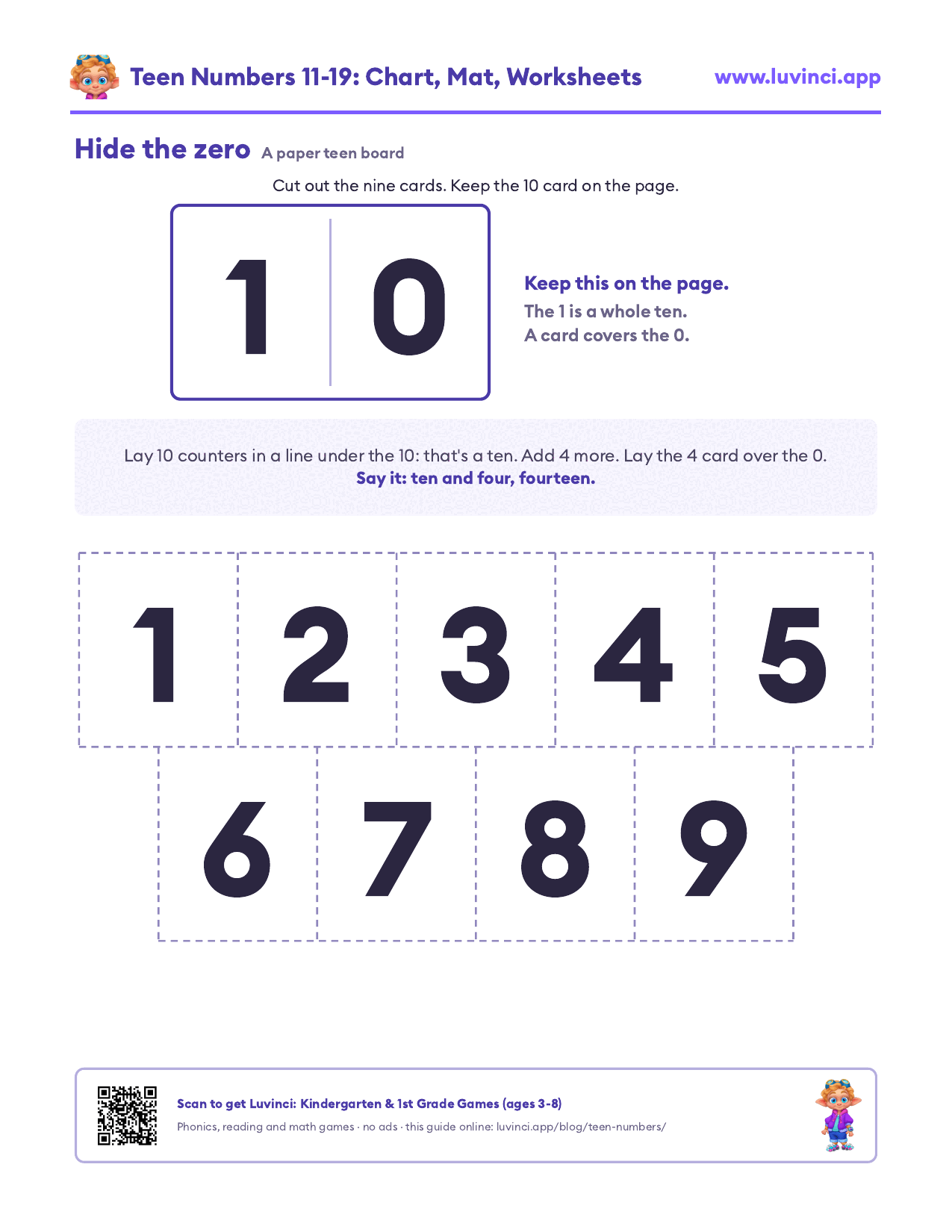
Page 10: a paper teen board. The 4 card covers the 0, and 10 becomes 14.
FAQ
What do the 1 and the 4 in 14 mean?
The 1 means one ten, and the 4 means 4 ones. That is why 14 is ten and 4 more. Kids meet bigger places in 1st and 2nd grade.
When do kids learn teen numbers?
During kindergarten (K.NBT.1). Kids aren’t expected to know them on the first day. In 1st grade, they learn that ten ones become one “ten” (1.NBT.2), and the teens become 1 ten and some ones.
How do you spell the teen numbers?
The teen numbers list above spells out 11, 12, 13 … 20, each one as a word. Eleven, twelve, thirteen and fifteen are the tricky ones, because they don’t follow the pattern, and eighteen has only one t.
The takeaways
- Teen numbers are 11 to 19, each one ten and some more.
- Build before you write. A full ten frame and some more, said as “ten and four more, fourteen”.
- Eleven and twelve break the pattern, and thirteen to nineteen say the ones first, so 41 for 14 is normal.
- The 1 in 14 is a ten: hide the zero to show it.
- Print the free teen numbers PDF: a chart, a mat, three worksheets, 40 match cards and hide-the-zero cards.
More free math worksheets: ten frames, number charts, addition and subtraction, daily practice workbooks and more, all in one place. See the math printables →
