 Luvinci
October 2, 2026
Subitizing Dot Cards 1-10: Free PDF and How to Teach It
Free printable · PDF · 657 KB
Subitizing Dot Cards 1-10: Free PDF and How to Teach It
No signup needed. Just print it.
Download PDFSubitizing (say it SOO-bih-tize) means seeing how many things sit in a small group without counting them, like knowing a die shows 5 at a glance. Our free subitizing cards 1-10 (PDF) put that into practice. You get a no-cut dot chart for 1 to 10, dot cards ordered from easiest to hardest, number cards and a flash-and-say game board. 5 pages, US Letter. No signup, no email.
This guide is for parents who want a few minutes of practice at home, whether your kindergartner met dot cards or “quick images” at school or you have just heard the word.
The 5-minute version: print page 2, cut out the cards, flash one for about 2 seconds, then ask “How many? How did you see it?” Start with 1 to 5.
Jump to: the free cards · what is subitizing · to 5, then 10 · how to teach it · games · FAQ
Free printable subitizing cards 1-10 (PDF)
You’ll use the subitizing dot cards in this order.
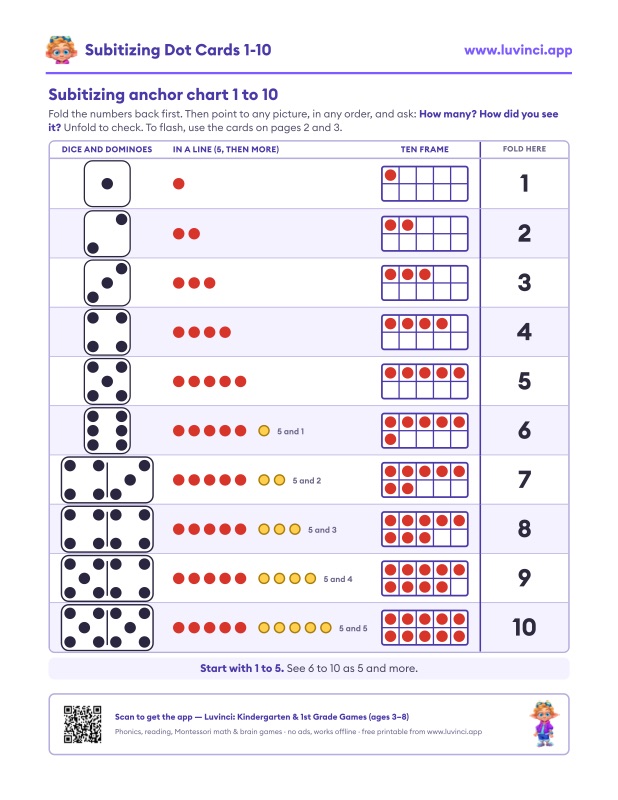
- Subitizing anchor chart 1 to 10 (page 1). No cutting, no prep. Each number from 1 to 10 is shown three ways on one row: as a die or a domino, as dots in a line (up to 5 red, then the rest in yellow, like “5 and 2”) and on a ten frame. Fold the numbers column back first, then point to any picture, in any order, and ask “How many? How did you see it?” Unfold to check. The chart is for talking and checking. The cards on pages 2 and 3 do the flashing.
- Start here: dot cards 1 to 5 (page 2). 15 cards. Each number from 1 to 5 appears three ways: a dice pattern, a five frame filled left to right, and a scattered group. The cards never show the answer, so your child looks instead of reading.
- Next: dot cards 6 to 10 (page 3). 10 more cards: 6 to 10 as “5 and more” (5 red dots over the rest in yellow) and as dominoes (doubles like 4 and 4, and near doubles like 4 and 3). Plus a zero card (a blank domino: flash it now and then, and “zero!” is the answer) and a card to draw your own dots.
- Number cards 0 to 10 (page 4). Big numbers with their words, plus a blank card to write on. 6 and 9 are underlined. Paired with the dot cards, they make a set of dot number cards for Hold up the match, below.
- Flash and say (page 5). A game board for 2 players, no cutting. Plus 5 more games for the same cards.
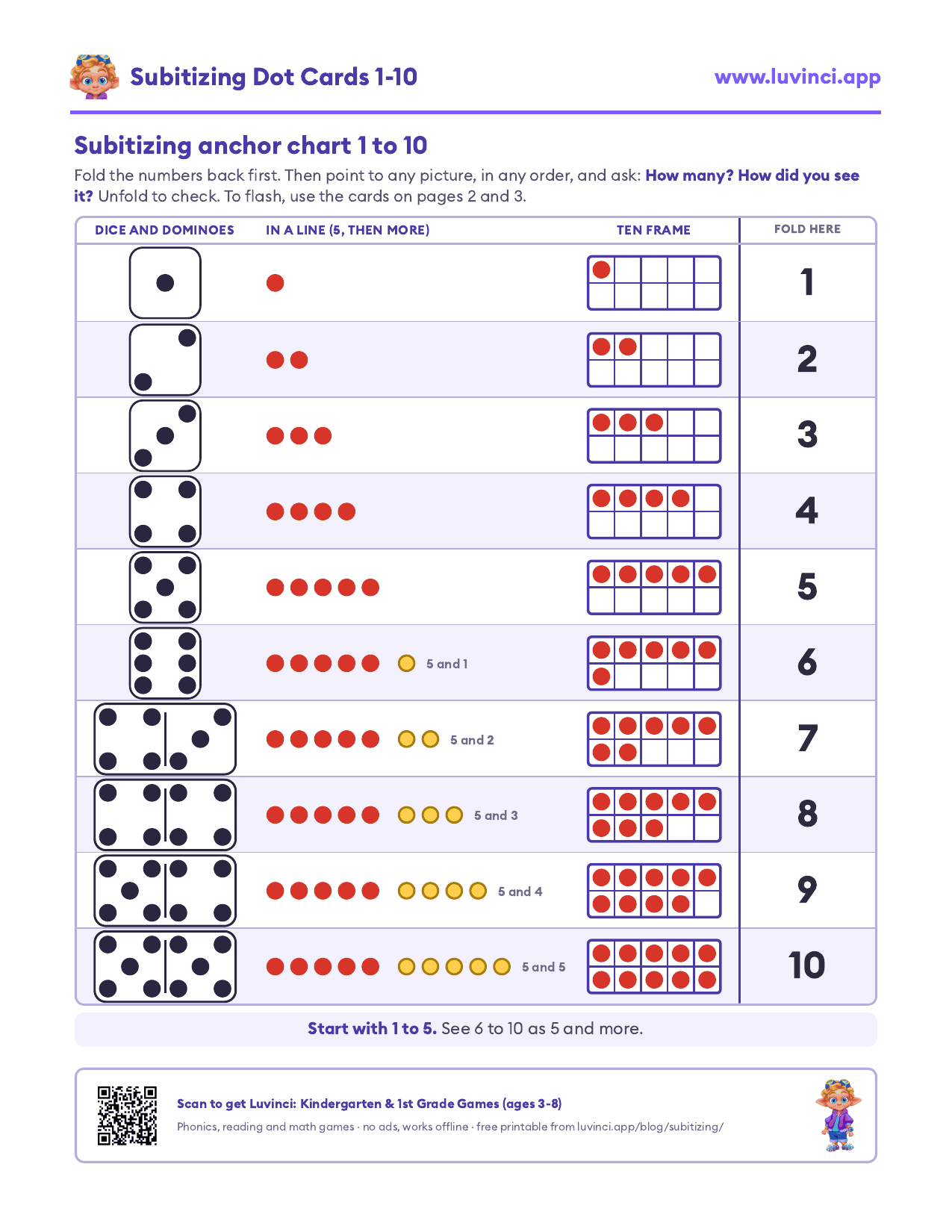
Page 1: the no-cut anchor chart. Fold the numbers back, then unfold to check.
The cards need scissors but no glue. On cardstock they last all year as subitizing flash cards, and they print fine in black and white.
Looking for subitizing with ten frames? Page 1 shows every number on a ten frame, and the ten frame dot cards 0 to 10 live in our ten frame printable. So the flash cards here use other patterns: dice, dominoes, lines and scattered dots.
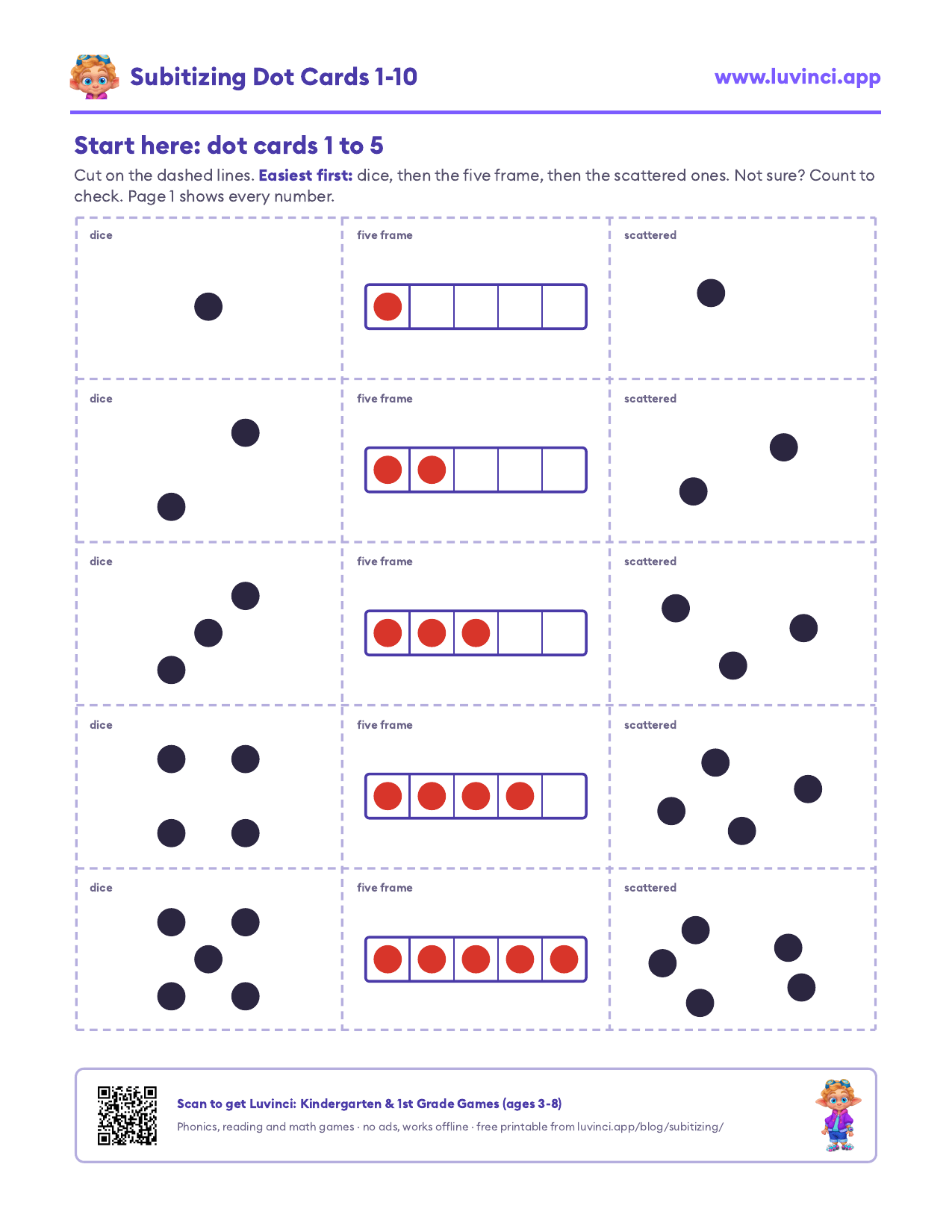
Page 2: start here, with dot cards 1 to 5 from easiest (dice) to hardest (scattered).
What is subitizing in math?
Subitizing is seeing how many at a glance, with no counting. Flash 3 dots for a second. A child who says “3” right away is subitizing.
The word comes from the Latin subitus, which means sudden. Psychologists coined the word in 1949. (In the UK you’ll also see it spelled subitising.)
Most people see up to about 4 things at once, or 5 in a tidy pattern like the 5 on a die. Young children start with fewer, often 1 to 3.
Counting goes one by one. You touch a thing, say a number, and move on. Subitizing skips that for small groups. Children need both, and counting still does the work for bigger groups. Our one to one correspondence guide covers the counting side.
Perceptual and conceptual subitizing
Perceptual subitizing is seeing a small amount all at once. 3 dots are just “3”, with no parts.
Conceptual subitizing is seeing a bigger amount as parts you already know. 7 on a domino is 4 and 3. 7 in a line is 5 and 2. Your child takes in each part at a glance and puts them together.
That’s where number bonds begin: 7 is 5 and 2. Seeing 5 and 2 inside 7 is also how 5 + 2 = 7 starts, which is where addition for kindergarten picks up.
Why subitizing matters in kindergarten
Why is subitizing important? For a kindergartner it does three jobs:
- It builds number sense. 5 becomes a shape your child knows, not just a word in the counting list.
- It gets adding ready. Seeing 7 as 5 and 2 is the idea behind 5 + 2 = 7, long before your child writes it.
- It saves recounting. A child who can see 3 stops counting small groups they can already see. For bigger groups, counting one by one is still the right move.
In kindergarten, children work on seeing up to 5 at a glance and start seeing 6 to 10 in parts, like 5 and 2. Many keep building that in 1st grade. Children vary, and this isn’t a test.
The Common Core Progressions (the writers’ guide to the kindergarten math standards) say kindergartners should quickly recognize numbers to 5 on their fingers. Texas asks kindergartners to “recognize instantly the quantity of a small group of objects” (TEKS K.2(D)).
Subitizing to 5, then to 10
Start with subitizing to 5 first, then to 10, in this order.
- 1 to 3. Most kids see these at a glance early on. Start here, even if it feels easy.
- 4 and 5. Dice patterns first, then the five frame, then scattered dots. That’s page 2 of the PDF, read left to right.
- 6 to 10 as “5 and more” or as doubles. 7 is 5 and 2. 6 is 3 and 3, and 8 is 4 and 4 on a domino. That’s page 3.
Keep scattered groups at 5 or less. Few people can take in 8 loose dots at once, so the 6 to 10 cards are built from smaller groups your child already knows.
How to teach subitizing at home
- Use plain dots, easiest first. Dice patterns, then dots in a line, then scattered dots.
- Flash for about 2 seconds, then cover. Teachers call these “quick images”. The short look is the point. Your child starts counting if the card stays up longer.
- Ask two questions. “How many?” then “How did you see it?” An answer like “I saw 4 and 1” is exactly what you want.
- Watch for pointing. If your child points and counts, the card was up too long or the number is too big. Show it again, or go back to 1 to 5.
- Keep it to 5 minutes a day.
You can skip the cards some rounds. Everyday subitizing examples are all around the house:
- Dice from any board game
- Dominoes, turned face up one at a time
- Fingers: “Show me 4 without counting.”
- An egg carton with a few eggs in it
- Quick claps: clap 1 to 4 times fast, then ask how many
Dot cards for math: why plain dots work
For a quick look, plain dots work best. Busy pictures, mixed shapes or messy layouts can pull a child into counting one by one. Picture cards are fine for counting practice.
Early math researchers suggest keeping math dot cards simple:
- Round dots, all the same size. Every dot on the PDF’s cards is the same size.
- Dark on white, or two clear colors like red and yellow.
- Even dot patterns with a little space between the dots.
- Rotate a card for variety. A 4 turned sideways is still 4, and your child learns the amount, not the card.
Dot cards for kindergarten number talks
Short number talks, sometimes called dot talks, run in many kindergarten classrooms. The teacher flashes a dot card, and the children explain how they saw it. Every way of seeing it counts, as long as the total is right: 7 can be 5 and 2, 4 and 3, or 3 and 3 and 1.
At home, it’s two lines:
- “How many?”
- “How did you see it?”
Share how you saw it next. Hearing a second way is half the fun. Any card on pages 2 and 3 makes a good number talks dot card.
Subitizing games and activities for kindergarten
You’ll play these six games with the dot cards on pages 2 and 3. Hold up the match also uses the number cards on page 4. Keep the quick look in every game: say how many as soon as a card turns over, before anyone counts. Counting is for checking.
- Flash and say (page 5). The full rules are on the board. In short: one player (or a grown-up) flashes a card for about 2 seconds, and the other says how many and how they saw it. Check together, then color in or cover that number. First to cover 5 numbers wins. Just starting? Use only the 1 to 5 cards.
- Memory. Use 2 cards for each number, like the dice and scattered cards for 1 to 5 (10 cards). Lay them face down and find the pairs. Add the 6 to 10 pairs when that is easy.
- Which one doesn’t belong? Use the 1 to 5 cards. Show three of one number and one that is one more or one less, like three 4s and a 5.
- Hold up the match. Flash a dot card. Your child holds up the number card that matches.
- One more. Take out the cards that show 10 first. Flash a card, and your child says the number that is one more: the next number when you count.
- Dot War. Each player flips a dot card. More dots wins both cards. A tie? Both players say how they saw it, then flip again. The winner takes all the cards.
Ten frame versions of the flash, war and matching games are in our ten frame printable. For War in four levels with a printable deck, see our math card games.
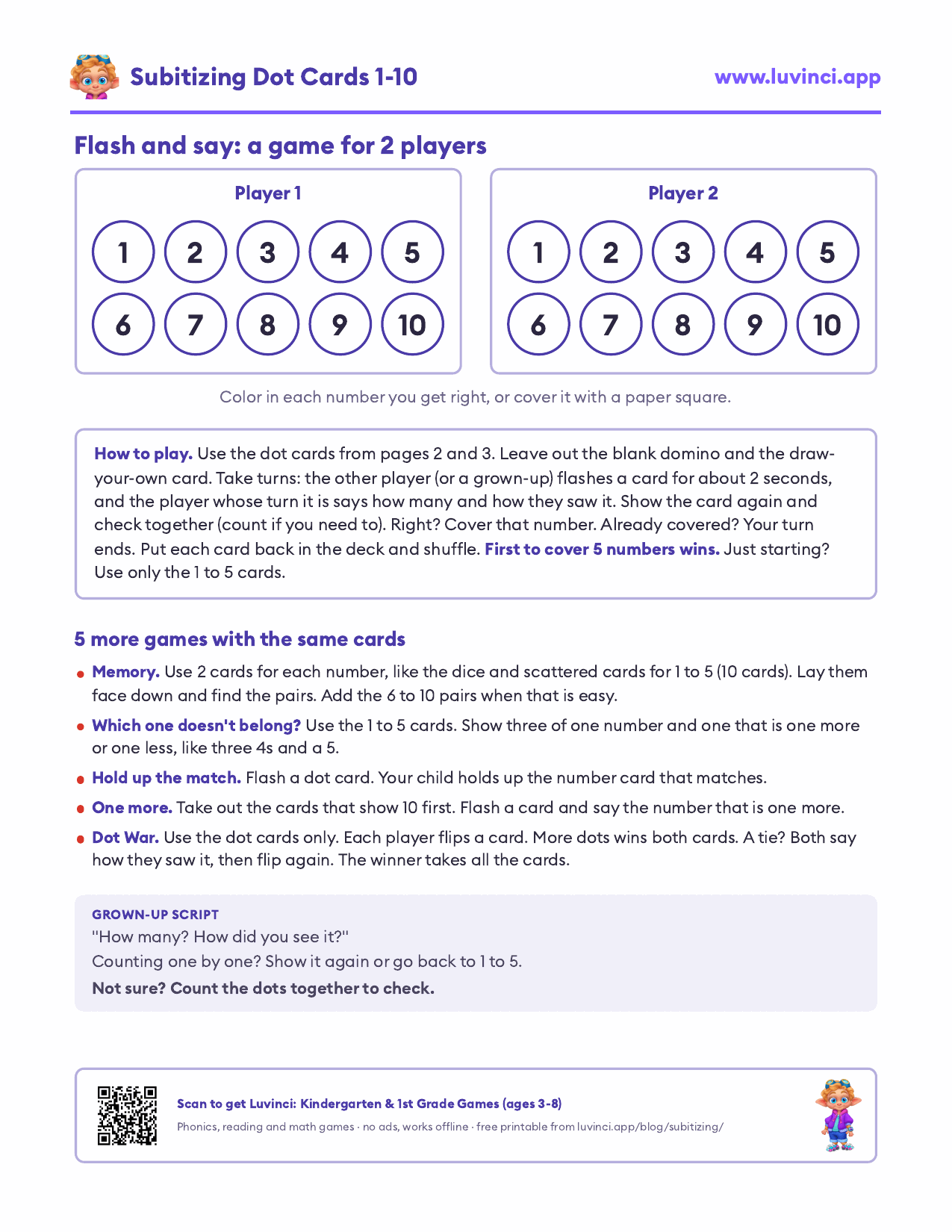
Page 5: the flash-and-say board, plus 5 more games for the same cards.
Two more ideas need no printing:
- Cover it up. Put 6 blocks out and let your child look. Then hide some under a cup while they close their eyes. How many are hiding? This one goes past subitizing: it’s the bridge to number bonds, because 6 is 4 and 2.
- Dot plates. Draw dot patterns on paper plates with a marker and flash them like cards.
You’ll find subitizing with dice in our first grade math games, and the within-10 games there suit late kindergarten. Subitizing with dominoes leads straight to doubles facts: a domino with 4 and 4 is 4 + 4.
Stick to the paper cards and big blocks, and stay close, if your child still puts small things in their mouth.
Common subitizing mistakes and myths
- Showing the card too long. A long look invites counting. Fix: about 2 seconds, then cover it.
- Big scattered piles. Past 5, loose dots have to be counted. Fix: keep scattered groups at 5 or less and show bigger numbers as “5 and more” or doubles.
- Busy or messy cards. Fix: plain dots in tidy patterns for quick looks.
- Skipping 1 to 5. Fix: start small, even if it looks easy. 6 to 10 are built from those.
- Myth: subitizing is fast counting. It’s seeing the amount, not racing through the numbers. Fix: praise “how did you see it?”, not speed.
- Myth: a longer look helps. A long look just turns it into counting. Keep it short and show it again instead.
Counting and matching in the app
In the app’s free counting board (Counting 1, in the Early Math row), your child drags a card of 1 to 10 strawberries onto its matching number while a voice counts along. That board is for counting and matching, not a quick-look game, so the dot cards are where the at-a-glance practice happens. On the Singapore Math boards in the full app, sums sit on ten frames of pictures. See how Luvinci’s math games work.
FAQ
What are subitizing cards?
Subitizing cards have dot patterns you flash for a moment, so your child names the amount without counting. Our free PDF has 25 dot cards for 1 to 10, a zero card, a blank card to draw your own, and number cards 0 to 10.
At what age do kids subitize?
Many children name 1 to 3 at a glance before kindergarten, and 4 and 5 come next. In kindergarten, children work on seeing up to 5 at a glance and start seeing 6 to 10 in parts. Many keep building that in 1st grade. Children vary, and this isn’t a test.
What comes first, subitizing or counting?
Both grow side by side. Children see tiny groups before their counting is solid, and counting takes over for bigger groups. See one to one correspondence for the counting half.
Can you teach subitizing?
Yes, especially seeing 6 to 10 in parts. Short daily flashes with plain dot patterns do it. About 2 seconds, then “How did you see it?”
How long should I show a dot card?
About 2 seconds, then cover it. A little longer at first is fine. Show fewer dots if your child counts one by one.
How can I teach subitizing to my 1st grader?
Stay with bigger amounts in parts. Show 6 to 10 as 5 and more (8 is 5 and 3) and as doubles (8 is 4 and 4), and ask how they saw it. Kindergarten lays the base with 1 to 5, and 1st grade builds on it. Those parts turn into addition facts.
The takeaways
- Subitizing is seeing how many at a glance, with no counting.
- Start with 1 to 5, dice patterns first.
- Flash for about 2 seconds, then ask “How did you see it?”
- See 6 to 10 as 5 and more, or as doubles.
- Plain dots work best for quick looks.
- Print the free subitizing dot cards 1-10: an anchor chart, 25 dot cards, number cards 0 to 10 and a flash-and-say game.
More free math worksheets: ten frames, number charts, addition and subtraction, daily practice workbooks and more, all in one place. See the math printables →
