 Luvinci
September 28, 2026
Number Chart 1-20: Free Printable Charts with Words (PDF)
Free printable · PDF · 624 KB
Number Chart 1-20: Free Printable Charts with Words (PDF)
No signup needed. Just print it.
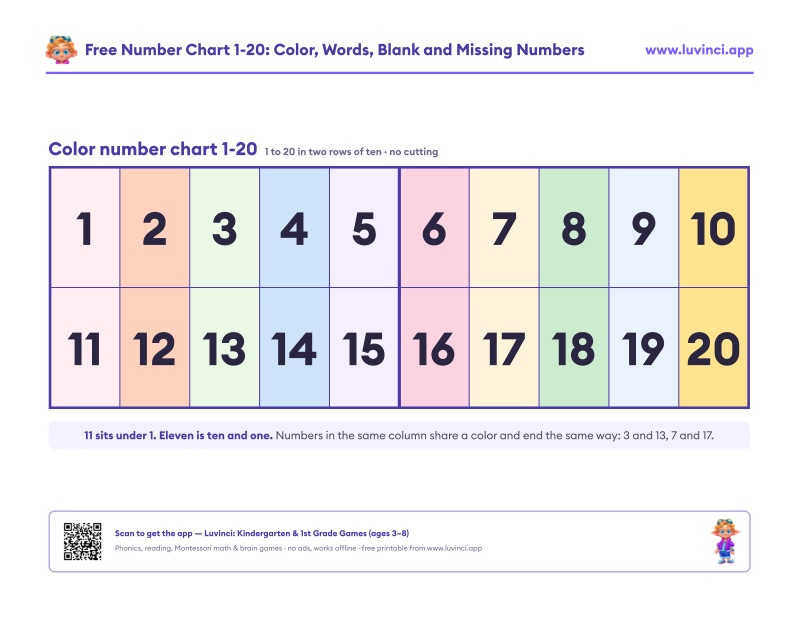
Download PDFOur number chart 1-20 puts the numbers 1 to 20 in two rows of ten, so 11 sits right under 1. Your child reads the top row, then drops down and sees the teens lining up with the numbers they already know.
The free number chart 1-20 PDF has 8 pages: a color chart, a big 1 to 10 chart, a chart with number words, a chart in 4 rows of 5, blank charts, missing numbers, two counting pages and cut-out cards. Use it as a number chart for kindergarten, or for pre-K with the 1 to 10 page. You don’t need to sign up or leave an email.
When 20 feels easy, our number chart 1-50 adds three more rows of ten.
Jump to: the free PDF · how to read it · 1 to 10 first · number words · counting to 20 · worksheets · activities
Free number chart 1-20 printable PDF
All 8 pages are landscape, US Letter. Here’s what’s on each one:
- Color number chart 1-20 (page 1). Two rows of ten, big numbers, no cutting. It’s the page for the fridge and the answer key for the missing numbers.
- Number chart 1 to 10 (page 2). Boxes about 1.5 inches wide for younger kids, with a before-and-after row at the bottom.
- Number chart 1-20 with words (page 3). Each number with its name underneath, from one to twenty.
- 4 rows of 5 and a blank chart (page 4). A black and white 4 rows of 5 chart in the shape many classrooms use, with a blank one to fill in, and an empty two-row chart to write in or to fill with cards.
- Missing numbers 1 to 20 (page 5). Three strips, easiest first.
- How many? Count on two ten frames (page 6). Eight counts from 7 to 20. Count the counters, write the number.
- How many? Count to 20 (page 7). Six rows of counters to count, from 11 to 20.
- Number cards and word cards (page 8). 40 cut-out cards. The number cards are the same size as the boxes on the blank chart.
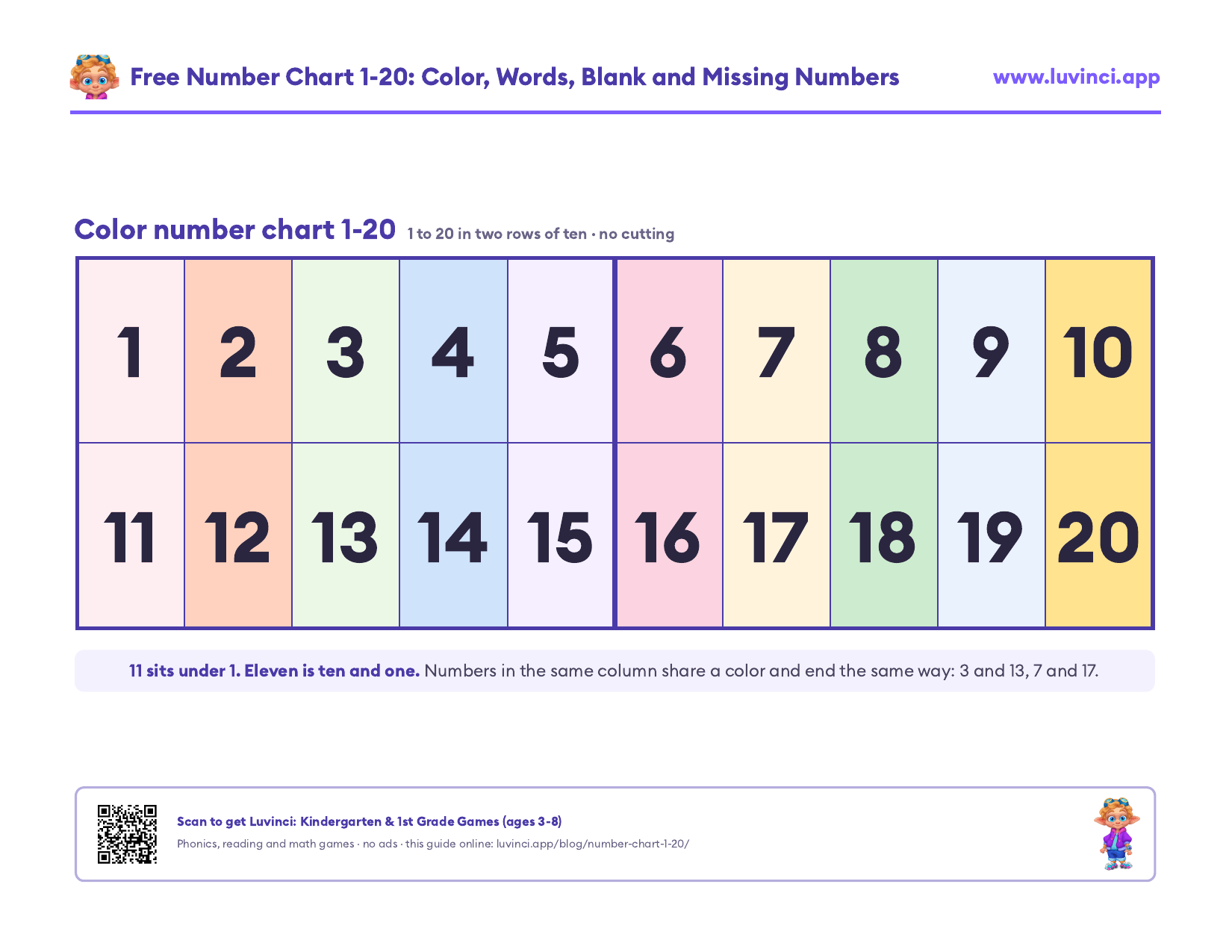
Page 1: the color chart. 13 sits under 3, and both are green.
Print tips: set the printer to landscape. The colors are light, so the whole PDF prints fine in black and white. 10 and 20 just lose their yellow. Slide pages 4 and 5 into a sheet protector and they become dry-erase pages. Print page 8 on cardstock if you have it, to help the cards last.
How to read a number chart 1-20
Read the top row left to right, 1 to 10. When that row ends, start the next row the way you read a book, and keep going from 11 to 20.
Every number in the bottom row sits under its partner in the top row. 13 sits under 3. Thirteen is ten and three. On page 1 the two share a color too, and both end in 3. The thicker line after 5 and 15 helps kids find a number fast. 7 is two boxes past the line. 10 and 20 are yellow, at the end of each row.
Our chart starts at 1, because 0 means none. A number chart 0-20 is fine too. Kindergartners do learn to write 0.
Why 2 rows of 10? The teens line up with 1 to 9, and the rows match the first two rows of a hundreds chart. Many classrooms use 4 rows of 5, so page 4 has that version as well.
By the end of kindergarten, the standards ask kids to count up to 20 things (K.CC.5) and write the numbers 0 to 20 (K.CC.3). The chart helps with both.
Number chart 1-10: where to start
Most kids start kindergarten able to count to at least 10, and many stop around 10 or 12. In New South Wales, Australia, about 87% of children can do this when they start school (Gould, 2012). Counting to 20 at that point is a bonus, as our kindergarten readiness checklist says. Preschool programs such as Head Start aim for counting to 20 by the end of pre-K. Plenty of kids aren’t there on the first day of school, and that’s fine. A child who counts to 10 isn’t behind.
For pre-K and early kindergarten, start with page 2. It’s 1 to 10 in big boxes, five on top and five below, in the same colors as the full chart.
Next, try before and after. Point to 5: “What comes after 5?” Most kids answer fast. “What comes before 5?” is harder, because your child has to run the count backward in their head. Practice after first, then before, all within 10. The row at the bottom of page 2 has 5, 2, 8 and 6: write the number before and the number after each one.
When 1 to 10 comes easily, go on to page 1 and the second row.
Number chart 1-20 with words
Page 3 is the chart with each number’s name printed underneath it, one to twenty. Use this page for reading. Spelling number words isn’t a kindergarten goal, so nobody needs to copy them out.
Eleven and twelve have their own names, so they take longer to learn.
Ways to use it:
- Point and read. You read a word, your child points to the number above it.
- Word cards. Cut out the word cards on page 8 and lay each one on its number.
For writing the words, our number tracing worksheets have number words to trace.
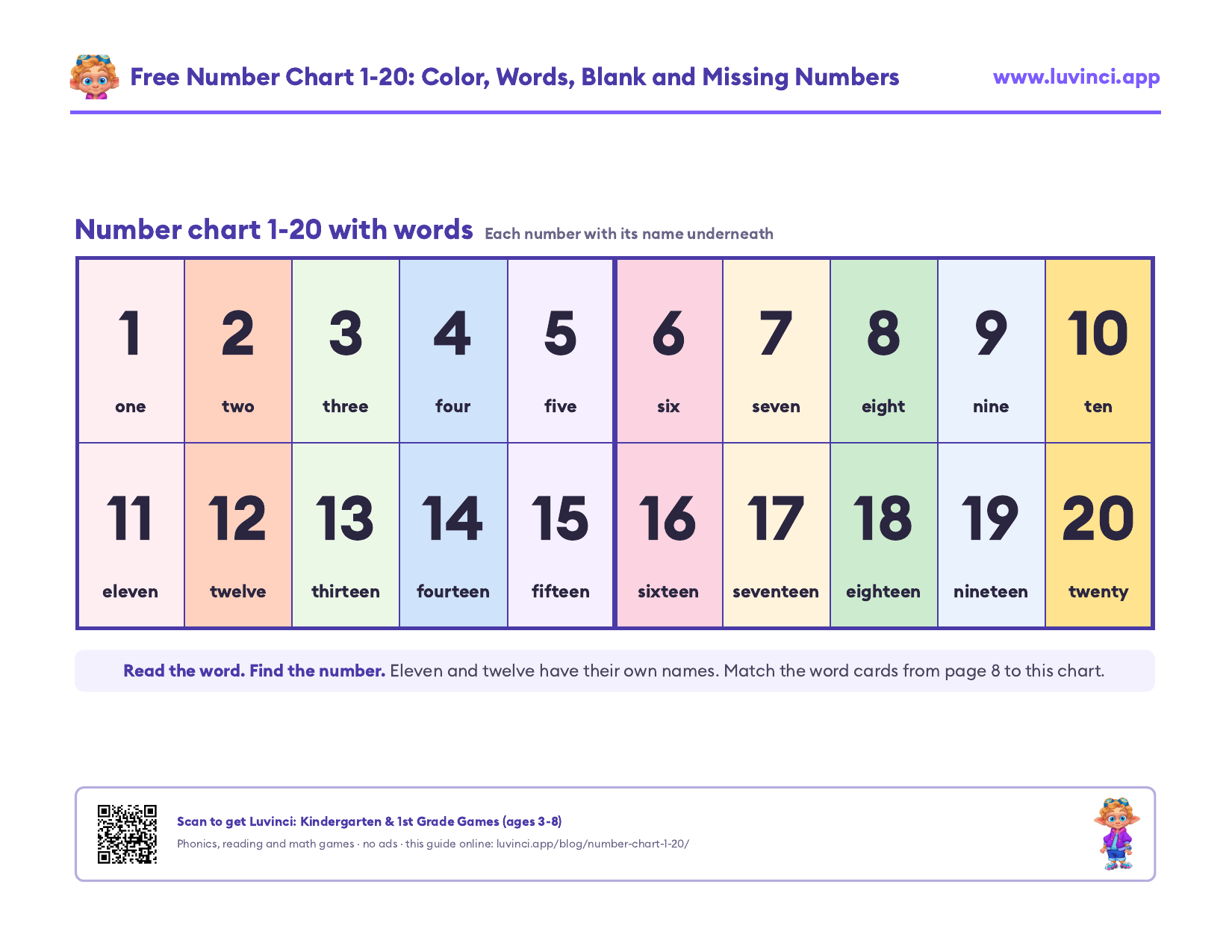
Page 3: read the word, find the number.
How to teach counting to 20
Counting 1 to 20 is really three skills. Your child needs to say the numbers in order, count that many things, and start from any number.
12 and 14 are the tricky spots. In a study of 800+ kindergartners in Australia (Gould, 2016), 12 was the most common place a count stopped at the start of the year, then 10. Kids who got past 15 usually made it to 19. Thirteen and fifteen are the trouble. They don’t sound like “three-teen” and “five-teen”, so the count wobbles right after 12 and 14.
Listen for “fiveteen”. You might also hear “tenteen”. That’s your child using a rule: a number, then “teen”. Praise the idea, then give the special name: “Yes, five and teen. We say fifteen.”
Try “ten one, ten two”. Some languages say the teens as “ten one, ten two, ten three”. The notes that go with the Common Core standards suggest English speakers can learn that way alongside the usual names. Point to 13 and say “ten three, thirteen.”
Say it, then count it. A child can often say 1 to 20 before they can count 20 things. To count 20 toys, your child needs one number for each toy (see one to one correspondence). A line of things is easiest, then rows, then a circle. Keep scattered piles to 10 or fewer in kindergarten.
Start in the middle. Counting forward from any number, not just 1, is a kindergarten skill of its own (K.CC.2). Try: “Start at 8 and count to 15.” Put a finger on 8 on the chart and go. If your child starts back at 1, cover 1 to 7 with a strip of paper.
Counting to 20 worksheets: missing numbers 1-20
On page 5, your child fills in missing numbers 1-20 in three strips. Each strip is a small 1-20 chart with some boxes left empty:
- Strip A: four missing numbers in the top row (3, 6, 8 and 10).
- Strip B: five missing numbers in the bottom row.
- Strip C: only 1, 5, 10, 11, 15 and 20 are given.
Start with A. Your child finds an empty box and fills in the missing number. If they get stuck, don’t give the answer. Ask them to say the count out loud from the last number they know: “1, 2… 3!” Then check against page 1.
On strip C, the 5, 10, 15 and 20 are landmarks. A child who knows 6 comes after 5 can fill 6 to 9 from there.
Writing to 20 is a kindergarten goal, but little hands tire fast. If writing is hard, your child can say the number and point while you write it. Or your child finds the matching number card from page 8 and holds it up.
For more counting 1-20 worksheets, page 7 has rows of counters to count. Each row is a line of counters, 11 to 20 of them, with a small gap after every five. Your child touches each counter while counting, then writes how many in the box. The gaps split each row into fives, so it’s easy to see where a count went wrong. Answers: 12, 15, 18, 11, 20, 16.
Counting to 20 on two ten frames
Page 6 has eight counts on two ten frames, from 7 to 20. Your child counts the red counters and writes how many. The left frame always fills first, top row first. So any number past 10 shows a full left frame, and a child who knows a full frame is 10 can say “10” and count on: “11, 12, 13”. Then find the number on page 1. Answers, row by row: 7, 12, 16, 9, 20, 14, 18, 11.
For more on the double ten frame, and a Race to 20 game, see our ten frame printable. If you build the numbers with real counters, remember that buttons, dried beans and cereal are choking hazards for young children, so a grown-up stays close.
On the Singapore Math addition boards in the full app, each sum sits on two ten frames of pictures, one frame for each number. Those sums stay within 10, so counting past 10 happens on paper. See how Luvinci’s math games work.
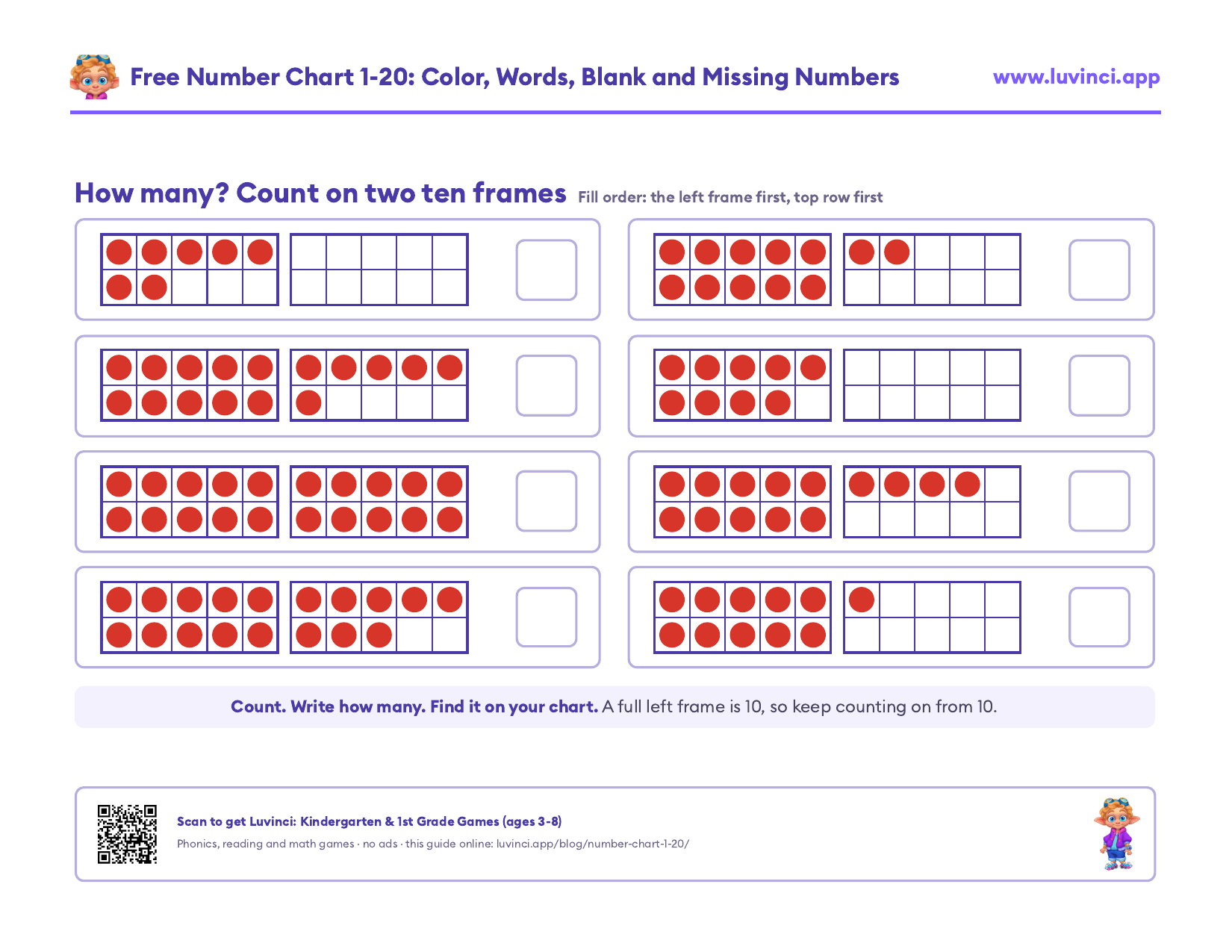
Page 6: count, write how many, and find it on the chart.
Number chart 1-20 activities
Five short ones. Each takes 5 minutes or less:
- Order the cards. Cut out the number cards on page 8, mix them up and lay them on the blank chart on page 4. Easier: only 1 to 10. Harder: take away three cards and ask which ones are missing.
- Word match. Lay the word cards from page 8 on the chart with words on page 3. Harder: lay the word cards in order on the blank chart on page 4, without looking at page 3.
- Clap and stop. Count out loud together with a clap for each number. You say “stop at 14”, and your child points to 14 on the chart. Then swap: your child says where to stop.
- Flip a card. Lay the number cards in order on the blank chart on page 4. While your child closes their eyes, turn one card face down. “Which number did I flip? What comes before it?” Harder: flip one in each row.
- Count out that many. Pick a number card and count out that many blocks or toy cars. Counting out a set number is harder than counting a pile that’s already there. It’s part of the kindergarten standard too (K.CC.5). Put them in a line, then count again to check.
FAQ
At what age should a child count to 20?
Saying the numbers to 20 is a pre-K goal in programs like Head Start, by about age 5. Many kids start kindergarten counting to 10 or 12, and that’s normal. During kindergarten, kids learn to count 20 things (K.CC.5) and write 0 to 20 (K.CC.3). By the end of kindergarten, around age 6, they say the numbers to 100.
Is it OK if my child says “fiveteen”?
Yes. It shows your child knows the teens follow a pattern. Call it a good guess, then give the special name, fifteen.
Should I use 2 rows of 10 or 4 rows of 5?
Both work. If your child’s class uses 4 rows of 5, use that shape at home too, so the chart looks the same in both places. Page 4 has that version, filled and blank. Otherwise, 2 rows of 10 lead straight into the hundreds chart.
Should a number chart start at 0?
It can, and some classrooms use a 0-20 chart. Our hundreds chart guide has a longer answer on starting at 0 or 1.
What comes after 20?
21, 22 and on up, in a new row. The number chart 1-50 goes on to 50, and the hundreds chart all the way to 100.
The takeaways
- Our number chart 1-20 uses two rows of ten, so 13 sits right under 3.
- Start with 1 to 10. Counting to 10 at the start of kindergarten is normal, and 20 comes during the year.
- 12 and 14 are where kids often stop, and “fiveteen” is a good sign.
- Saying the numbers isn’t counting things. Count things in a line, and start from any number.
- Print the free number chart 1-20 PDF: a color chart, number words, missing numbers, blank charts, two counting pages and cards.
More free math worksheets: ten frames, number charts, addition and subtraction, daily practice workbooks and more, all in one place. See the math printables →
