 Luvinci
October 2, 2026
Reading Comprehension Worksheets for First Graders (Free PDFs)
Reading passages for first graders, in phonics order
These short stories for first graders run in teaching order. “Ready after” is the lesson after which your child can read every word of each story. The first five rows overlap with kindergarten: review for some first graders, new ground for others. Every file is free, 4 pages, US Letter.
Lessons 35-58: review, or the start of first grade
| Free PDF | Lessons | Phonics skill | The 3 stories | Ready after lesson |
|---|---|---|---|---|
| PDF 5 | 35-41 | short vowel words with blends like st, gr, dr, mp, spr | The Sprint, The Raft, The Bug and the Bun | 41, 41, 41 |
| PDF 6 | 42-44 | ff, ll, ss, zz; -all, -oll, -ull; ck | Lots of Suds, Nell and the Gull, Nell and the Duck | 42, 43, 44 |
| PDF 7 | 45-49 | digraphs sh, th (both sounds), ch | The Moth, The Shell, The Chest | 47, 48, 49 |
| PDF 8 | 50-53 | wh, ph, ng, nk | The Whisk, The Pink Fish, The Swing | 50, 52, 53 |
| PDF 9 | 54-58 | magic e: a_e, i_e, o_e, e_e, u_e | The Red Cape, The Mole, The Mule | 54, 56, 58 |
Lessons 59-98: first grade
| Free PDF | Lessons | Phonics skill | The 3 stories | Ready after lesson |
|---|---|---|---|---|
| PDF 10 | 59-62 | -ce and -ge endings, magic e review | The Dice, The Big Cube, The Cone | 60, 61, 62 |
| PDF 11 | 63-68 | -es, -ed, -ing; compound words; closed and open syllables | Helping Mom, The Rabbit, Milo and the Frog | 65, 67b, 68 |
| PDF 12 | 69-76 | tch, dge; -ild, -old, -ind, -olt, -ost; y as in my and happy; -le | Fetch, Smudge!, The Wild Wind, The Puddle | 70, 73, 76 |
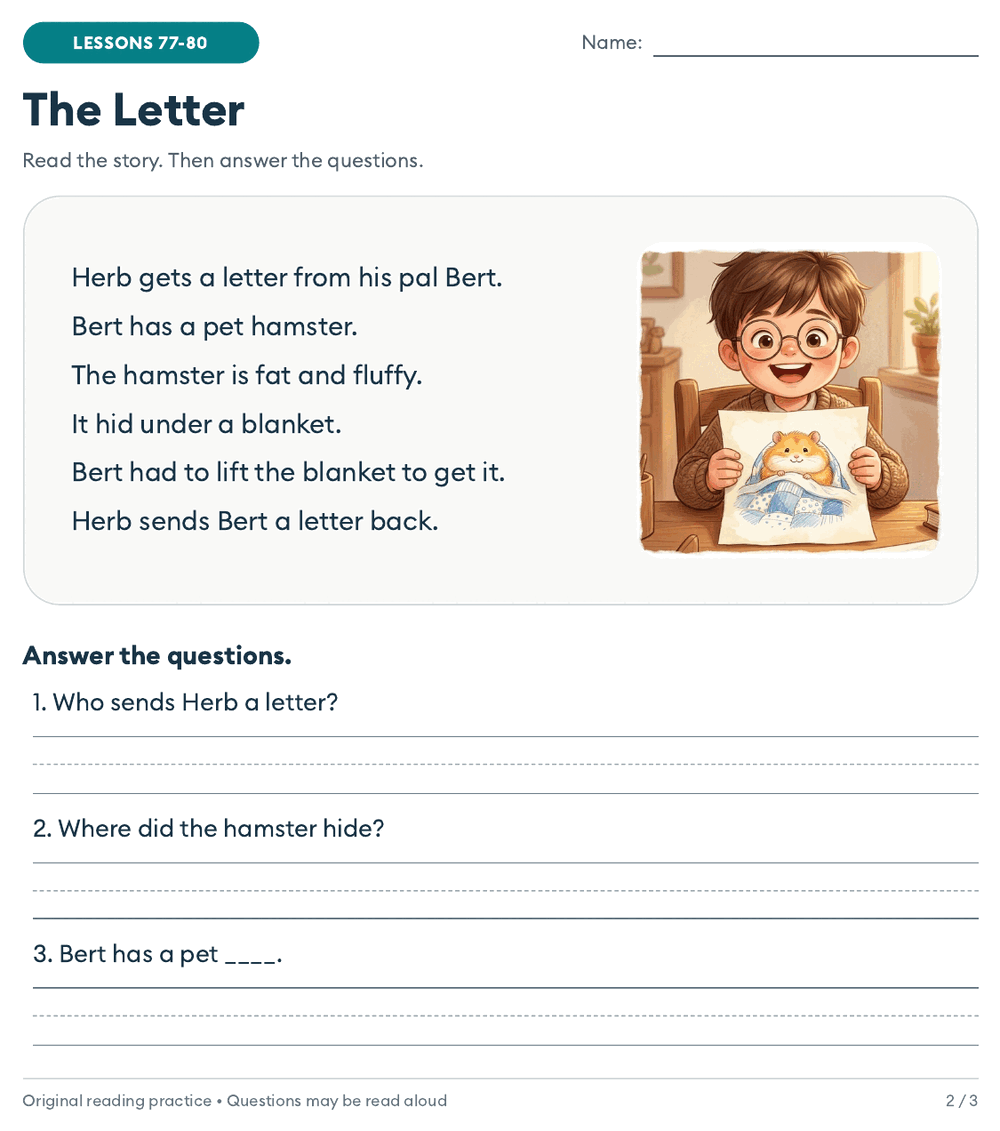
| PDF 13 | 77-83 | bossy r: ar, or, ore, er, ir, ur, w + or as in work | The Fort, The Letter, The Worm | 78, 80, 83 |
| PDF 14 | 84-88 | vowel teams ai, ay, ee, ea, ey, oa, ow, oe, ie, igh | A Rainy Day, Moe the Goat, The Bright Light | 84, 86, 88 |
| PDF 15 | 89-94 | oo as in book and moon, u as in put, ew, ui, ue, au, aw, augh, ea as in head, a as in wash | The Moon, Good Stew, The Hawk | 91, 91, 94 |
| PDF 16 | 95-98 | oi, oy, ou, ow as in cow; kn, wr, mb | Paws, The Storm, The Mouse | 95, 97, 98 |
Lessons 99-110: end of first grade
| Free PDF | Lessons | Phonics skill | The 3 stories | Ready after lesson |
|---|---|---|---|---|
| PDF 17 | 99-106 | suffixes -s, -es, -er, -est, -ly, -less, -ful; prefixes un-, pre-, re-, dis- | The Slow Snail, Bolt the Robot, Ava’s Horse | 101, 103, 106 |
| PDF 18 | 107-110 | doubling, drop the e, y to i | Swimming, Skating, Fireflies | 108, 109, 110 |
More practice at the same stage: phonics worksheets for lessons 35-41, 42-53, 54-62, 63-68, 69-76, 77-83, 84-88, 89-94, 95-97 and 98.
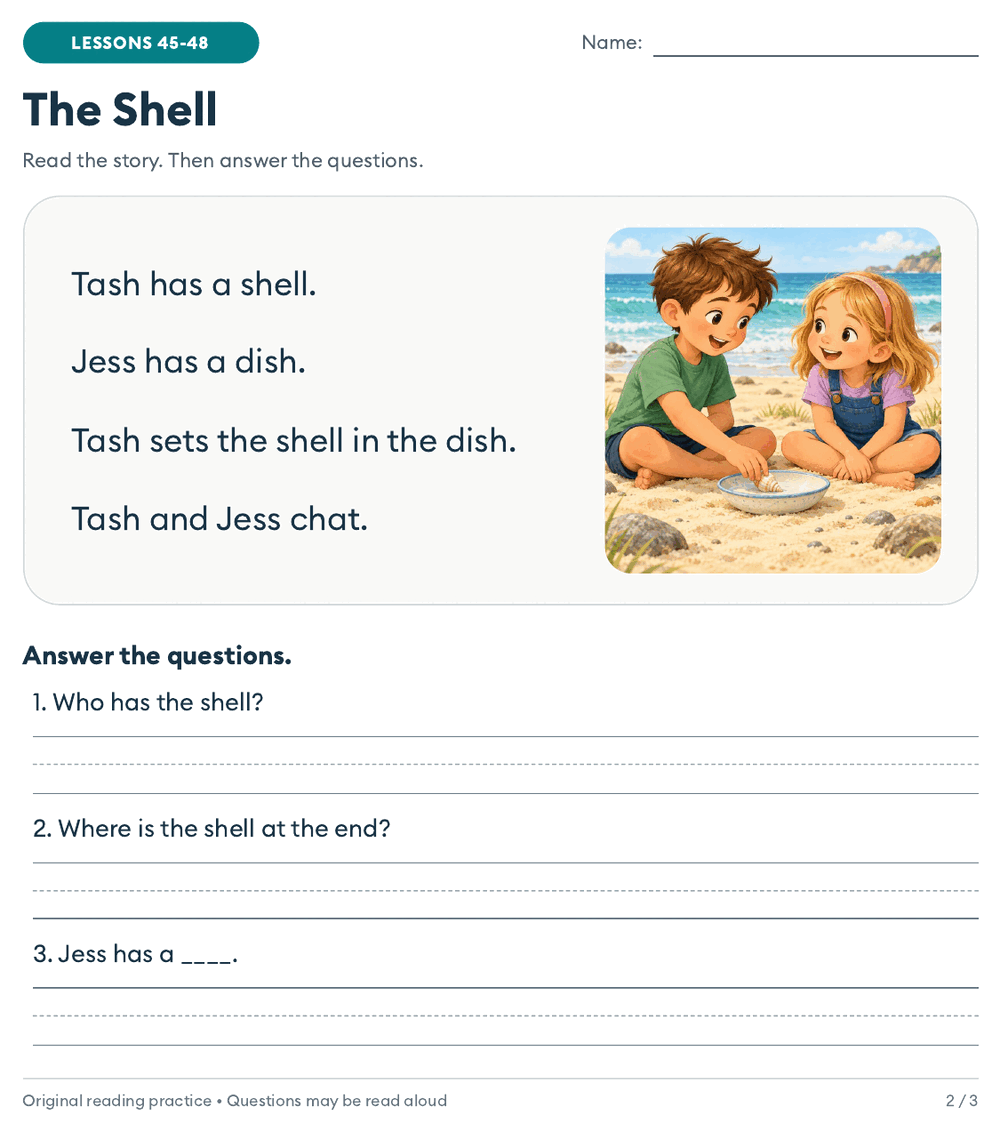
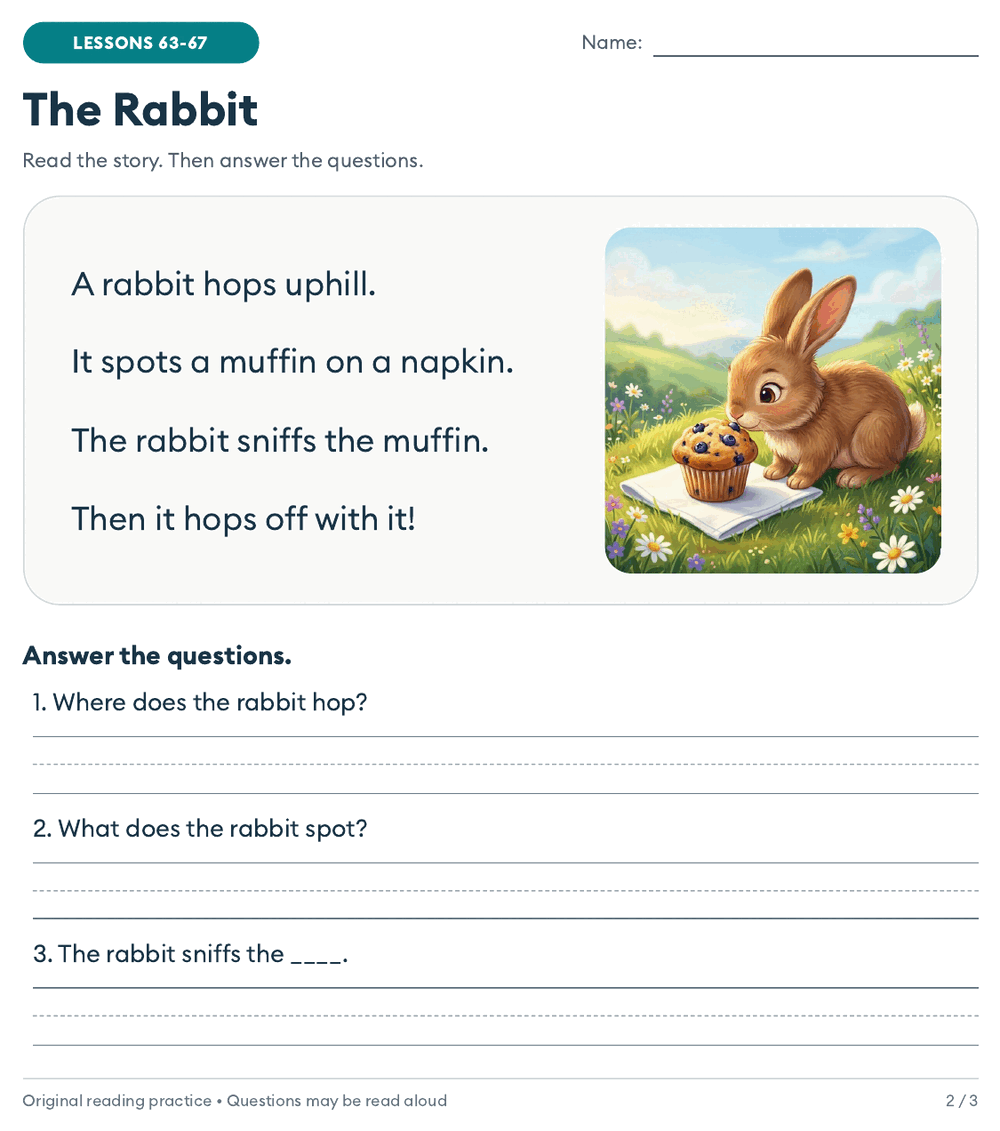
These free reading comprehension worksheets for first graders are 42 short stories your child can sound out. Each one has a picture, three questions and lines to write on, and every PDF ends with an answer key. They are reading worksheets for first graders who are still learning the code: every word uses phonics patterns taught so far, plus a few heart words.
Good reading comprehension for first graders starts with words a child can read. So the 14 PDFs go in phonics order, from blends and digraphs to vowel teams, suffixes and prefixes. Each story is labeled with the lessons it needs.
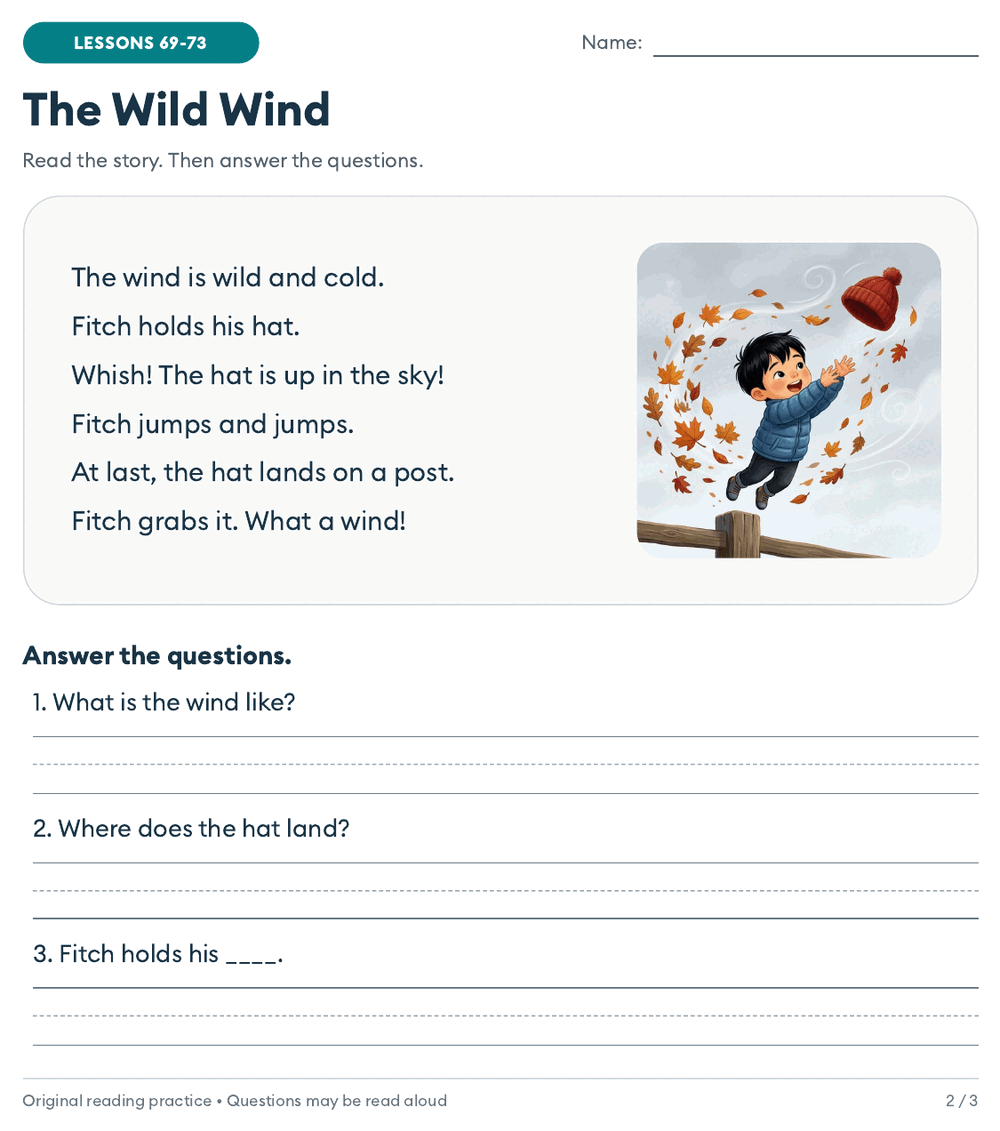
There’s no signup. The PDF above is lessons 69-76, the middle of first grade. Find your child’s row in the table, or use the placement check if you’re not sure.
Jump to: where to start · a 3-day routine · questions to ask
What is on each worksheet
Each PDF has 4 pages. Pages 1 to 3 hold one story each, with its lessons, a full-color picture and three questions. Stories start at four sentences. Later ones have up to nine short sentences, still on one page.
The questions are the same three kinds every time. Questions 1 and 2 ask about details, like who, what, where or why, and the footer says they may be read aloud. Question 3 is a line from the story with a blank. Your child reads it alone and writes the missing word.
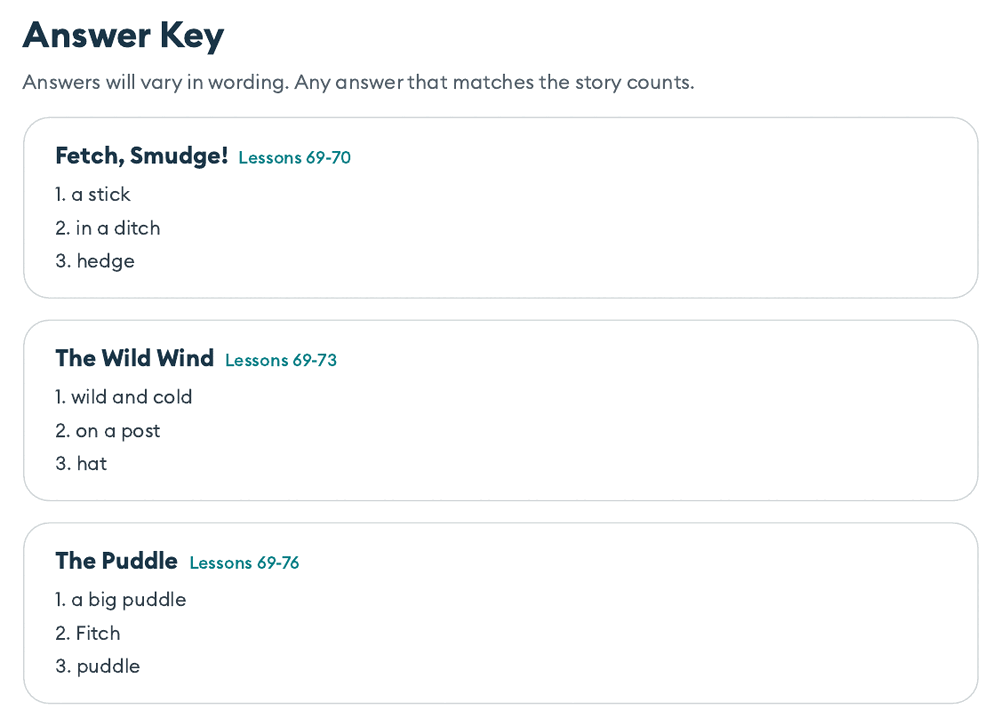
Page 4 is the answer key, so these are reading comprehension worksheets for first graders with answers. Any answer that matches the story counts, in your child’s own words, so you don’t need a teacher’s guide.
Which story to start with
Ask your child to read these four lines, one at a time:
- “Stan and Brit get on a raft.” (PDF 5)
- “Zeke rides the mule to a dune.” (PDF 9)
- “Fitch giggles. Midge giggles.” (PDF 12)
- “He sees a light, way up high.” (PDF 14)
- Line 1 is a struggle: blends are still new. Go back to the kindergarten stories for a while.
- Line 1 is easy, line 2 is hard: start at PDF 6.
- Line 2 is easy, line 3 is hard: start at PDF 10.
- Line 3 is easy, line 4 is hard: start at PDF 13.
- All four are easy: start at PDF 15. Past lesson 98 already? Start at PDF 17. After PDF 18, the suffix and prefix stories go on to lesson 128.
The right level is a story your child reads with one or two stumbles. If every line is a fight, go back one PDF.
If your child’s class uses UFLI, you can skip the check. Each story lists its lessons, so pick the row with this week’s lesson number.
How to help a first grader with reading comprehension
Reading comprehension for first graders depends on decoding. If your child spends all their effort on the words, there’s little left for the story. So keep the level right and give each story three short days, five to ten minutes each:
- Day 1: read. Cover the picture with a sticky note so your child reads the words, not the picture. They read aloud, finger under each word. On a hard word, point to the letters and say “Sound it out.” Then uncover the picture and talk about it. Does it match the story?
- Day 2: reread and answer. The second read should sound smoother. Read questions 1 and 2 aloud. Your child answers out loud, then writes a word or two. They read the fill-in line alone and write the missing word.
- Day 3: retell. Cover the story. Your child tells it back from the picture: who was in it, what went wrong, and how it ended.
That’s about two weeks per PDF. A child who is flying can do one story a day.
After a story, a sentence building worksheet at the same stage lets your child build and write a new sentence with the same pattern. More on the path from letter sounds to meaning in how kids learn to read.
Reading comprehension questions to ask a first grader
The three questions on the page check the facts. In The Wild Wind they are “What is the wind like?”, “Where does the hat land?” and “Fitch holds his ____.” The answers are right there in the story.
First graders can go further out loud. Pick one or two of these, during or after the story:
- Why? “Why does Fay groan?” (Moe the goat is eating her coat.) Your child has to put two lines together.
- What next? On the first read of The Bright Light, stop after “Is it a plane? Is it a kite?” and ask what the light could be.
- How do they feel? “Is Fitch mad when he gets muddy? How do you know?” The clue is in the words: he giggles.
- Retell in order. “What happened first? Then what? How did it end?”
Don’t turn it into a quiz. One good question, talked through, is worth more than five.
Reading worksheets for first graders they can sound out
Many reading worksheets for first graders use words a child can’t decode yet. A first grader who meets beautiful or giraffe too early ends up guessing from the picture. These stories are decodable. Every word uses phonics patterns taught by the “ready after” lesson, or is a heart word: a common word with a part that doesn’t sound out the way your child expects.
So a story ready after lesson 83 can say “Kurt digs in the dirt with his mother.” Kurt and dirt are bossy r words, and mother is a heart word taught at the same stage. It can’t say “Kurt finds treasure,” because treasure uses patterns that come much later.
Heart words like they, could, one and mother are explained in our heart words guide. To see which ones a first grader is expected to learn this year, use the first grade sight words list.
Questions parents ask
Do these match my child’s school program? If the school uses UFLI, each story is labeled with the lessons it was written to follow, so you can match it to this week’s lesson. Other programs teach the same patterns in a similar order, so use the placement check and start there.
Should my first grader write full sentences? Only if that’s easy for them. A word or a short phrase is fine, and saying the answer out loud counts too. The comprehension is in the thinking, not the handwriting.
Quick takeaways
- 42 short stories in 14 free PDFs, in phonics order, each with a picture, 3 questions and an answer key.
- Start where your child reads with only one or two stumbles.
- Cover the picture on the first read.
- Read questions 1 and 2 aloud; your child reads the fill-in line.
- Ask one extra “why?” or “what next?” out loud.
For days without the printer, our reading games have read-aloud stories that light up each word as it’s read. They’re for ages 3 to 8, with no ads.
Created to align with UFLI’s scope and sequence; lesson numbers are cited for alignment only. These stories and PDFs are our own original work, not created by nor endorsed by UFLI or the University of Florida.
