 Luvinci
October 2, 2026
Free Decodable Stories With Questions, by UFLI Lesson
Decodable passages with comprehension questions, by lesson band
Each row is one PDF of decodable reading passages. The answer key sits on page 4 after three stories that build through the band. Each story page shows the lessons it needs, so “Lessons 54-56” means every word is readable once lesson 56 is done. Every file is free, 4 pages, US Letter.
| Lessons | Grade | Pattern | The 3 stories | |
|---|---|---|---|---|
| 1-12 | K | First letter sounds: a, m, s, t, p, f, i, n, o, an/am | Fin and Pip · Pip and Pat · Pat and Fin | |
| 13-19 | K | d, c, u, g, b, e: all five short vowels | Mop It! · Fun in the Sun · The Big Bug | |
| 20-27 | K | CVC words with -s, k, h, r, l | Ten Cups · The Hot Dog · The Red Book | |
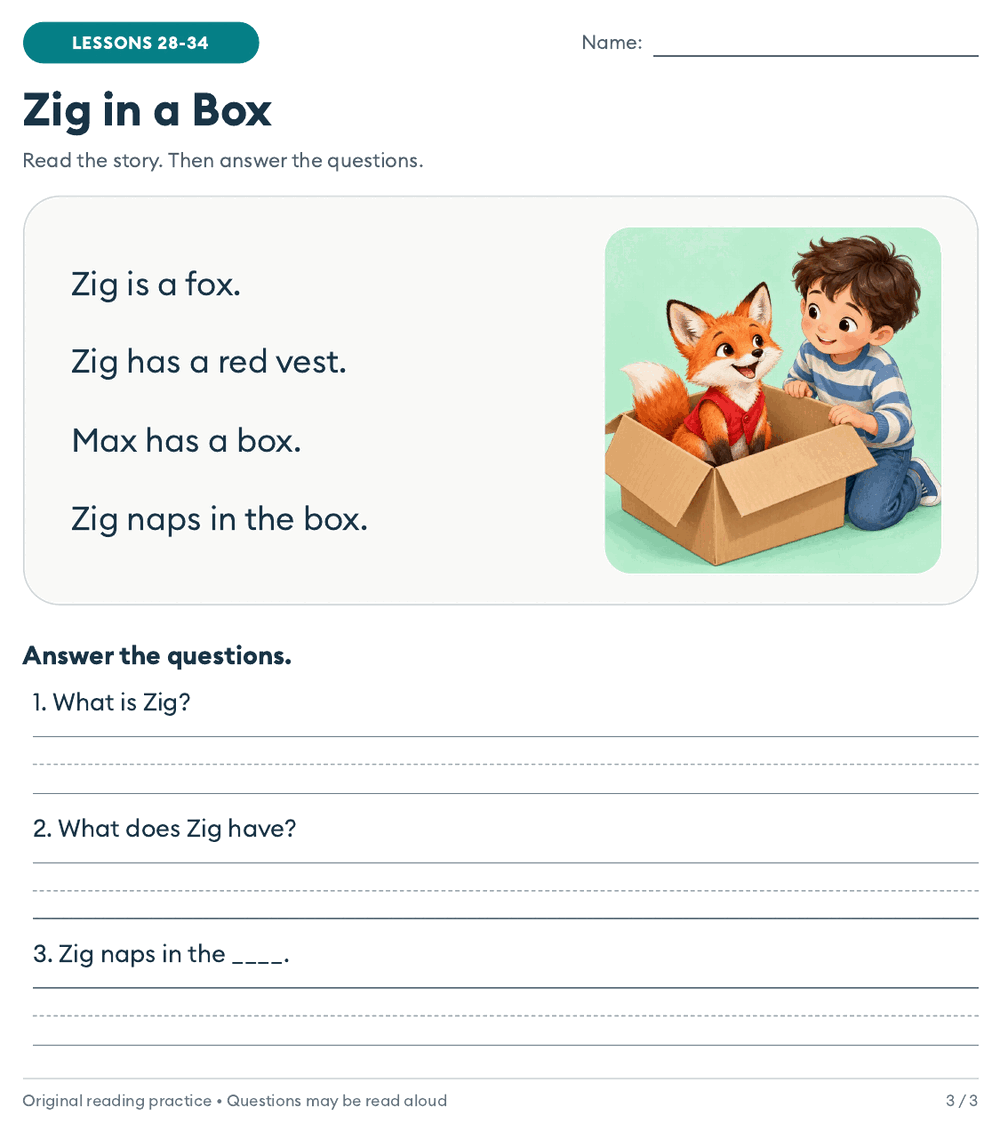
| 28-34 | K | w, j, y, x, qu, v, z | Deb and the Yak · The Squid · Zig in a Box | |
| 35-41 | K-1st | Consonant blends: st, gr, dr, mp | The Sprint · The Raft · The Bug and the Bun | |
| 42-44 | K-1st | ff, ll, ss, zz, -all, -oll, -ull, ck | Lots of Suds · Nell and the Gull · Nell and the Duck | |
| 45-49 | K-1st | Digraphs sh, th, ch | The Moth · The Shell · The Chest | |
| 50-53 | K-1st | wh, ph, ng, nk | The Whisk · The Pink Fish · The Swing | |
| 54-58 | K-1st | Magic e: a_e, i_e, o_e, e_e, u_e | The Red Cape · The Mole · The Mule | |
| 59-62 | 1st | -ce and -ge (soft c and g at the end), magic e review | The Dice · The Big Cube · The Cone | |
| 63-68 | 1st | -es, -ed, -ing, two-syllable words | Helping Mom · The Rabbit · Milo and the Frog | |
| 69-76 | 1st | tch, dge, -ild, -old, -ind, -ost, y, -le | Fetch, Smudge! · The Wild Wind · The Puddle | |
| 77-83 | 1st | Bossy r: ar, or, ore, er, ir, ur, w + or | The Fort · The Letter · The Worm | |
| 84-88 | 1st | Vowel teams: ai, ay, ee, ea, ey, oa, ow, oe, ie, igh | A Rainy Day · Moe the Goat · The Bright Light | |
| 89-94 | 1st | oo, ew, ui, ue, au, aw, ea as in head | The Moon · Good Stew · The Hawk | |
| 95-98 | 1st | oi, oy, ou, ow, kn, wr, mb | Paws · The Storm · The Mouse | |
| 99-106 | 1st-2nd | Suffixes -er, -est, -ly, -ful, -less; prefixes un-, pre-, re-, dis- | The Slow Snail · Bolt the Robot · Ava’s Horse | |
| 107-110 | 1st-2nd | Doubling, drop the e, y to i | Swimming · Skating · Fireflies | |
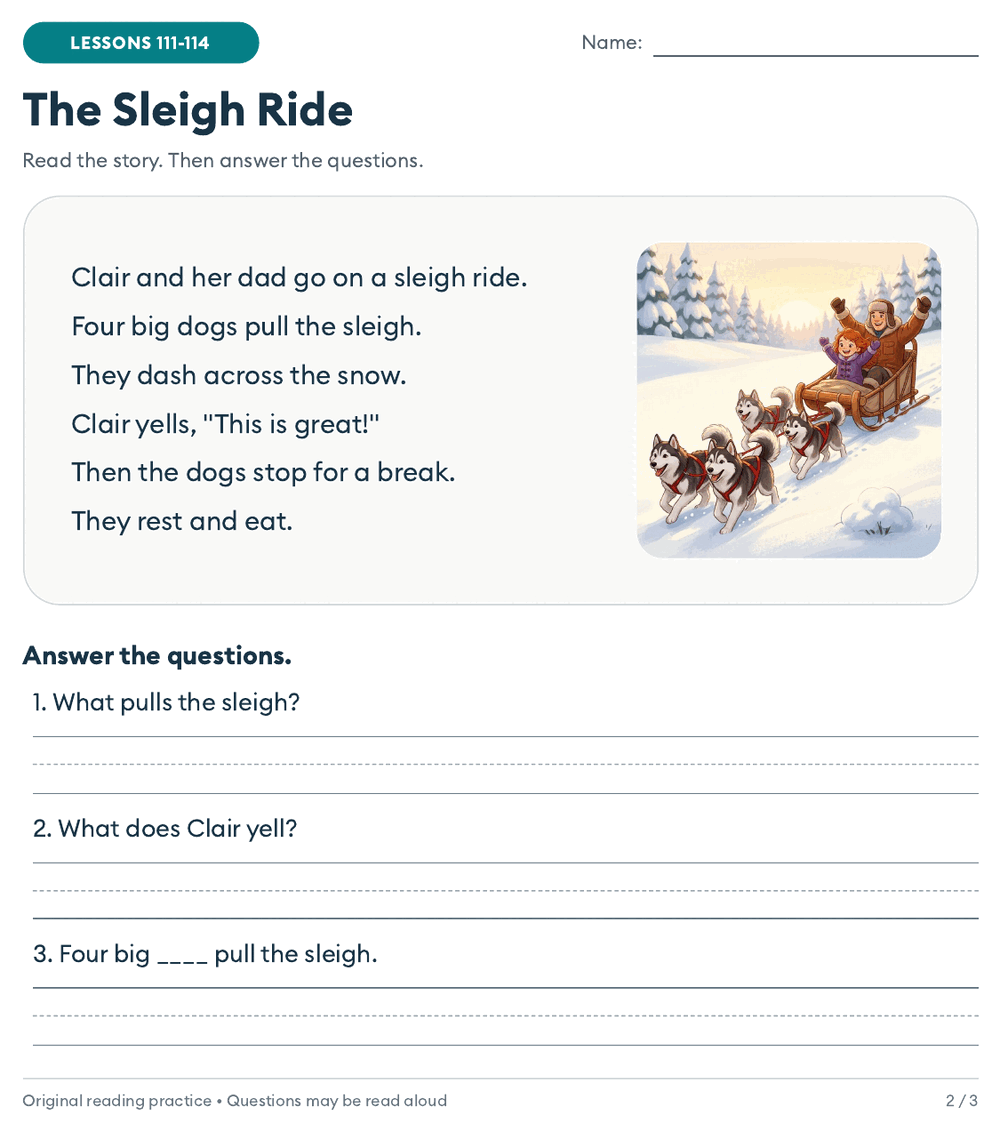
| 111-118 | 2nd | air, are, ear, eigh, ough, ar and or as in collar, c and g before e, i, y | The Lost Bear · The Sleigh Ride · Gemma’s Gem | |
| 119-128 | 2nd | -tion, -sion, -ture, -or, -ist, -ish, -ness, -ment, -able, -ible, bi-, tri- | The Creature · Ivy the Inventor · Leo’s Bicycle |
Teaching one grade? Our pages on kindergarten reading comprehension worksheets, reading comprehension worksheets for first graders and reading comprehension for 2nd graders walk through that grade’s stories, with tips for that age.
Need a worksheet for the same week? There are free phonics worksheets for each lesson band up to 98 too, or open a band in the printables library: 1-34 · 35-41 · 42-53 · 54-62 · 63-68 · 69-76 · 77-83 · 84-88 · 89-94 · 95-97 · 98.
These are decodable passages with comprehension questions. You’ll find 60 short stories across 20 free PDFs, each written so a child can read every word with the phonics and heart words taught so far. Every story has a full-color picture and three questions, and every PDF ends with an answer key.
The PDFs run by lesson band, from the first letter sounds of kindergarten through the prefixes and suffixes of 2nd grade. The very first story, Fin and Pip, is readable once a child knows a, m, s, t, p, f, i and n, plus the word and: “Fin sat. Pip sat. Fin and Pip sip.” By lesson 128 a story runs six sentences and has words like bicycle and excitement.
These free decodable passages need no signup and no email. Pick the row with your child’s lesson number, or the sound pattern they’re working on, and print that PDF.
Jump to: what decodable means · a 10-minute routine · vs leveled readers · FAQ
Extra stories to use alongside UFLI passages
Looking for UFLI’s own decodable passages? They are free in the UFLI Foundations Toolbox. Ours are extra stories, with pictures and questions, written to follow the same lesson order.
Use them when a child needs one more go at a pattern before moving on, as homework that matches this week’s lesson, or for a small group that’s ready while the rest of the class catches up. Characters, plots and questions are all new in every story.
What is a decodable passage?
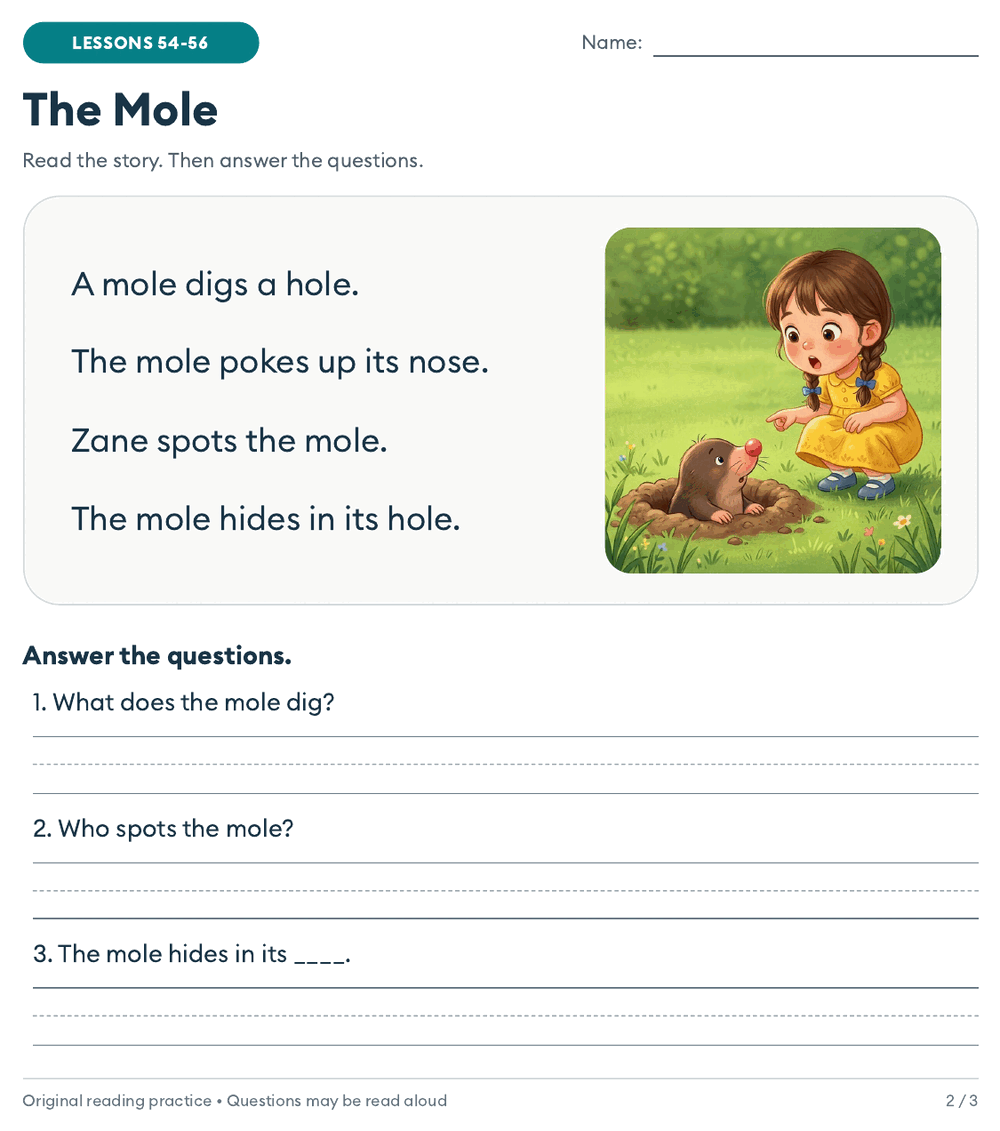
A decodable passage is a short piece of decodable text in which every word uses letter-sound patterns the child has already been taught, plus a few practiced heart words. The child doesn’t need to guess. If a child has learned magic e, they can read The Mole from the first word to the last:
A mole digs a hole. The mole pokes up its nose. Zane spots the mole. The mole hides in its hole.
Every word there is a short vowel word, a magic e word or one of two heart words (a, the). A line like “The mole looked around for food” would not work at that point, because oo and ou come more than 30 lessons later, and the -ed ending comes after lesson 63. A decodable text is written to fit what the child knows. That’s the whole difference, so reading it is practice in using the code.
We check every word against the lessons taught up to that point before a story goes in a PDF. Each story still has a plot and an ending. A cat gets rescued, a hat blows away, a robot comes unplugged. If blending sounds is still slow, stay with the earlier rows for a while.
How to use one story in 10 minutes
One story a day is plenty for a confident reader. A newer reader can spend three days on one story, as in the kindergarten routine. On spare days, reread a favorite.
- Read (3 minutes). Cover the picture with a sticky note so your child reads the words, not the picture. They read aloud, finger under each word. If they stop on a word, point to its letters and say “Sound it out” instead of giving the word.
- Reread (2 minutes). Read the story again. It should sound smoother the second time. Now lift the sticky note and talk about the picture: does it match what they read?
- Answer (4 minutes). Read questions 1 and 2 aloud (the footer says questions may be read aloud). Your child can answer out loud, then write a word or two. Question 3 is a sentence from the story with a blank, so your child reads it alone and writes the missing word. The answer key counts any wording that matches the story.
- Retell (1 minute). “Tell me what happened. What happened first? What happened at the end?” A good retell has the who, the problem and the ending, in order.
In a class, run the same routine with a small group. After the group has read the story together, use it as independent work. To keep going after the story, a child can build and write a new sentence with the same pattern on one of our sentence building worksheets.
Decodable text vs leveled readers
Leveled readers sort books by overall difficulty (level A, B, C and up). Their words are chosen for meaning and repetition, not for the phonics a child has learned, so an early level might open with “Look at the elephant.” A child who can’t decode elephant yet has two choices: guess from the picture, or stop.
Decodable text controls the phonics instead. The child uses the sounds they were taught and finds out they work. The choice between decodable and leveled readers matters most in kindergarten and 1st grade, while a child is still learning the code.
Keep both in the mix. Decodable stories are for your child’s own reading practice while they’re learning patterns. Keep reading picture books and chapter books aloud for vocabulary, ideas and fun. Most children lean on decodable text less as they can decode more of the new words they meet. More on how schools approach this in phonics vs. whole language, and the full path from sounds to fluent reading in how kids learn to read.
Questions parents and teachers ask
What grade are these decodable stories for? Kindergarten to 2nd grade. PDFs 1-4 are kindergarten, 5-9 are late kindergarten or early 1st grade, 10-16 are 1st grade, 17-18 are the end of 1st grade or the start of 2nd, and the last two are 2nd grade. Use the lesson or pattern your child is on, not the grade.
Which PDF should my child start with? The row for the pattern they’re learning now. Unsure? Try a story from the row before. Stay on that row until your child reads it with only a stumble or two. Then move to the next row.
Does my child have to write the answers? No. Answering out loud counts. Writing one or two words is good practice once spelling those patterns feels easy (1st grade and 2nd grade spelling lists).
Will these short stories with comprehension questions work with a different phonics program? Most phonics programs teach these patterns in a similar order, though rarely the exact same one. Look up your child’s current pattern in the table and start there.
Who made the stories and pictures? Stories and questions are written by us. Illustrations are made with an AI image tool and checked by hand.
Quick takeaways
- 60 decodable stories in 20 free PDFs, each with a picture, 3 questions and an answer key.
- Pick the row with your child’s lesson number or sound pattern, not their grade.
- One story a day, about 10 minutes: read, reread, answer, retell.
- Cover the picture on the first read so your child reads the words.
- Decodable text is for practicing the code; keep reading other books aloud for fun.
When you’re between printed stories, our reading games read stories aloud and highlight each word. They’re for ages 3 to 8, with no ads, and work offline.
Created to align with UFLI’s scope and sequence; lesson numbers are cited for alignment only. These stories and PDFs are our own original work, not created by nor endorsed by UFLI or the University of Florida.
