 Luvinci
October 2, 2026
Kindergarten Reading Comprehension Worksheets: 27 Free Stories
Kindergarten reading passages by lesson: all 9 PDFs
These kindergarten reading comprehension passages run in teaching order. They are easy reading stories for kindergarten, each with questions. “Ready after” is the lesson after which your child can read every word of each story.
Lessons 1-41: kindergarten (35-41 also early 1st grade)
| Lessons | New sounds | The 3 stories | Ready after lesson | |
|---|---|---|---|---|
| PDF 1 | 1-12 | a, m, s, t, p, f, i, n, o, an/am (letter sound order) | Fin and Pip, Pip and Pat, Pat and Fin | 9, 11, 12 |
| PDF 2 | 13-19 | d, c, u, g, b, e | Mop It!, Fun in the Sun, The Big Bug | 14, 16, 18 |
| PDF 3 | 20-27 | -s endings, k, h, r, l | Ten Cups, The Hot Dog, The Red Book | 21, 24, 27 |
| PDF 4 | 28-34 | w, j, y, x, qu, v, z | Deb and the Yak, The Squid, Zig in a Box | 30, 32, 34 |
| PDF 5 | 35-41 | short vowels with blends like st, gr, sp, dr | The Sprint, The Raft, The Bug and the Bun | 41, 41, 41 |
Lessons 42-58: late kindergarten for most children, the start of 1st grade for many
| Lessons | New sounds | The 3 stories | Ready after lesson | |
|---|---|---|---|---|
| PDF 6 | 42-44 | double letters ff, ll, ss, zz (the floss rule), -all, -oll, -ull, ck | Lots of Suds, Nell and the Gull, Nell and the Duck | 42, 43, 44 |
| PDF 7 | 45-49 | two letters, one sound: sh, th, ch | The Moth, The Shell, The Chest | 47, 48, 49 |
| PDF 8 | 50-53 | wh, ph, ng, nk | The Whisk, The Pink Fish, The Swing | 50, 52, 53 |
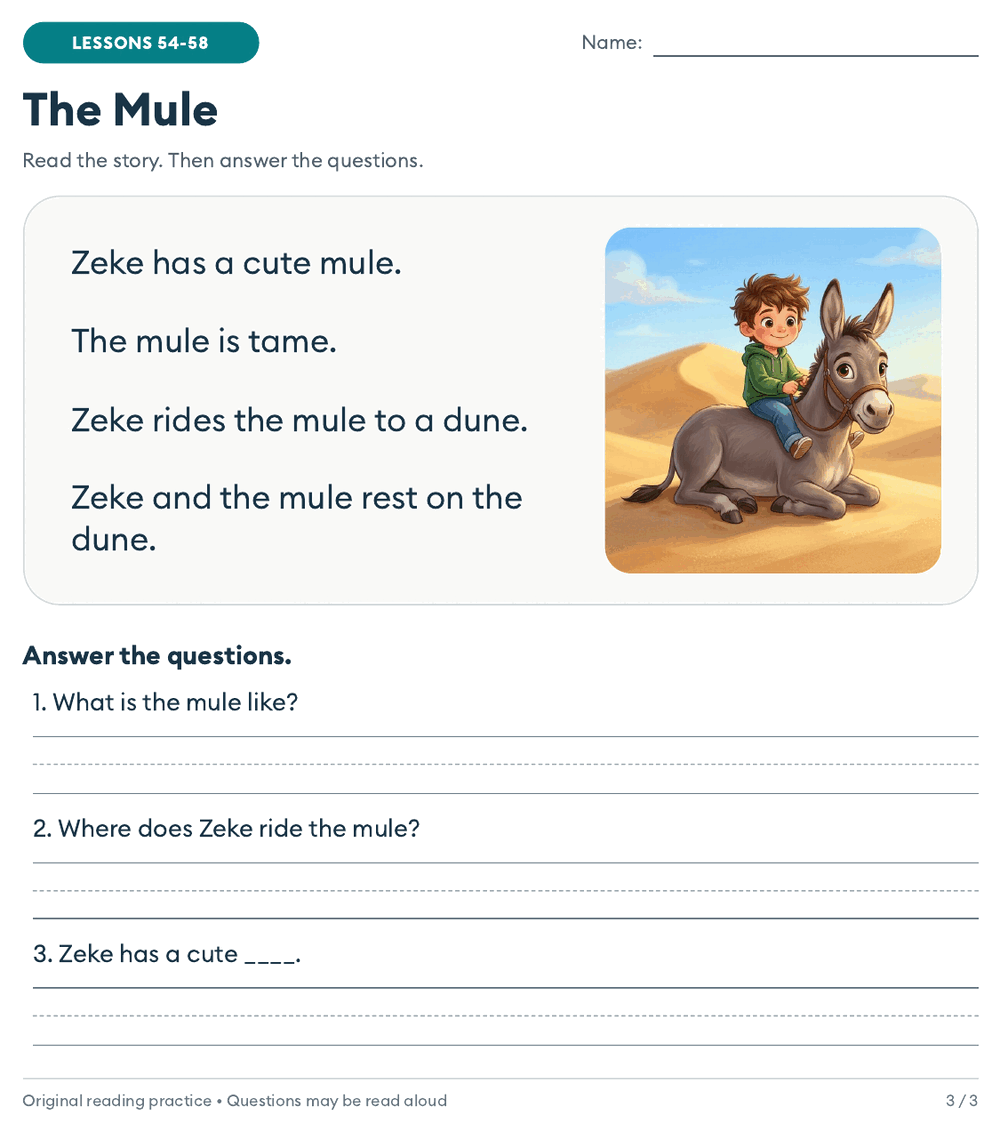
| PDF 9 | 54-58 | magic e: a_e, i_e, o_e, e_e, u_e | The Red Cape, The Mole, The Mule | 54, 56, 58 |
More practice at the same stage: phonics worksheets for lessons 1-34, 35-41, 42-53 and 54-62, and CVC word lists alongside PDFs 1-4.
These free kindergarten reading comprehension worksheets give you 27 short stories your child can really read. Every word uses letter sounds they have learned, plus a few heart words like the. They are free printable kindergarten reading worksheets, each with a picture, three questions and write-on lines, and every PDF ends with an answer key.
The 9 PDFs go in phonics order, from the first letter sounds (a, m, s, t) to magic e. The stories were created to align with UFLI’s scope and sequence, and each one is labeled with its lessons, so if your child’s class uses it, you can match a story to this week’s lesson. If not, the placement check finds the right PDF.
There’s no signup. Start with PDF 1, lessons 1-12, or pick from the table.
Jump to: where to start · the questions · a 3-day routine
Free kindergarten reading worksheets that tell a story
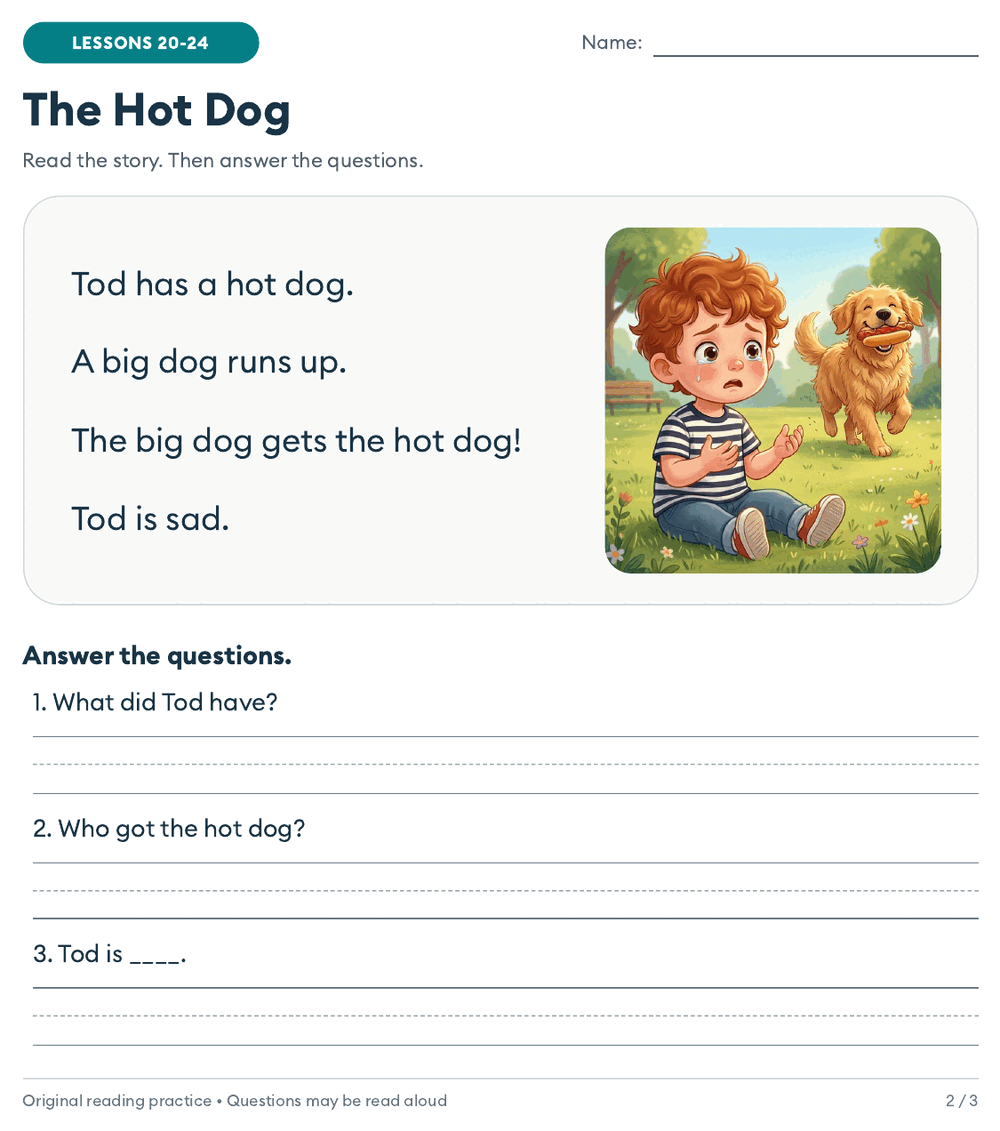
Many kindergarten reading worksheets are word lists. These are tiny stories with a beginning, a middle and an end. In The Hot Dog, a big dog takes Tod’s hot dog, and Tod is sad. The page gives your child something to understand, along with something to sound out.
Each page has a 4-line story in big print, a picture and three questions. The last page is the answer key. Any answer that matches the story counts.
Which PDF should my child start with?
Ask your child to read Fin and Pip sip., a line from the first story.
- They blend F-i-n, P-i-p and s-i-p: start with PDF 1. (and is a heart word, so it’s fine if they just know it.)
- They say the sounds but can’t blend them: practice blending first, with the routine in our blending sounds guide.
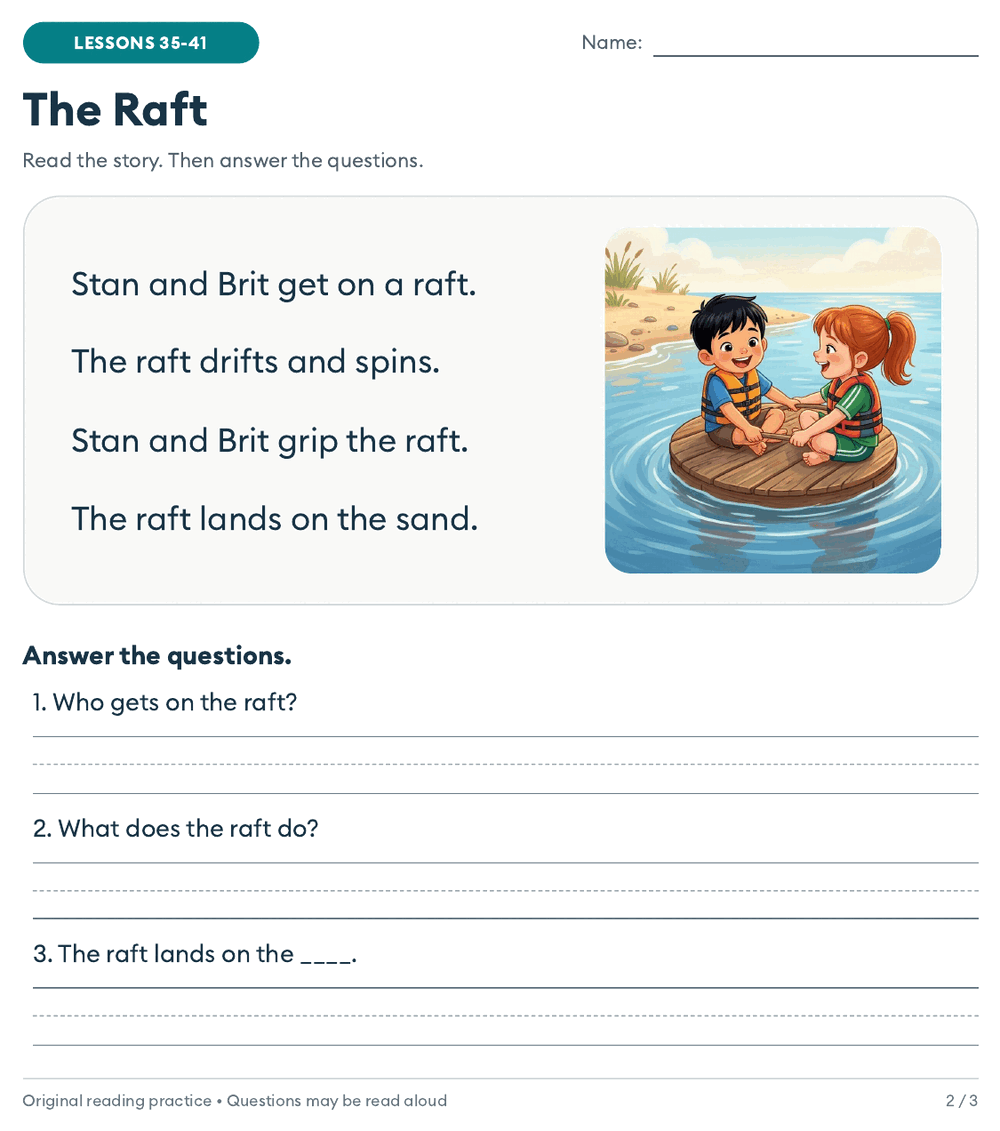
- They read it straight away: try “Stan and Brit get on a raft.” (PDF 5) and “Gabe has a red cape.” (PDF 9). Start at PDF 2 if the PDF 5 line is hard, or at PDF 6 if only the PDF 9 line is.
- The PDF 9 line is easy too: your child is ready for stories past lesson 58, so move on to the first grade stories.
The right level is a story your child reads with one or two stumbles. Go back one PDF if every line is a fight.
What reading comprehension looks like in kindergarten
Kindergarten reading comprehension is understanding what you read, and a beginner can only do that once the words themselves are easy to work out. That is why every story here is short and fully decodable. By the end of kindergarten, your child should be able to say who was in a story and what happened, and tell it back in order. More in how kids learn to read.
Decodable stories for kindergarten: what decodable means
A decodable story uses only the letter sounds a child has been taught, plus a few heart words. Teachers also call these decodable passages or decodable texts. Every story here was checked word by word. If it is ready after lesson 24, every word uses sounds or heart words taught by lesson 24.
When a beginner can’t sound out a word, they guess, often from the picture. A decodable story lets your child practice the code, and shows that sounding out works.
The heart words in the stories (the, a, and, is, are, I, to, of, see, look, book, have) are explained in our heart words guide, and the kindergarten sight words list shows which to learn this year.
Leveled readers, the little books many schools send home, often include words a beginner can’t sound out yet. Here is how decodable text and leveled readers compare.
Comprehension questions for kindergarten: the three kinds on every page
Every story has the same three kinds of question, in the same order:
- A beginning question, answered in the first line or two: “What did Tod have?”
- A what-happened question from later in the story: “Who got the hot dog?”
- A finish-the-sentence line: “Tod is ____.” Your child finds the missing word in the story and writes it. Every word in this line is decodable or a heart word your child has learned, so they can read it alone.
The footer on each page says the questions may be read aloud. Read questions 1 and 2 to your child, and let them read the fill-in line.
Then ask one question that isn’t on the page: “Why is Tod sad?” Comprehension grows when your child puts two lines together to work out an answer.
One story, three days: a kindergarten routine
Five to ten minutes a day:
- Day 1: read. Read the title together, then cover the picture with your hand or a sticky note so your child reads the words, not the picture. Your child reads the story, sounding out. If they get stuck, point to the tricky letter and ask, “What sound?” Then uncover the picture and talk about it.
- Day 2: reread and answer. The second read will be smoother; that’s the point. Then read questions 1 and 2 aloud, your child answers, and they finish the fill-in line.
- Day 3: retell. Cover the story. Your child tells it back from the picture: “First… then… at the end…”
That is about two weeks per PDF, or one story a week in a classroom.
On days you skip the printer, our reading games have read-aloud stories where every word lights up as it is read, ages 3 to 8, no ads.
Questions parents ask
Do I need UFLI to use these? No. The stories follow that lesson order, which many schools use. If your child’s program teaches letters in a different order, use the placement check.
Can a kindergartner write the answers? Some can, later in the year. Until then, your child says the answer or points to the word while you write it. Talking through the answer is the comprehension part.
What age are these for? Kindergarten, ages 5 to 6. A younger child who knows the letter sounds and can blend is ready to start PDF 1.
The takeaways
- 27 short stories in 9 free PDFs, in phonics order.
- Start where your child stumbles only once or twice.
- Read questions 1 and 2 aloud; your child reads the fill-in line.
- One story over three days: read, reread and answer, retell.
- Ask one extra “why?” question out loud.
Created to align with UFLI’s scope and sequence; lesson numbers are cited for alignment only. These stories and PDFs are our own original work, not created by nor endorsed by UFLI or the University of Florida.
