 Luvinci
October 2, 2026
Reading Comprehension for 2nd Graders: Free Story Worksheets
Reading passages for 2nd graders, by phonics skill
These reading passages for 2nd graders run in teaching order. Each PDF has three stories and an answer key on the last page. “Ready after” is the lesson after which your child can read every word of that story.
Lessons 99-110: the end of 1st grade or the start of 2nd
| Lessons | Phonics skill | The 3 stories | Ready after lesson | |
|---|---|---|---|---|
| PDF 17 | 99-106 | endings -s, -es, -er, -est, -ly, -less, -ful; prefixes un-, pre-, re-, dis- | The Slow Snail, Bolt the Robot, Ava’s Horse | 101, 103, 106 |
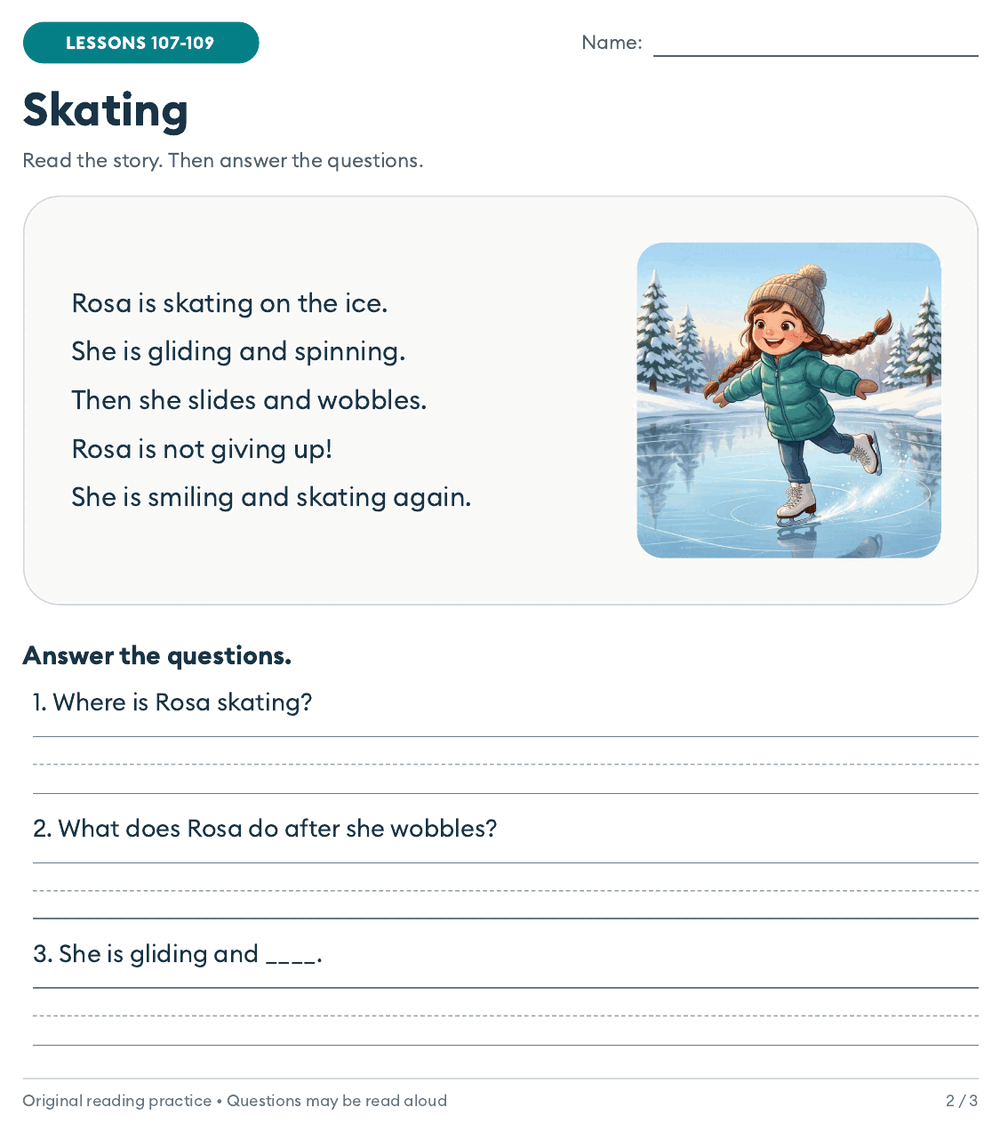
| PDF 18 | 107-110 | doubling after a closed syllable (swimming, clapped), dropping the magic e (skating, smiling), y to i (tried, fireflies) | Swimming, Skating, Fireflies | 108, 109, 110 |
Lessons 111-128: 2nd grade
| Lessons | Phonics skill | The 3 stories | Ready after lesson | |
|---|---|---|---|---|
| PDF 19 | 111-118 | ar and or saying er (collar, doctor); air, are, ear (chair, scared, bear); ear as in hear; ei, eigh, ey, ea, aigh saying long a (sleigh, great); eu, ew, ue as in few, ou as in soup; ough (thought, though); soft c and g before e, i, y (cent, gem); ch as in chef and school, gn, gh, silent t | The Lost Bear, The Sleigh Ride, Gemma’s Gem | 112, 114, 117 |
| PDF 20 | 119-128 | -sion, -tion, -ture (endings with a schwa sound); -er, -or, -ist, -ish, -y, -ness, -ment, -able, -ible; prefixes bi-, tri-, uni- | The Creature, Ivy the Inventor, Leo’s Bicycle | 120, 124, 128 |
These 12 short stories make reading comprehension for 2nd graders easy to practice at home. Each one has a story, a picture, three questions and write-on lines. Every PDF ends with an answer key.
At the right level, your child can read every word. Each story uses only the phonics patterns taught so far, plus a few heart words. In 2nd grade those patterns get longer: prefixes and suffixes, endings like -tion and -ture, and spellings like eigh in sleigh. The stories were created to align with UFLI’s scope and sequence, and each page shows its lessons, so you can match a story to this week’s lesson at school.
These free reading comprehension worksheets for 2nd graders need no signup. They are short stories for 2nd graders, five to nine short sentences each.
The card above is PDF 19, lessons 111-118, the first set that is 2nd grade only. A child just out of 1st grade may need PDF 17 first. The placement check tells you which.
Jump to: a 3-day routine · the questions · where to start
How to use the stories with a 2nd grader
One story over three days, about ten minutes a day:
- Day 1: read. Read the title together. Then cover the picture with a sticky note, so your child reads the words, not the picture. Your child reads the story aloud. On a long word, cover the ending with your finger: they read slow, then slowest. Last, uncover the picture and talk about it. Does it match what they read?
- Day 2: reread and answer. Your child reads the story once more. It should sound smoother, with fewer stops. Then read questions 1 and 2 aloud. Your child answers out loud, and can then write a short answer. They read the fill-in line alone.
- Day 3: retell. Cover the story. Your child tells it back from the picture: who it was about, the problem, and how it ended.
Three stories take about two weeks. Short on time? Do days 1 and 2 in one sitting.
If common words still slow your child down, add five minutes a day with the second grade sight words list.
Reading comprehension for 2nd graders: what the 3 questions check
Every story has the same three kinds of question, in the same order:
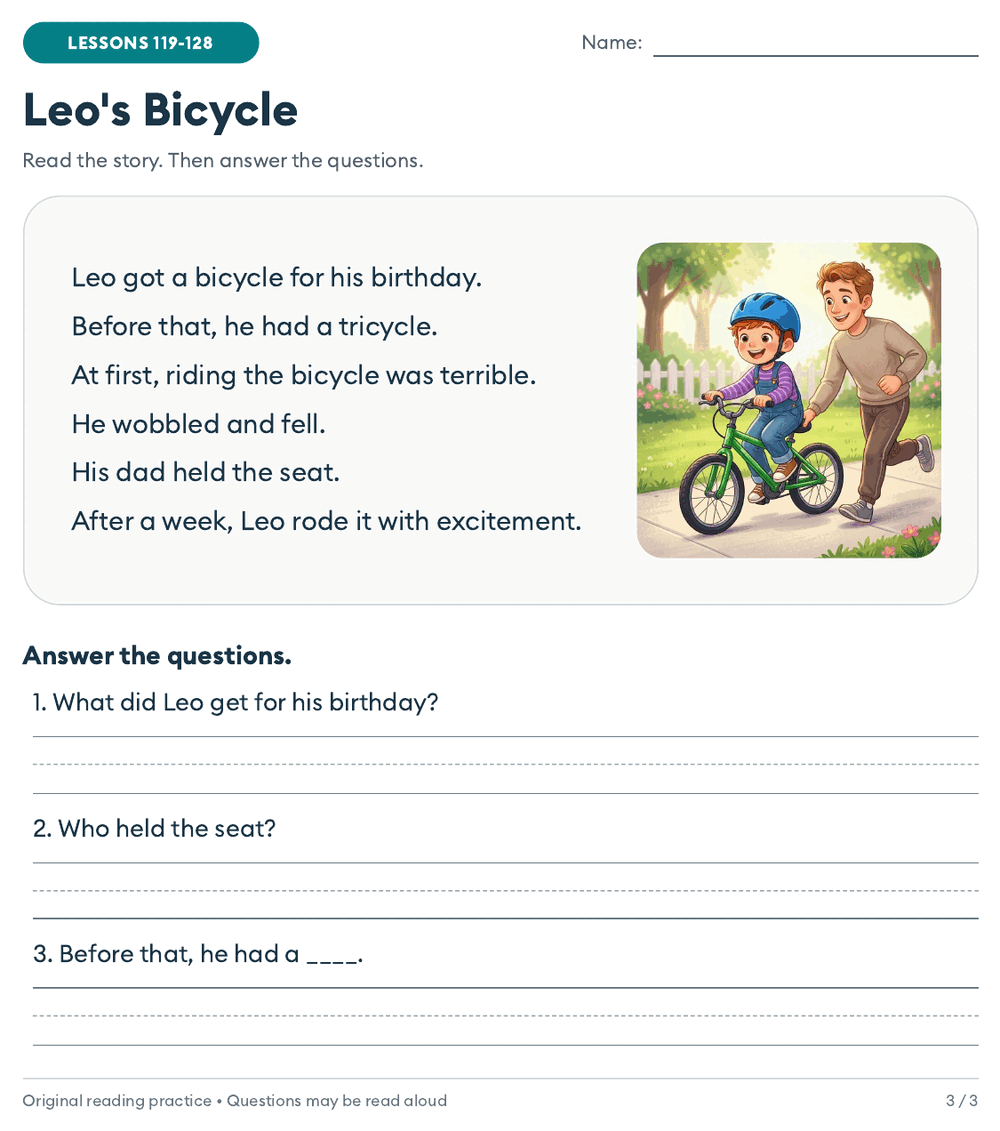
- A detail from the start. “What did Leo get for his birthday?” The answer is in the first line or two.
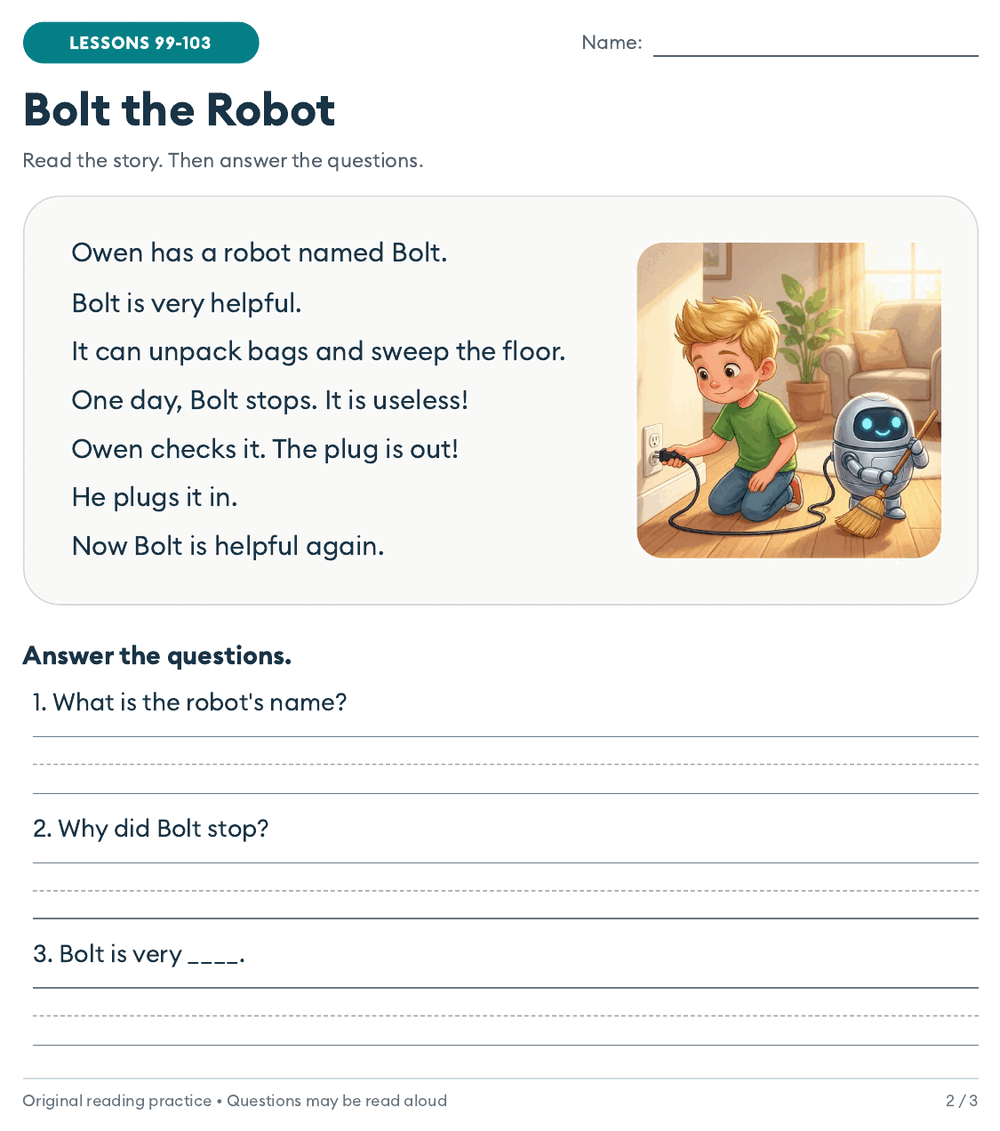
- A question about later in the story. “Who held the seat?” or, in Bolt the Robot, “Why did Bolt stop?” A why question means putting two lines together: Bolt stops, then Owen finds the plug is out.
- A fill-in line. “Before that, he had a ____.” Your child reads it alone, finds the word in the story and writes it.
The footer says the questions may be read aloud. The answer key counts any answer that matches the story, so “his dad” and “Dad held it” are both right.
Then ask one question that is not on the page: “How did Leo feel at first? How do you know?” 2nd graders are expected to describe how a character responds to what happens, and “How do you know?” sends them back to the words. Riding was terrible at first; after a week Leo rides with excitement, and the story says what changed.
Reading worksheets for 2nd graders: longer words, taught patterns
2nd grade stories are full of long words. Here, every long word is built from parts your child has been taught. Useless is use plus -less. Redraws is re- plus draws. Fireflies is fire, fly, and y changed to i. Bicycle and tricycle differ only in the prefix.
That helps comprehension too. A child who knows un- means “undo” can work out unpack. A child who knows -less means “without” knows a useless robot doesn’t work. Spelling them runs the other way: our second grade spelling words take one ending or prefix a week.
When a word is new, try this:
- Find the base word. Cover the prefix or ending with a finger.
- Read the base, then add the part. Excite, then excitement.
- Ask what it means. “Dis- in dislikes: does Ava like the legs?”
Is your child ready for these stories?
Many schools teach lessons 99-110 at the end of 1st grade and lessons 111-128 in 2nd grade. But your child’s reading is a better guide than their grade. Ask them to read these lines:
- “It is the slowest snail in the yard.” (PDF 17) If snail or yard is a struggle, vowel teams or bossy r are still shaky. Start with the first grade stories and come back in a few weeks. If only slowest is hard, start at PDF 17: the -est ending is what it teaches.
- “Clair and her dad go on a sleigh ride.” (PDF 19) If the PDF 17 line was easy but Clair or sleigh stops them, start at PDF 17 and work through PDF 18.
- “After a week, Leo rode it with excitement.” (PDF 20) If only this line is hard, start at PDF 19. If it is easy too, start at PDF 20.
The right level is a story your child reads with one or two stumbles. Go back one PDF if every line is a fight.
Questions parents ask
Do I need UFLI to use these? No. Many schools use that lesson order, and lessons 99-128 are its prefixes, suffixes and later spellings. If your child’s program differs, use the placement check.
My child reads the story well but can’t answer the questions. What now? Slow the reading down. Stop after every two sentences and ask, “What just happened?” Reading the words and following the story are two skills, and the second grows with practice.
Does my child have to write the answers? No. Saying the answer counts. If your child writes, a short answer is enough; the key accepts any answer that matches the story.
Is there phonics practice for the earlier patterns? Yes. If the placement check sends your child back, there are free phonics worksheets by lesson number up to lesson 98.
Who made the stories and pictures? Stories and questions are written by us. Illustrations are made with an AI image tool and checked by hand.
Your plan for this week
- Find the level: read the three placement lines and pick a PDF.
- One story over three days: read, reread and answer, retell.
- Cover the picture on the first read, so your child reads the words.
- Read questions 1 and 2 aloud; your child reads the fill-in line.
- Ask one “how do you know?” question that is not on the page.
- Need more? The printables library has more free phonics sheets by pattern.
Our reading games cover kindergarten and 1st grade skills, handy for review. Stories are read aloud and every word lights up as it is read, with no ads.
Created to align with UFLI’s scope and sequence; lesson numbers are cited for alignment only. These stories and PDFs are our own original work, not created by nor endorsed by UFLI or the University of Florida.
