 Luvinci
September 24, 2026
Number Line to 20: Free Printable 0-20 Number Line (PDF)
Free printable · PDF · 673 KB
Number Line to 20: Free Printable 0-20 Number Line (PDF)
No signup needed. Just print it.
Download PDFOur number line to 20 starts at 0 and runs to 20 in equal hops. Taller marks sit at 5, 10, 15 and 20 so your child can find a number fast. Each number is how many hops it is from 0, which makes a number line a good tool for counting on and counting back.
You’ll find 10 pages in the free number line to 20 PDF: a 0-20 line for the fridge, a number path over a number line, hop forward, hop back and hop up pages, a fill-in line, a blank number line to 20, a 0-10 page, a desk strip to cut out and tape together, and a Race to 20 board game. You don’t need to sign up or leave an email.
Need lines with no numbers on them? Our blank number line templates have 5, 10 and 20 spaces. For counting to 20 in rows, see the number chart 1-20.
Jump to: the free PDF · 0-20 or 1-20 · path or line · counting on · counting back · fill-in lines · number line to 10 · Race to 20 · activities
Free number line to 20 printable PDF
All 10 pages are landscape, US Letter. Here’s what’s on each one:
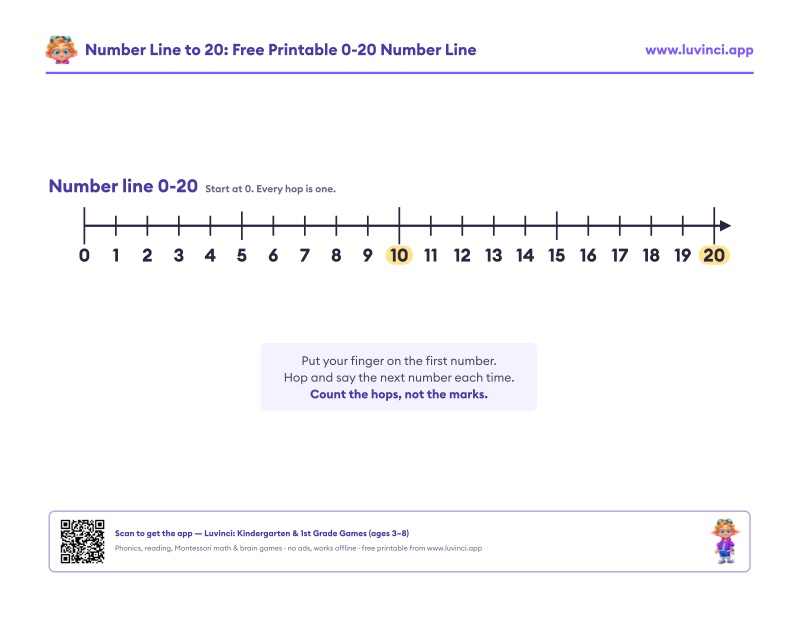
- Number line 0-20 (page 1). One big line, no cutting. The page for the fridge, and the answer key for pages 6 and 7.
- Number path and number line (page 2). Boxes 1 to 10 and 1 to 20 sitting right on top of a number line, so each box lines up with one hop.
- Hop forward (page 3). One worked example and three to try.
- Hop back (page 4). Taking away by hopping back. One worked example, three to try.
- Hop up (page 5). How many more: start on the small number and count the hops to the big one.
- Fill in the number line (page 6). Three lines, easiest first. Check with page 1.
- Blank number line to 20 (page 7). 21 tick marks with only 0 and 20 printed.
- Number line 0-10 (page 8). A big 0-10 line, two hop problems and a blank 0-10 line.
- Desk number line to cut out (page 9). Two strips, 0 to 10 and 10 to 20, that tape into one line about 16 inches long.
- Race to 20 board game (page 10). A straight board in two halves, two paper-clip spinners and the rules.

Page 1: the 0-20 line. 10 sits halfway, on a taller mark.
Print landscape. The light colors print fine in black and white. Slide pages 3 to 8 into a sheet protector and you have dry-erase pages. Use cardstock for pages 9 and 10 if you have it.
Number line 1-20 or 0-20? Why ours start at 0
Many number lines online, and some in classrooms, start at 1. Ours start at 0. A number line measures. Each number is how many hops it is from 0. 1 is one hop from the start, so 0 has to be there.
A number chart or a number path counts things instead. Box 1 is the first box, so a chart starts at 1, like our number chart 1-20.
A printable number line 1-20 isn’t wrong, though. A number line can show just a piece of the line. A 1-20 line still has 0. It’s just off to the left. If your child’s class uses a 1-20 line, that’s fine. Point to where 0 would be, one hop to the left of 1.
Where is 10? On a line from 0 to 20, it’s exactly halfway, on a taller mark.
Number path or number line? Kindergarten and 1st grade
- A number path puts each number in a box. Each box counts one thing.
- A number line puts each number on a mark, and the spaces between the marks are what you count.
The Progressions (notes from the writers of the Common Core standards) explain that early childhood materials “often may use a number path in which numbers are put on shapes such as circles or squares”, and that “this is a count model, not the measurement model.”
In US schools, the number line itself is a 2nd grade topic. Kindergarten and 1st grade build what it needs first: counting forward from any number, then adding and subtracting within 20 by counting on. Some states start sooner: Florida puts 0 to 20 on a number line in kindergarten. (Common Core 2.MD.6, K.CC.2, 1.OA.5-6; Florida MA.K.NSO.2.3.)
At home, start on the path. Our addition for kindergarten and subtraction for kindergarten PDFs each have a 0-10 path page for stepping box by box (it adds a 0 box to start on, like a game’s Start square). Stay on the path until your child counts hops, not marks. Then move to the line. Page 8’s 0-10 line, with its wide spaces, is a good first line.
Page 2 joins the two. The boxes sit right on the line, so box 5 ends exactly where the line says 5.
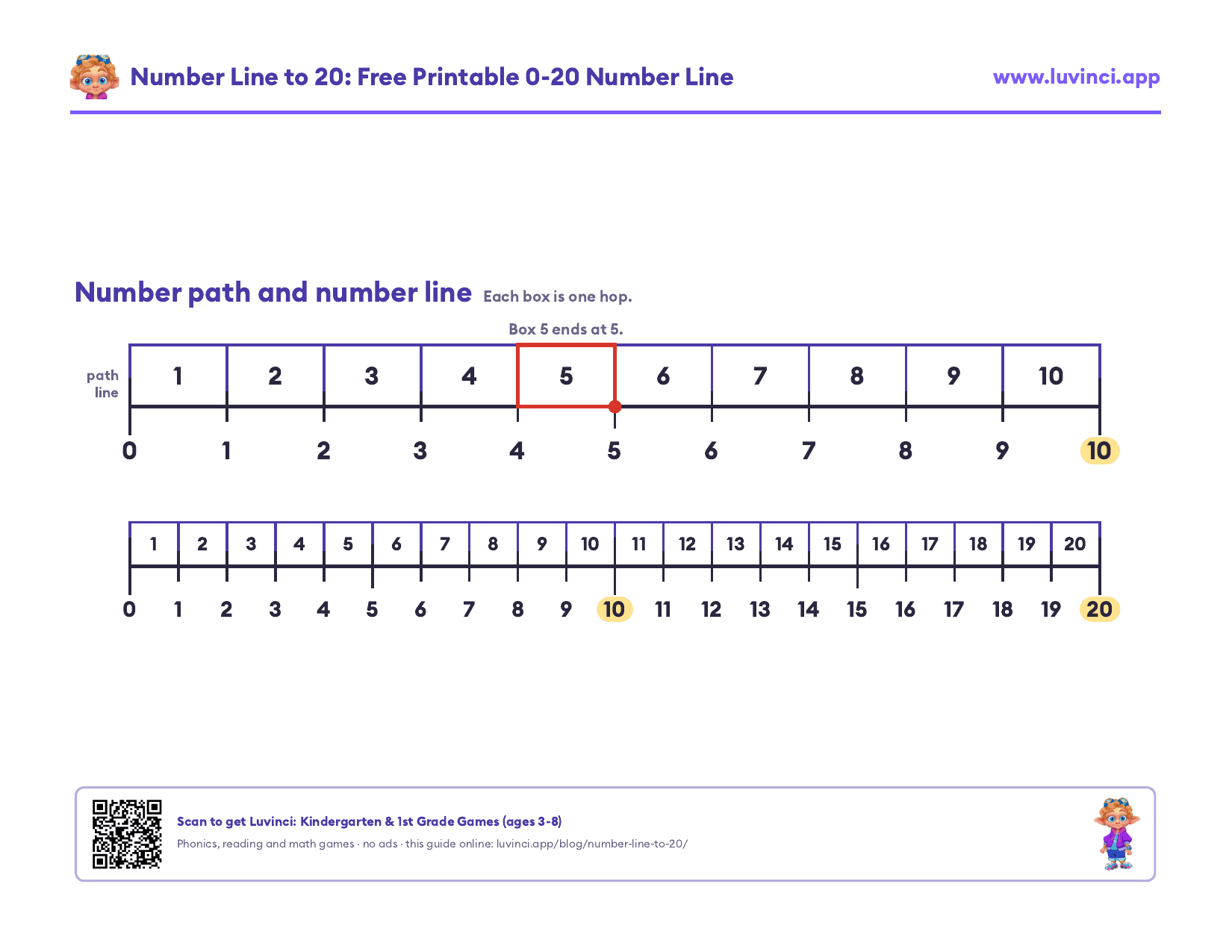
Page 2: box 5 ends where the line says 5.
Counting on a number line: count the hops, not the marks
This is how to use a number line for adding. Take 8 + 3.
Put a finger on 8. Think eight, or say it softly. That is where you start, not a hop. Then hop and say a number on each landing: nine, ten, eleven. 8 + 3 = 11.
Where you land is the answer. The hops are the count.
The usual mistake is counting the start mark. A child puts a finger on 8 and says “eight, nine, ten”, lands on 10 and answers 10, one short. The Progressions describe the same mix-up: children “count the 0 and the other numbers or the marks instead of counting the length units.” Eight is where you start, not a hop.
- Start with +1, +2 and +3. Small hops are easy to track.
- Put the bigger number first. 2 + 9 is easier as 9 + 2: two hops instead of nine. Our counting on section explains counting all and counting on.
- Draw the hops. Page 3’s worked example draws an arc for each hop. Have your child draw one for each hop on the lines to try.
Some classes call these frog hops.
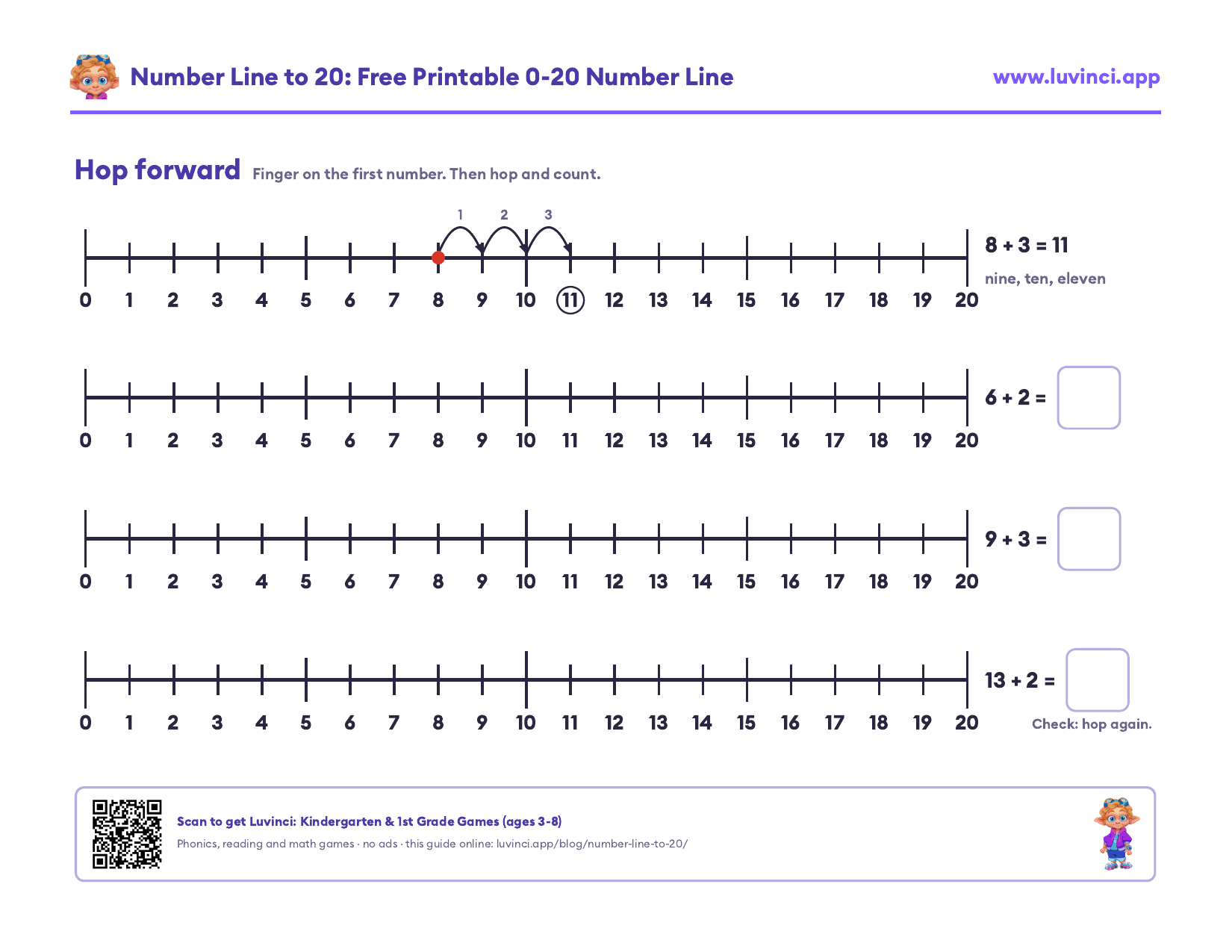
Page 3: finger on 8, then hop: nine, ten, eleven.
Counting back on a number line (and hopping up)
Hop back to take away. For 12 − 3, put a finger on 12. Then hop back and say a number on each landing: eleven, ten, nine. 12 − 3 = 9. Counting back works best for taking away 1, 2 or 3, as in our counting back section.
Page 5 hops up instead: start on the smaller number and count the hops to the bigger one.
Draw an arrow on each hop. The arrowhead shows which way your child went, left on page 4 and right on page 5. Ready for bigger numbers? See number line addition and subtraction.
Fill-in lines and a blank line to 20
Page 6 has three number lines with some numbers hiding. Line 1 has three boxes to fill, line 2 has six, and line 3 only shows 0, 5, 10, 15 and 20. Your child counts from 0, or from the nearest taller mark, to find each one. Florida’s kindergarten standard describes the same skill: filling in missing numbers on a number line by counting from left to right. Check with page 1.
The write boxes take turns above and below the line, so every box is big enough for a two-digit number. Each box sits right over or under its own tick mark.
For missing numbers on a chart instead, our number chart has a missing numbers 1-20 page with three strips.
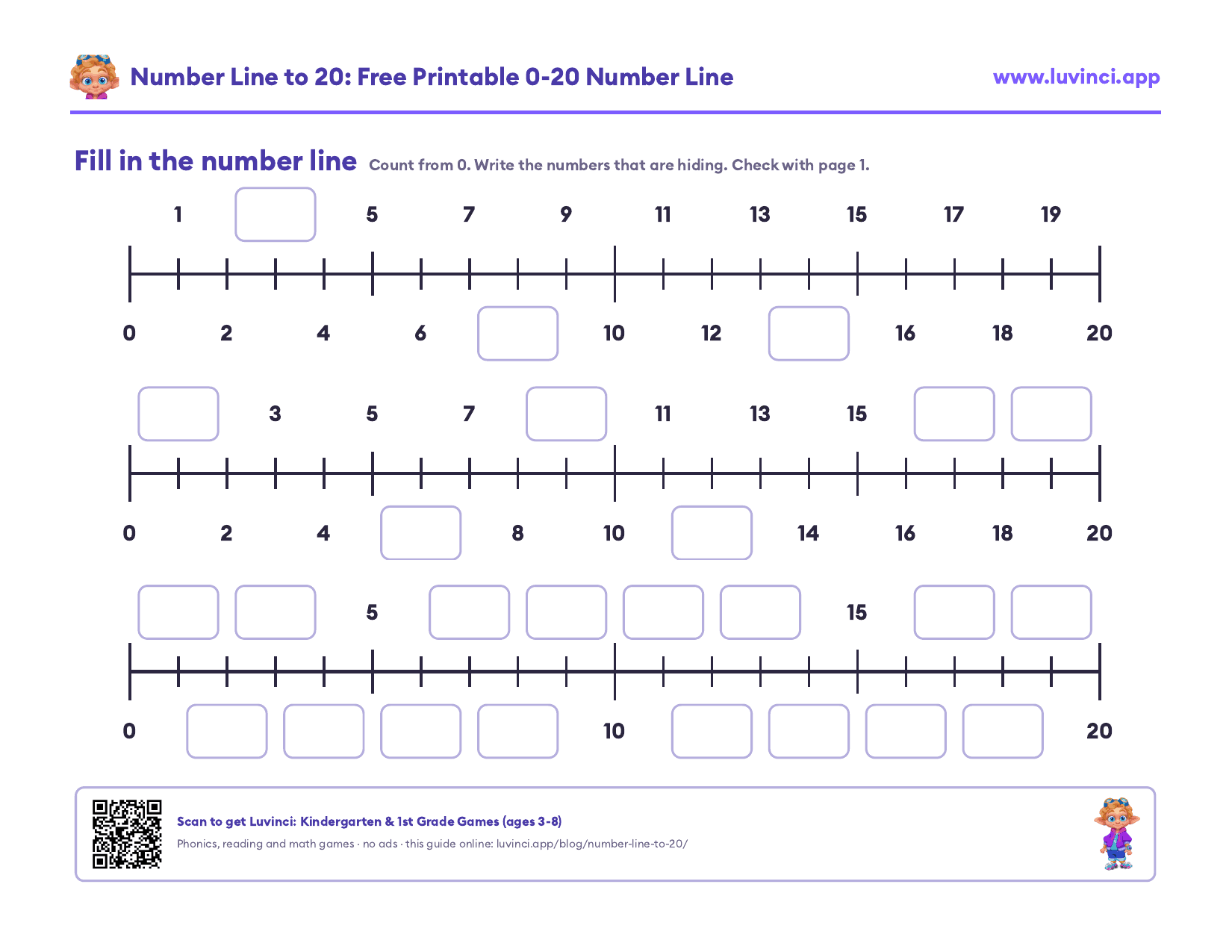
Page 6: count from 0, then fill in the boxes.
Page 7 is a blank number line to 20. It has 21 marks with only 0 and 20 given. Your child writes in 1 to 19 on the first two lines. The third line has no boxes, for more hop problems.
For lines with no numbers at all, use our blank number line templates.
Number line to 10 (0-10)
A number line to 10 is the place to start. On page 8 the spaces are twice as wide as the 0-20 line, 22 mm, almost an inch, so small fingers can land on one number at a time.
Many 1-10 number lines skip 0. As above, 0 is just off to the left.
Page 8 has three parts:
- A big 0-10 line with the numbers printed, and a taller mark at 5.
- Two hop problems on 0-10 lines: 3 + 2 (hop forward) and 9 − 3 (hop back).
- A blank number line to 10, with only 0 and 10 printed and a box under each other mark.
Stay on the 0-10 line until your child can hop without counting the start mark. Then move on to page 3.
Race to 20: a number line board game
In a well-known set of studies, preschoolers who played a simple race game on a straight 1 to 10 board, saying each number as they moved, got better at placing numbers on a number line (Siegler & Ramani, 2008; Ramani & Siegler, 2008). A straight board worked better than a circular one (Siegler & Ramani, 2009). A 2025 review of 18 studies found a real but modest benefit, so think of it as good practice, not a shortcut (Nelson et al., 2025).
Page 10 is our version, from Start to 20. The board is made of squares, so it’s really a number path, the step before the line.
Cut out both halves, lay the pale 10 on square 10, then tape.
How to play:
- Each player puts a button or a dried bean on Start.
- Take turns: spin, then move that many squares.
- Say the number on each square as you move. If you’re on 6 and spin 2, say “seven, eight.”
- The first one to reach 20 wins. You don’t need an exact spin.
Pick a spinner. For kindergarten, use the 1-or-2 spinner. For 1st grade, use the 1-2-3 spinner. To spin, hold a small paper clip in the middle with a pencil tip and flick it. Buttons and beans are small, so play with an adult.
Keep the board straight, never a snake or a circle. That’s what the studies used. When 20 is easy, the Count-On Race on our hundreds chart page goes further.
Number line activities
Five short ones. Each takes 5 minutes or less:
- Floor number line. Put painter’s tape on the floor and mark 0 to 10, or 0 to 20, one step apart. It’s the Hop and count activity with numbers added.
- Desk strip. Tape the page 9 strip to the table for checking sums.
- What’s my number? Cover a number on page 1 with a sticky note. Your child names it from its neighbors: “It comes after 13 and before 15, so it’s 14.”
- Which is bigger? Put two fingers on the line, one on each number. The one further right is bigger.
- Landmarks. “Find 10, then hop back 1.”
FAQ
What is a number line in kindergarten?
A number line is a straight line with numbers on evenly spaced marks, starting at 0. Kindergartners often count on a number path (numbers in boxes) first, then move to a 0-10 line. The standards differ. Common Core saves number line diagrams for 2nd grade, while Florida puts 0 to 20 on a number line in kindergarten.
Should a number line start at 0 or 1?
A number line starts at 0, because each number is a count of hops from 0. A number chart or a number path starts at 1, because it counts boxes. A number line can show just a piece of the line. A 1-20 line still has 0, off to the left. For charts, see should a hundreds chart start at 0 or 1.
Where is 10 on a number line to 20?
Exactly halfway. On our lines it sits on a taller mark, with yellow behind it on page 1.
How do you explain a number line to a child?
Call it a road of numbers. You start at 0, and each hop along the road is one more. The number you land on tells you how many hops you’ve made since 0.
Is a number line the same as a number chart?
No. A number chart puts the numbers in boxes, in rows, and counts the boxes. A number line puts the numbers on marks along one straight line, and you count the spaces. See our number chart 1-20 for the chart.
What comes after 20?
21. The numbers keep going the same way: 21, 22, 23, all the way to 100 and past it. To count past 20, a hundreds chart shows every number to 100 in rows of ten. To keep going on a line, use our number line to 100.
The takeaways
- A number line starts at 0, because every number is a count of hops from 0.
- Count the hops, not the marks. Finger on the first number, then hop and count.
- Kindergarten often starts on a number path, then moves to the line.
- Hop back to take away, hop up to find the difference. Keep it to 1, 2 or 3 hops at first.
- A straight race game is good practice. Say each number as you move.
- Print the free number line to 20 PDF: a 0-20 line, a number path, hop pages, a blank line, a 0-10 page, a desk strip and Race to 20.
Number lines live on paper. The app’s math boards use pictures for counting, adding and taking away. The first counting board is free. See how Luvinci’s math games work.
More free math worksheets: ten frames, number charts, addition and subtraction, daily practice workbooks and more, all in one place. See the math printables →
