 Luvinci
October 11, 2026
Number Line Addition and Subtraction Worksheets (Free PDF)
Free printable · PDF · 829 KB
Number Line Addition and Subtraction Worksheets (Free PDF)
No signup needed. Just print it.
Download PDFFree worksheets (2)
Printable PDFs, no signup.
Number line addition and subtraction comes down to one move. You start on a number. Jump right to add, and jump left to take away. These free number line subtraction worksheets and addition pages begin with jumps to 10 for 1st grade, then finish on the open number line that many 2nd grade classes use.
Take 13 − 4. Start on 13 and jump back 3 to land on 10. Then jump back 1 more. 13 − 4 = 9.
Everything is in one free number line addition and subtraction worksheets PDF of 10 pages. It has a matching page, a color by answer page, jump to 10 pages, subtraction pages, open number line pages, a jump chart and an answer key. No signup, no email. The board game and the dry-erase mat with task cards are separate free PDFs.
If number lines are still new, begin with the hop pages in our number line to 20, then come back here.
Jump to: the worksheets · what 1st and 2nd grade expect · addition · subtraction · open number line · the game · mistakes · FAQ
Free number line addition and subtraction worksheets PDF
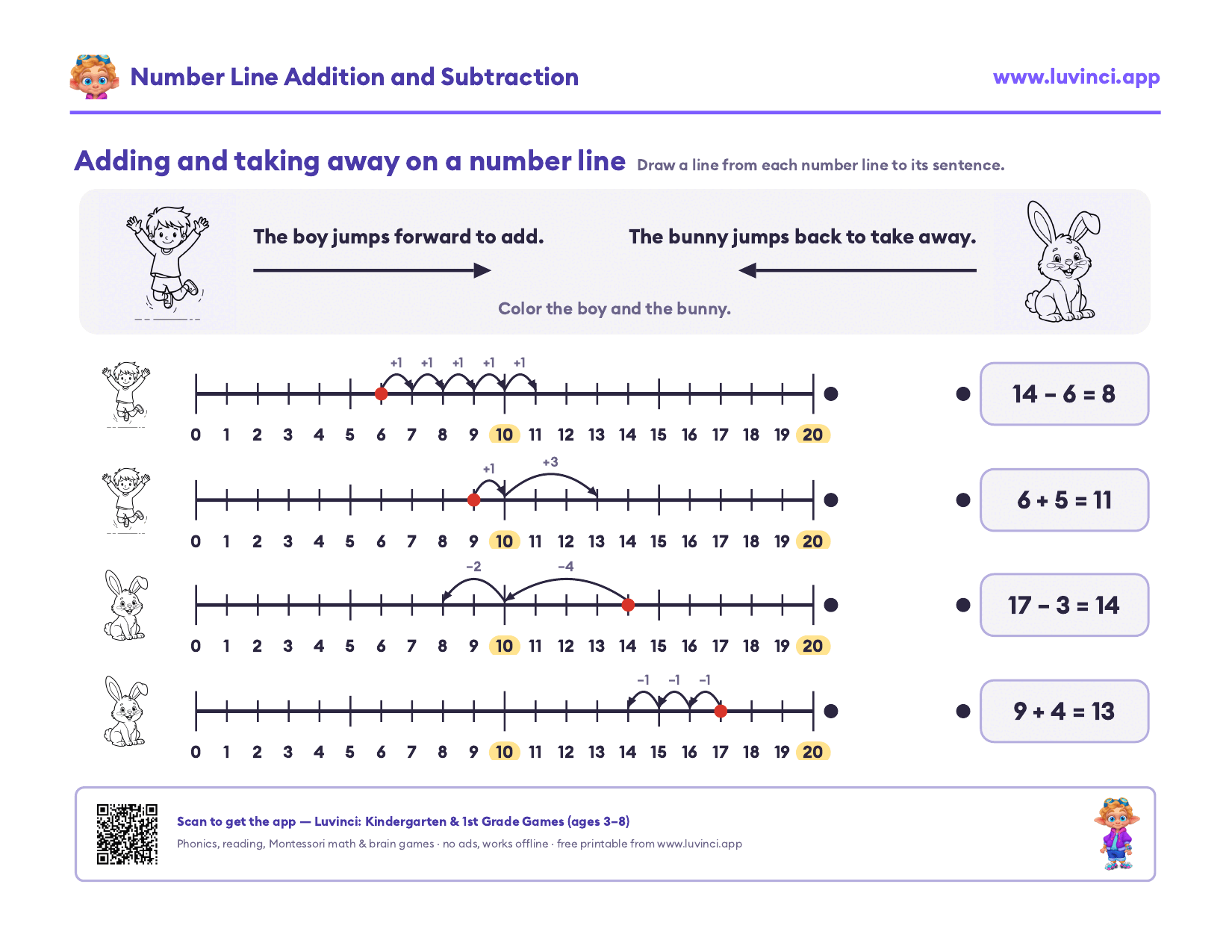
Page 1: jump forward to add, jump back to take away.
A page a day, in order, takes about 10 minutes, and that is plenty. The answer key is page 10. All 10 pages are landscape, US Letter.
- Page 1. Adding and taking away on a number line. Draw a line from each set of jumps to its number sentence, then color the boy and the bunny.
- Page 2. Color by answer: add and take away within 10. Solve each box and color a tree on a hill under a sun and a cloud.
- Page 3. Jump to 10 to add. One done for you and three to try, each with a sentence to fill in.
- Page 4. Jump to 10 to take away. The same steps, jumping back.
- Page 5. How far apart? Count up. Start on the smaller number and add up the jumps.
- Page 6. Jump back or count up? One done for you, then four subtraction rows. The picture at the start of each row tells your child which way to go.
- Page 7. Open number line: add the tens, then the ones. One done for you, one with the jumps printed, one to draw.
- Page 8. Open number line: jump back or count up. Taking away tens and ones, and one count up.
- Page 9. Three ways to jump. A no-cut chart for the fridge with the same examples as this post.
- Page 10. Answer key, every answer as a whole fact.
Pages 1 to 6 stay within 20. Pages 7 and 8 use the open number line within 100.
Print these landscape. The colors stay light, so the pages print fine in black and white.
Number line addition and subtraction: what 1st and 2nd grade expect
In 1st grade, children add and take away within 20 by counting on and counting back. They learn to jump to 10 first, so 8 + 5 becomes 8 + 2 + 3. They also learn to add 10 to a number in one jump, without counting by ones.
In 2nd grade, the numbers get bigger. Children add and take away within 100 and show how they did it, often on a number line. They jump in tens and ones, so 46 + 23 becomes 46, 56, 66, 69.
The open number line is a classroom tool, not a standard. Many 2nd grade classes use it. It came from Dutch 2nd grade classrooms around 1990. There, a line with every mark printed kept children counting by ones. A line with no marks let them jump in tens.
Our other number line pages call them hops. Here we say jumps. Classes use both words.
So for 1st and 2nd grade, the order is the same as in the PDF. Jumps within 20 come first, then jumps to 10, then jumps of 10 on an open line. Your child’s class may use another name for the line. That’s fine. The moves stay the same.
Addition on a number line
Number line addition starts on the bigger number. Jump right to add. For 9 + 3, start on 9 and jump right 3 times. You land on 12. Where you land is the answer.
Count the jumps, not the marks. The number you start on is never a jump. Our number line to 20 walks through this start-mark mistake step by step.
Addition using a number line gets faster when the number line jumps get bigger. The next two moves do that.
Jump to 10 first
Take 8 + 5. Start on 8. Jump 2 to land on 10. 5 is 2 and 3, so jump 3 more to land on 13. 8 + 5 = 13.
That’s the make 10 strategy drawn as jumps. Your child knows 8 needs 2 to make 10, then adds what’s left. On a line, they can see 10 as a landing spot.
Jump to 10 whenever a sum goes past 10. With 9 + 4, jump 1 to 10, then 3 more. With 6 + 8, start on 8, the bigger number. Jump 2 to 10, then 4 more. For other ways to add within 20, like doubles, see our addition for first graders page.
Add 10 in one jump
34 + 10 = 44. Start on 34 and make one big jump of 10. You land on 44. Only the tens digit changes, from 3 tens to 4 tens.
Don’t count 10 ones for this. Ten little jumps go slowly, and one slip lands on the wrong number. Try 62 + 10 the same way. One jump lands on 72. Counting by 10s from any number is on our number line to 100. When one jump of 10 feels easy, your child is ready for the open number line below.
Number line addition worksheets
Page 1 matches jumps to their number sentences, page 3 jumps to 10, and page 7 adds tens and ones on an open number line. Pages 3 and 7 start with one done for you. Your child follows it on the rows below and fills in the boxes.
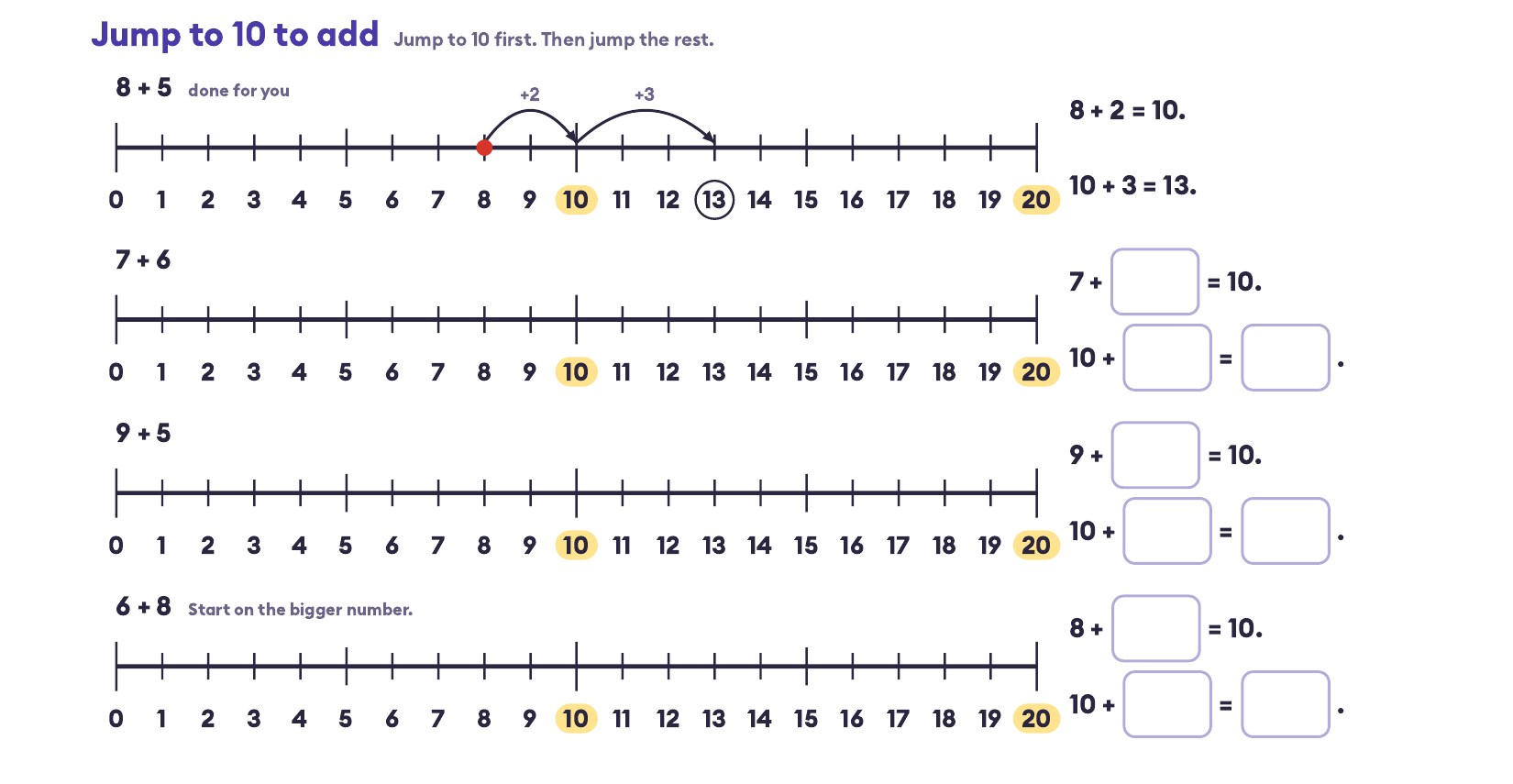
Page 3: jump to 10, then jump the rest.
Subtraction on a number line
Number line subtraction has two meanings, and both live on the same line. Taking away moves left. Finding how far apart two numbers are means counting up. Subtraction using a number line works both ways, so it helps to know which one a problem wants.
Take away: jump back
Take 13 − 4. Start on 13 and jump left. Jump back 3 to land on 10. 4 is 3 and 1, so jump back 1 more. You land on 9, so 13 − 4 = 9.
Jump left for every take-away. Ask your child to draw the arrowhead first, then the rest of the arc. The arrow tells which way they went before they count anything.
For taking away 1, 2 or 3, a plain count back works well. For 13 − 3, start on 13 and say one number on each landing. Twelve, eleven, ten. For bigger take-aways, jump back to 10 first.
How far apart? Count up and add the jumps
Take 15 − 8. Start on 8, the smaller number, and count up through 10. Jump 2 to land on 10. Then jump 5 to land on 15. Add the jumps. 2 + 5 = 7, so 15 − 8 = 7.
The answer is the jumps added up, not the number you land on. Say that part out loud. Your child lands on 15 and wants to write 15.
For most children, counting up is easier than counting back, because it feels like adding. Stop at 10 on the way, so the two jumps are easy to add. Our count up section in subtraction for first graders shows the same idea without a line.
Number line subtraction worksheets
Pages 4, 5 and 6 are the subtraction on a number line worksheets within 20, and page 8 takes them past 20. Page 4 jumps back to 10 first. Page 5 counts up from the smaller number. Page 6 mixes both. A bunny at the start of a row means take away. A “how far?” label means count up.
A page of only one kind teaches the steps. A mixed page makes your child pause and read each row first.
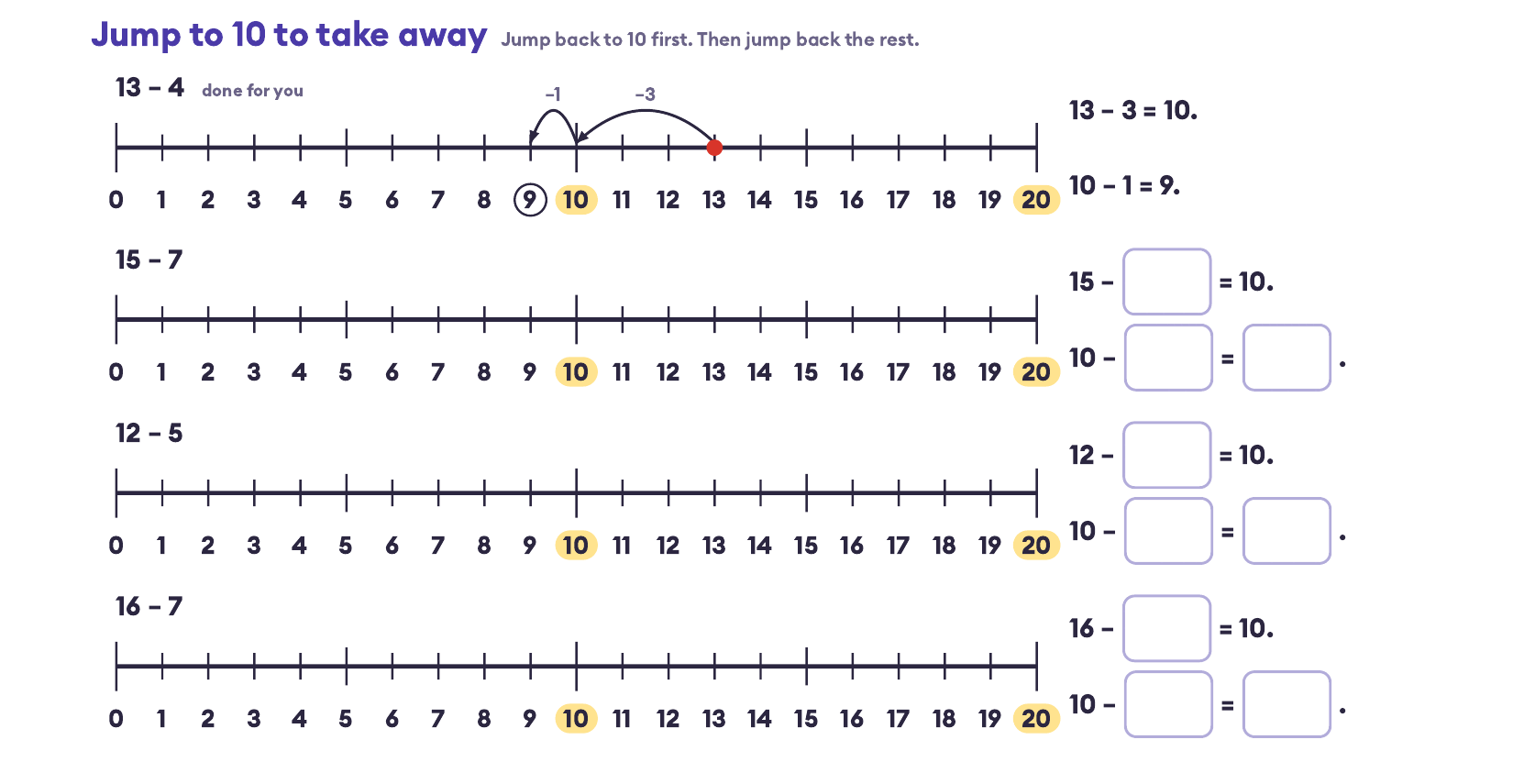
Page 4: back to 10 first.
Open number line: adding and subtracting within 100
An open number line is a line with no marks or numbers printed on it. Your child writes only the numbers they need and draws the jumps. Bigger jumps look bigger, so a jump of 10 is drawn longer than a jump of 3. The line does not need to be to scale. The numbers just have to stay in order, smaller on the left.
Some teachers call it an empty number line. For more lines with nothing printed in the middle, see our blank lines with ends only.
Jump the tens, then the ones
Take 46 + 23. Write 46 near the left end. 23 is 2 tens and 3 ones. Jump 10 to 56, then 10 more to 66. Then jump 3 to land on 69. 46 + 23 = 69. A child who is sure of the tens can make one big jump of 20 instead.
Keep the first number whole and jump the tens. The open number line is for that, and taking away works the same way.
Sometimes the ones go past a ten. Take 48 + 6. Jump 2 to land on 50, then 4 more to land on 54. On paper, that step is written in columns. See our 2-digit addition with regrouping guide.
Jump back on an open number line
Take 68 − 25. Write 68 near the right end. Jump back 10 to 58, back 10 again to 48, then back 5 to land on 43. 68 − 25 = 43. That’s open number line subtraction, tens first and then the ones. Open number line addition works the same way, just to the right.
Counting up is quickest when the two numbers sit close together. Take 43 − 38. Taking away 38 would be four long jumps. Instead, start on 38 and count up. 38 to 40 is 2. 40 to 43 is 3. 2 + 3 = 5, so 43 − 38 = 5.
Comparing word problems are count up problems too. Our subtraction word problems show how a “how many more” question becomes a count up.
Open number line worksheets and a dry-erase mat
Page 7 adds tens and ones. Page 8 jumps back and counts up. Each starts with one done for you, then a row with the jumps printed and landing boxes to fill in, then one your child draws alone. For more practice, our free open number line mat is its own 2-page PDF. Page 1 is a mat to laminate. Page 2 has 24 task cards to cut out, with the answers upside down at the bottom. None of the cards needs a new ten, so the jumps stay simple.
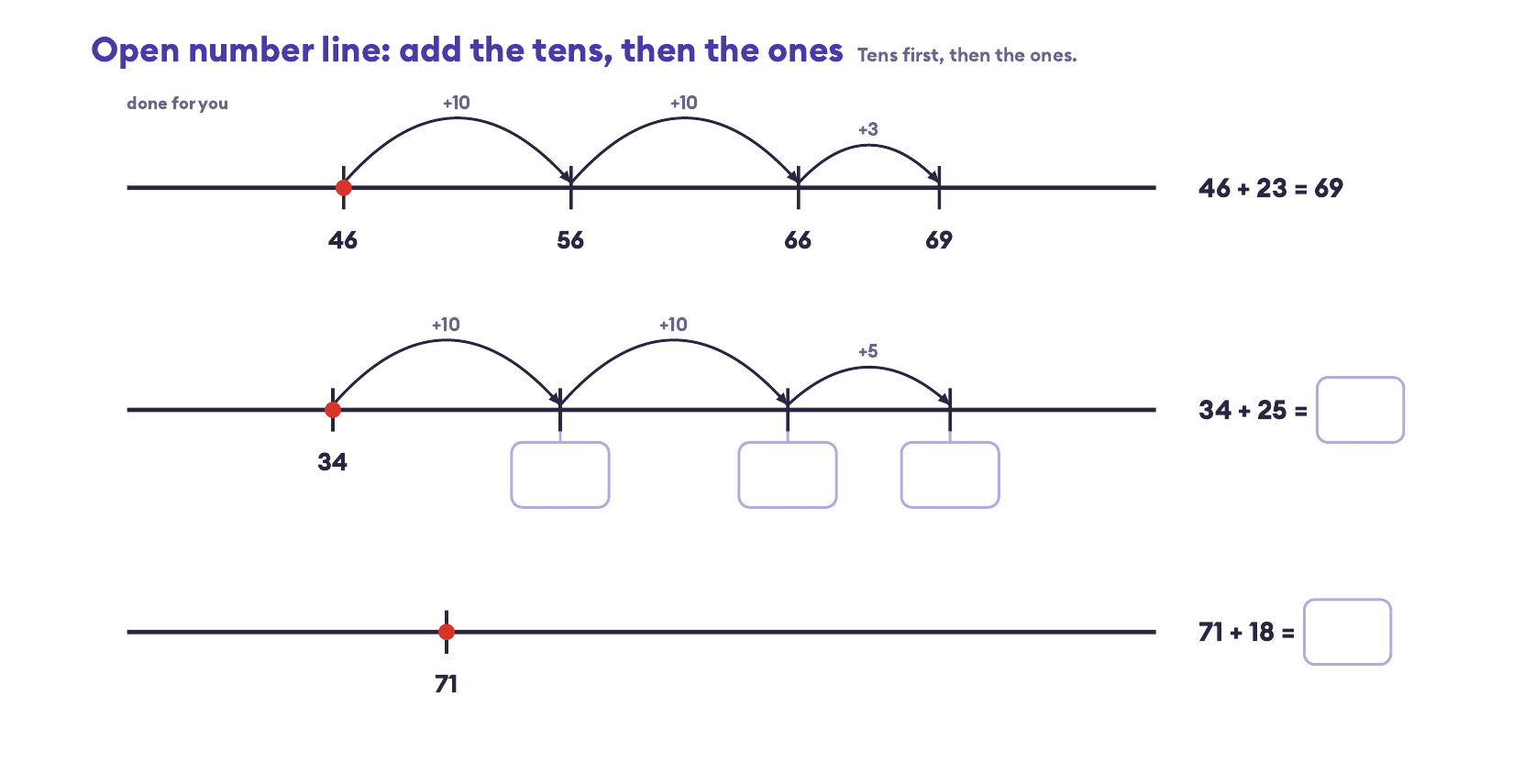
Page 7: tens first, then the ones.
When jumps of 10 are easy, your child is ready for the written way.
Stars and Puddles: jump on, jump back
Our free Stars and Puddles game is its own 2-page PDF. It practices jumping to the next 10, both forward and back, and saying the number sentence out loud. Page 1 has the spinner and the rules. The board on page 2 comes in two halves. Once the two halves are taped, the board is one straight line, 0 at one end and 30 at the other.
These are the rules as printed on page 1.
- Players: 2 or 3, with an adult. The board on page 2, a paper clip, a pencil and a button or a dried bean for each player.
- Spin. Jump your button forward that many and say the number sentence, like “4 + 2 = 6”.
- Star or puddle? A star jumps you on to the next 10. A puddle sends you back to the 10. Say it, like “13 − 3 = 10”.
- Win. The first to reach 30 wins.
- Tip: Count the jumps, not the marks.
To spin, hold a paper clip in the middle of the spinner with a pencil tip and flick it. Buttons and beans are small. Play with an adult.
Common number line mistakes
| Mistake | What it looks like | Quick fix |
|---|---|---|
| Counting the start mark | 7 + 3 counted “seven, eight, nine”, answer 9 | Finger on 7 and say it softly. Then say one number per landing. Count the arcs, not the marks. |
| Jumping the wrong way | 12 − 5 jumps right and lands on 17 | Take away goes left. Draw the arrowhead first. |
| Reading the landing as the count-up answer | 52 − 47 counted up, answer 52 | Add up the jumps. 3 + 2 = 5. |
| Adding up the jumps on a take-away | 15 − 7 jumped back 5, then 2, writes 7 | When you take away, the answer is where you land. 8. |
| Jumping 10 by ones | 62 + 10 drawn as ten little jumps, lands on 71 | One jump of 10. 62, 72. |
| Numbers out of order, or a jump of 10 drawn shorter than a jump of 2 | 50 written left of 40 | Numbers grow to the right. Bigger jumps look longer. |
| Staying on the line too long | A 3rd grader still drawing every jump of 1 | Once jumps of 10 are easy, move to the written way. |
More free math pages, each with its own free PDF:
FAQ
How do you use a number line for subtraction?
There are two ways. To take away, start on the first number and jump left. To find how far apart two numbers are, start on the smaller one, jump right to the bigger one and add up the jumps.
Which way do you jump for subtraction?
Jump left when you take away. Jump right when you count up from the smaller number, and then the answer is the jumps, not where you land.
How do you subtract on a number line in 2nd grade?
On an open number line, start on the bigger number and jump back the tens, then the ones. 68 − 25 is back 10, back 10, then back 5, landing on 43. When the numbers are close, count up instead.
How do you add 13 and 15 on a number line?
Start on 15, the bigger number. Jump 10 to 25, then 3 more to 28. Or start on 13, jump 10 to 23, then 5 more to 28.
Why does homework use a number line instead of the column way?
The jumps show the size of each step, so your child sees why 46 + 23 is 69. Adding tens without counting by ones is the big idea of 2nd grade. The column way comes next, once jumps of 10 are easy.
When should my child stop using a number line?
When jumps of 10 are automatic and your child can add or take away 10 without counting, move on to the written way. The line stays handy for checking.
The takeaways
- Add: jump right. Take away: jump left. Where you land is the answer. When you count up, the answer is the jumps.
- Count the jumps, not the marks. The start number is never a jump.
- Jump to 10 first when a sum or a take-away crosses 10.
- Count up and add the jumps to find how far apart two numbers are. It is quickest when they are close.
- On an open number line, jump the tens, then the ones, and move to the written way once that is easy.
- Print the free number line addition and subtraction worksheets: jump to 10 pages, open number lines for 1st and 2nd grade, a jump chart and an answer key. 10 pages, no signup.
- Play the Stars and Puddles game. Stars jump you on to the next 10. Puddles send you back.
- Laminate the open number line mat and work through its 24 task cards.
Number lines happen on paper. Page 2’s facts, like 7 + 3 and 8 − 4, also live in the app, on its Singapore Math boards. There, an adding fact shows as two ten frames of pictures, and a take-away is one ten frame with the taken-away pictures crossed out. Those boards are in the full app. The first counting board is free. See how Luvinci’s math games work.
Sources
- Common Core State Standards for Mathematics (2010): 1st grade 1.OA.5, 1.OA.6, 1.NBT.4 and 1.NBT.5; 2nd grade 2.NBT.5, 2.NBT.7 and 2.MD.6.
- Progressions for the Common Core State Standards in Mathematics: Counting and Cardinality and Operations and Algebraic Thinking, K-5; Number and Operations in Base Ten, K-5; Geometric Measurement, K-5.
- Klein, A. S., Beishuizen, M., & Treffers, A. (1998). The empty number line in Dutch second grades: Realistic versus gradual program design. Journal for Research in Mathematics Education, 29(4), 443-464.
More free math worksheets: ten frames, number charts, addition and subtraction, daily practice workbooks and more, all in one place. See the math printables →
