 Luvinci
October 11, 2026
Number Line to 100: Free Printable 1-100 Number Line (PDF)
Free printable · PDF · 697 KB
Number Line to 100: Free Printable 1-100 Number Line (PDF)
No signup needed. Just print it.
Download PDFFree worksheets (2)
Printable PDFs, no signup.
Our number line to 100 starts at 0 and runs to 100 in equal hops. The tens are the big landmarks, and a taller mark sits at every 5, so your child can find 47 without counting from 0. A number line to 100 is where 1st graders hop by 10s and place numbers, and where 2nd graders see how far apart two numbers are.
Everything is in one free number line to 100 PDF of 8 pages. It has frog hops by 10s on a 0-100 line, a where-does-it-go matching page, fill-in rows, hops by 10s and 5s, a number line to 50, strips that tape into a line about 1 meter long, a 1-100 line and an answer key. No signup, no email. The number line puzzle and the Hop to the Pond board game are separate free PDFs.
If 0 to 20 still takes some counting, begin with our number line to 20 and come back.
Jump to: the free PDF · 1-100 or 0-100 · how to read it · finding numbers · by 10s and 5s · number line to 50 · puzzle · a long line · Hop to the Pond · at home · mistakes · FAQ
Free number line to 100 printable PDF
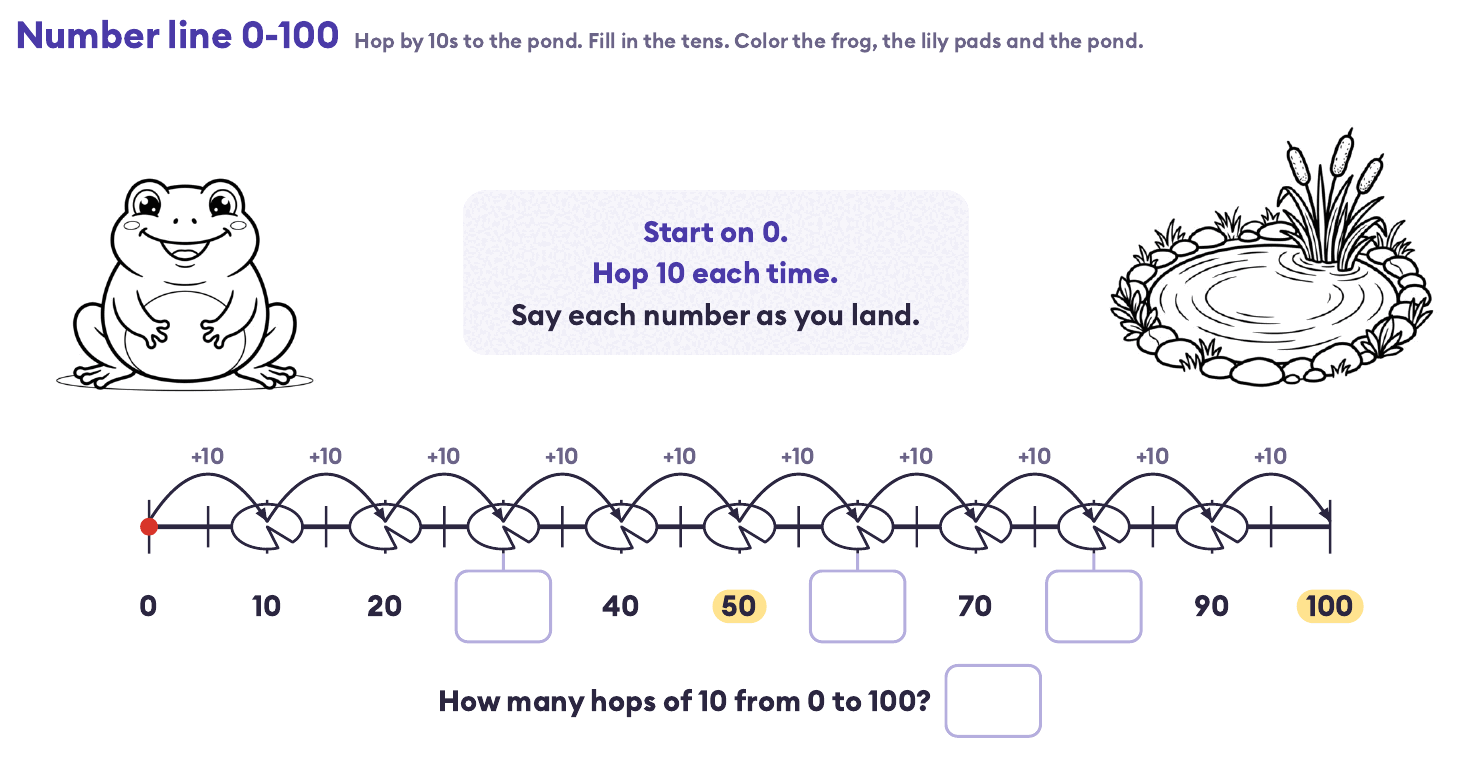
Page 1. A number line by tens. The frog hops by 10s from 0 to the pond.
All 8 pages are landscape, US Letter. Here’s what each page covers, and who it suits.
- Page 1. Number line 0-100. A frog hops by 10s on lily pads to the pond. Your child fills in 30, 60 and 80, then colors the picture. 1st grade.
- Page 2. Where does it go? Lines with only 0 and 100 printed. Your child matches each number to its arrow. 1st and 2nd grade. Row 3 is a 2nd grade stretch.
- Page 3. Fill in the number line to 100. Three rows, 20-40, 50-70 and 80-100, easiest first. 1st grade.
- Page 4. Number line by 10s. Hops of 10 forward from 27 and back from 94. Rows 1 and 2 are 1st grade. Rows 3 and 4 give only a start dot, a 2nd grade stretch.
- Page 5. Number line to 50. Two rows to read and a line for hops of 5. 1st grade.
- Page 6. Big number line to 100. Five strips that tape into one line about 1 meter long. 1st grade.
- Page 7. Number line 1-100. Four rows from 1 to 100, with 0 shown just left of 1. It’s also the page for checking.
- Page 8. Answer key.
If you came for a plain printable number line 1-100, it’s page 7.
Print landscape, at 100%. Page 6 has to print at actual size to make a line about 1 meter long, so turn off “fit to page”. Laminate page 7, or slide it into a sheet protector, for dry-erase hops. Page 8 has the answers.
Number line 1-100 or 0-100? Both are in the PDF
Many number lines start at 1. Ours start at 0, for the same reason our 0-20 line starts at 0. A number on the line tells you how many hops it is from 0. 1 is one hop from the start. If the line starts at 1, that first hop stays hidden.
Plenty of classes still use a 1-100 line, and that’s fine. Page 7 has the 1-100 template look you see in classrooms. It’s a number line 1 to 100 in four rows of 25. We kept a small gray 0 just left of 1. A 1-100 line is just a piece of the line. 0 is still there, off to the left.
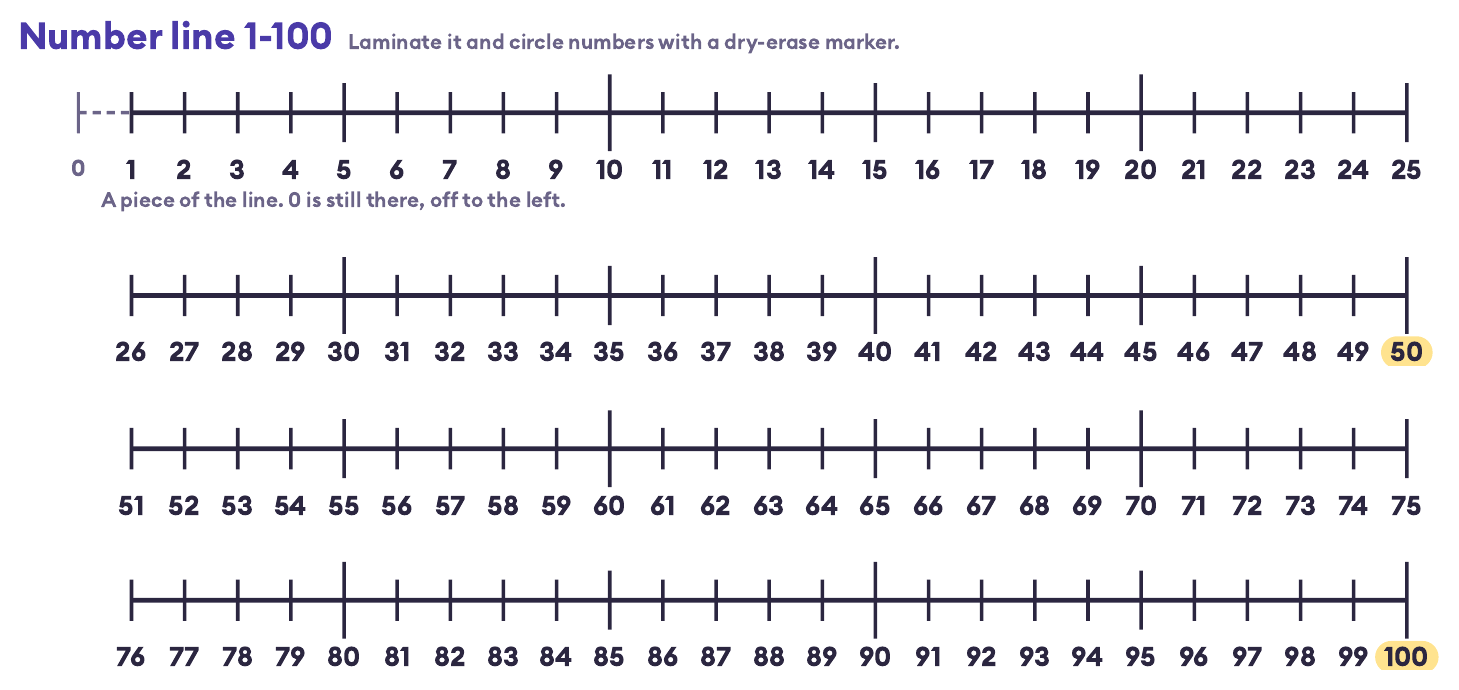
Page 7. A 1-100 line with its 0 kept in gray.
How to read a number line to 100
Read the labels first. If they go 0, 10, 20, each tall mark is a ten. On our lines the tens are the tallest marks, the fives are middle marks and the ones are the small marks.
50 sits halfway. Bigger numbers sit further right. A number like 47 lives between 40 and 50, closer to 50. Find the ten first, then count the ones.
Page 3 practices this on fill-in rows at three levels. The first row hides four numbers. The second hides nine. The last shows only the fives. Your child counts on from the nearest number they can see, then checks with page 7. If you’d rather make your own line, here is how to label your own line by tens.
In 1st grade, children count to 120 from any number and find 10 more or 10 less without counting. In 2nd grade, they show numbers as distances from 0 on a number line, and show sums and differences within 100 on it. In 3rd grade, the same line helps with rounding to the nearest ten.
So a 100 number line earns its spot on the wall for three school years. Some teachers call it a hundreds number line.
Where does 37 go? Finding numbers on the line
Draw a line with 0 at one end and 100 at the other. Nothing else. Where does 50 go? 25? 90? 37?
That is page 2. Each row is a number line 0 to 100 with only the ends printed. Your child draws a line from each number bubble to its arrow. Row 1 has a mark at every 10, so it’s easy. Row 2 has one middle mark. Row 3 has none. Row 4 asks your child to draw their own arrows for 70 and 15.
Why take five minutes for this? Children who place numbers well on a 0-100 line tend to do better in math. That’s a pattern, not proof that the page makes them better. It is still a quick way to see how your child pictures the numbers.
Kindergartners often squash the big numbers together at the right end. 50 lands near 100. By 2nd grade most children space them more evenly. A good fix is to mark 50 halfway first, then 25 and 75. After that, 37 is easy. It sits between 25 and 50, near the middle of that gap.
These number line to 100 worksheets work for 2nd grade too.
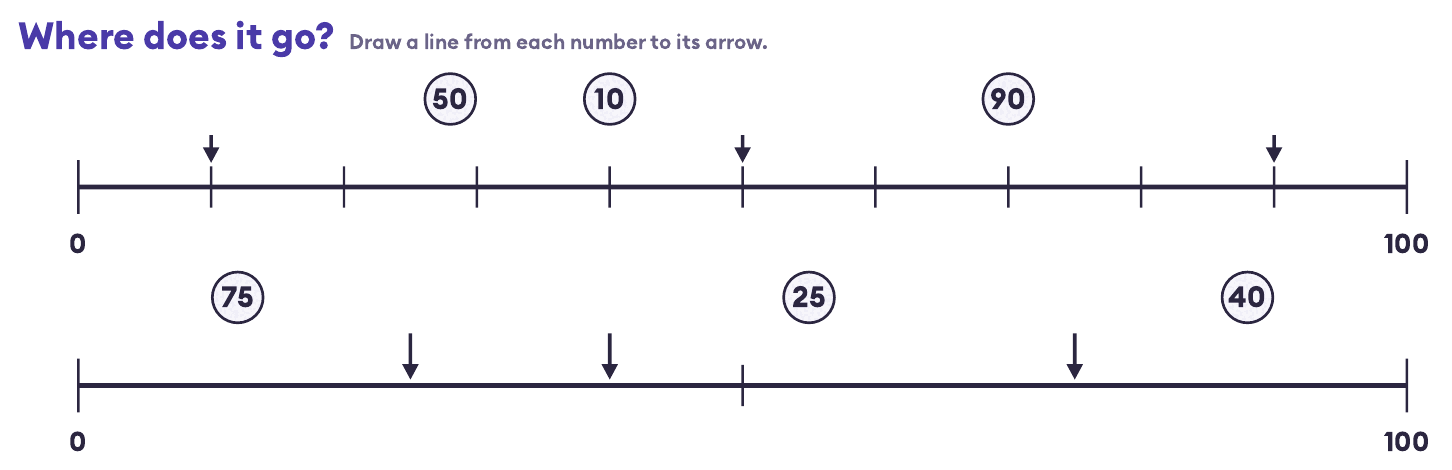
Page 2. Match each number to its arrow.
Number line by 10s and 5s
Hop by 10s from any number. Start on 27, and the hops land on 37, 47, 57 and 67. Only the tens digit changes. A counting by 10s number line makes that pattern easy to see. One hop of 10 is one ten. It is never ten little hops.
Then hop back by 10s. From 94 you land on 84, 74, 64 and 54. Page 4 has both. Its first row is done for you. In the last two rows your child gets only a start dot and an arrow showing which way to go.
Next, hop by 5s from 0 to 50 on page 5. On a number line by 5s, each hop lands on a middle mark or a tall mark. A counting by 5s number line shows the pattern 5, 10, 15, 20 as hops. Hop by 2s from 0 to 20 and you land on every even number.
This is skip counting on a number line, the same counts as on our skip counting chart, laid out as hops. For counting by 10s in rows of ten, see counting by 10s to 100.
Hops of 10 also show 10 more and 10 less in a way your child can see. Hop forward a ten and the number grows by 10. Hop back and it shrinks by 10.
Ready to add tens and ones, like 46 + 23? Our number line addition and subtraction guide does it on an open number line.
Number line to 50 (0-50)
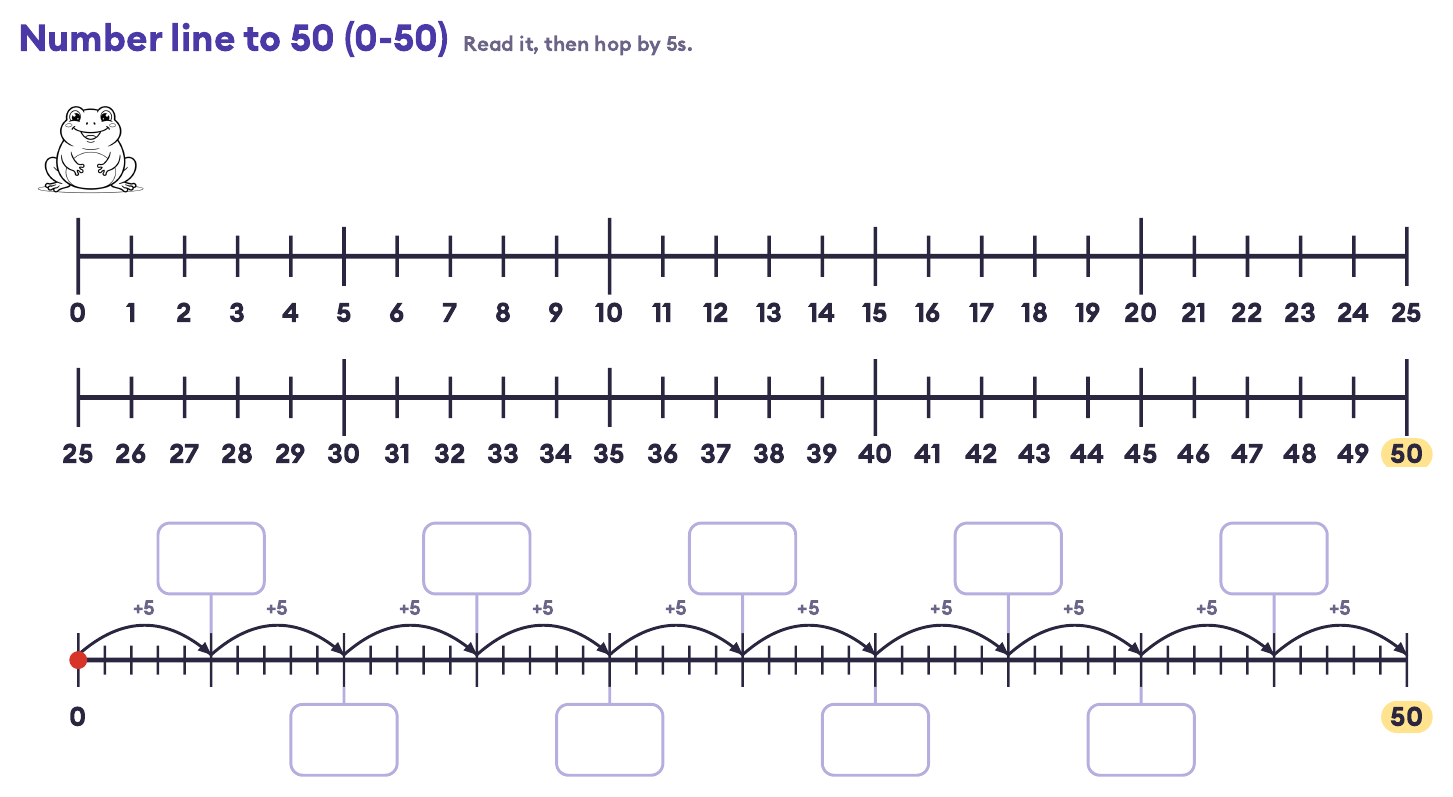
Page 5. Read 0 to 50, then hop by 5s.
A number line to 50 is a good first long line for 1st grade, before a number line up to 100. Page 5 has 0-25 and 25-50 rows with every number printed, plus a 0-50 line to hop by 5s. Your child writes where each hop lands.
A number line 1-50 works the same way. Ours starts at 0.
For a number line to 30, print page 6 again and cut the strips after 30. You get a 0-30 line, which does the job of a 1-30 line too.
Prefer numbers in rows of ten? See our number chart 1-50.
Number line puzzle: cut, order, paste
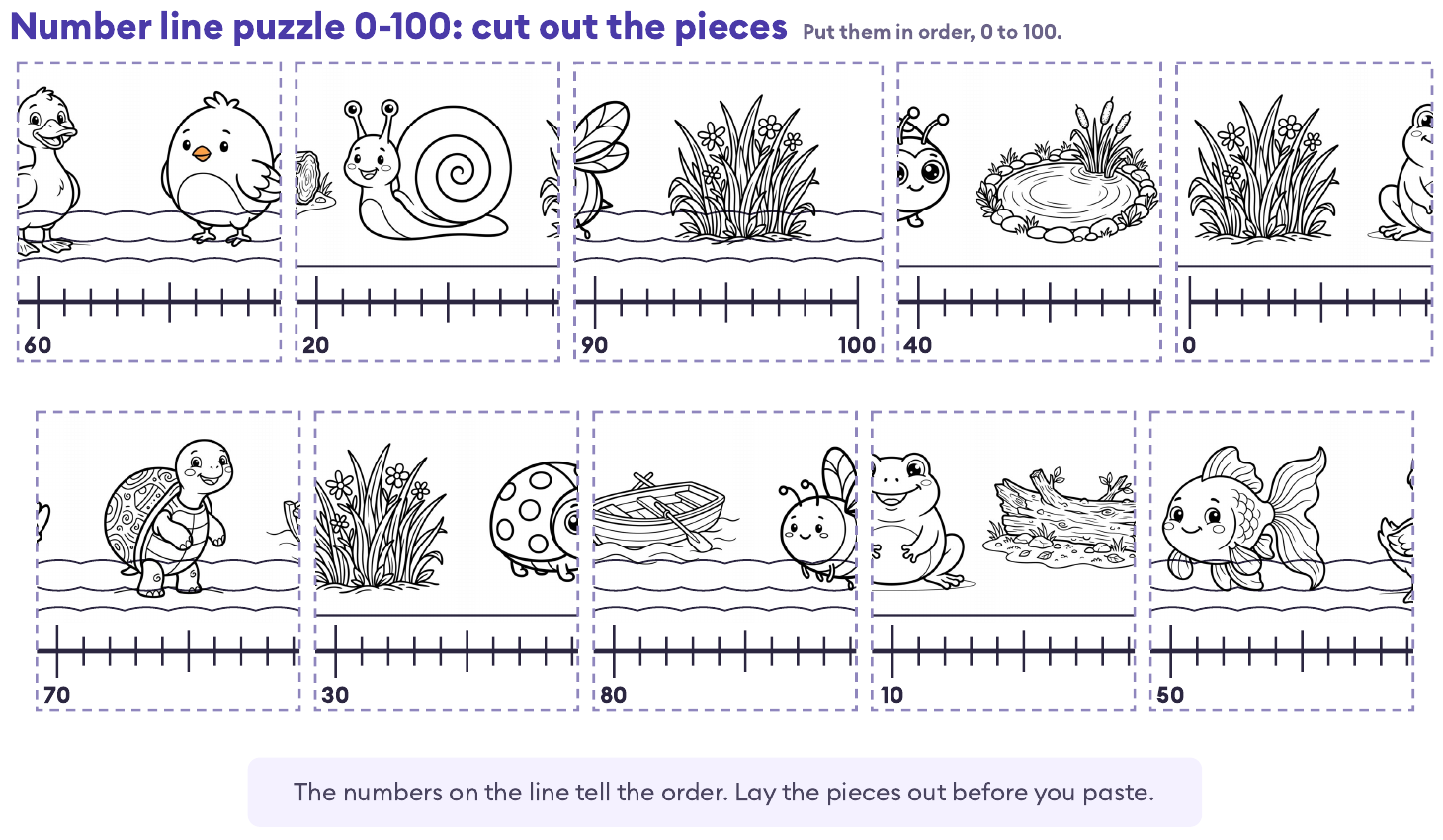
The puzzle PDF, page 1. Ten pieces, each with a piece of the pond picture.
Our free number line puzzle is its own 2-page PDF. There are ten pieces, from 0-10 up to 90-100. Each piece has a slice of a pond picture on top and a piece of the line below.
Your child cuts them out and puts them in order by the numbers on the line. Then they paste them on the mat on page 2 and color the picture.
Lay the pieces out before you paste. The numbers decide the order, not the picture. When the line is right, the picture comes together too.
Kindergartners who count by tens can do this one.
Make a long number line to 100 (cut and tape)
Page 6 has five strips, 0-20, 20-40, 40-60, 60-80 and 80-100. Each strip lies on top of the one before it, so the two 20s match, then the two 40s, and so on. Tape them together.
Printed at 100%, 0 to 100 is about 1 meter long. That’s about 39 inches, a little longer than a yardstick. Every hop is 1 centimeter, the same as on a meter stick.
Tape it along a table edge or a wall. It also works as a number line to 100 classroom display. The Hop to the Pond game below is played on the same strips.
Want a giant number line? Put painter’s tape on the floor and mark 0 to 100 with one big step for each ten. That makes a large number line to 100 your child can walk. They walk the tens, then guess where 45 is.
Hop to the Pond: a number line board game to 100
Our free Hop to the Pond game is its own 2-page PDF. Page 1 has a spinner, three frogs to cut out and color, a pond to stand at 100 and the rules. Page 2 is the board: five strips that tape into one straight 0-100 line, the same strips as page 6 of the number line PDF.
- Players: 2 or 3, with an adult. The taped board, the spinner and frogs, a pencil and a paper clip.
- Everyone puts a frog on 0.
- Spin, hop that many and say where you land.
- The first frog to reach the pond at 100 wins. You don’t need an exact spin.
- Tip: On a 10, only the tens digit changes. 18 becomes 28.
Short on time? The first to 50 wins.
The spinner has 1, 2, 5 and three 10s, so a game takes about 16 spins each. To spin, hold a paper clip in the middle with a pencil and flick it.
On a grid instead of a line? Try Race to 100.
Our number line to 20 game uses a straight line too.
Five quick ways to use the line at home
Each one takes 5 minutes or less.
- Guess my number. Give clues on the line. “It’s between 40 and 50. It’s closer to 50.” Your child points to it. Then you both check.
- Start anywhere. Count on from 47 to 62. Your child keeps a finger on the line the whole way.
- Order three numbers. Find 62, 26 and 60 on the line. The one furthest right is biggest. Our tens first page shows the same idea with 2-digit numbers.
- Ten up, ten back. Put a finger on 36. Hop up a ten, then hop back a ten. That’s 10 more and 10 less.
- Count the 9s. How many 9s do you write from 0 to 100? Most kids say 19. It’s 20, because 99 has two.
Celebrating the 100th day of school? Our 100th day of school printables go well with the long line.
Common mistakes and quick fixes
| Mistake | What it looks like | Try this |
|---|---|---|
| Counting the start number or the marks | Starting on 40 and hopping three 10s, the child says 40, 50, 60 and stops on 60 | Finger on 40, then say a number on each landing. Count the hops, not the marks. |
| Every mark is one? | On a line marked by 10s, 30 is read as 3 | Read the labels first. If they go 0, 10, 20, each tall mark is a ten. |
| Hopping 10 one mark at a time | 47 to 57 counted by ones, lands on 56 or 58 | One hop of 10 changes only the tens digit. |
| Counting a row end twice | 25 counted at the end of row 1 and again at the start of row 2 | The last number of a row starts the next one. Count it once. |
| Mixing up teens and tens, or writing 71 for 17 | 13 found where 30 should be, or 17 written as 71 | Say it slowly. Thir-TEEN is just past 10. THIR-ty is a tens mark. Teen numbers say the ones first. Seventeen is 1 ten and 7 ones, so the 1 goes first. |
| Squashing big numbers together | On an ends-only line, 50 lands near the right end | Mark 50 halfway first, then 25 and 75. |
More free math pages, each with its own free PDF:
- Teen numbers as ten and some more
- Math War and three more card games
- 2nd grade word problems within 100
FAQ
What is 0 on a number line?
0 is the starting point, where you stand before any hops. Everything to the right of it is more than 0. Every number tells you how many hops it is from 0, which is why our lines start there. A 1-100 line is a piece of the line, with 0 just off to the left. More in 1-100 or 0-100.
How high should a number line go in 1st grade?
Many classes start with 0-20, then 0-50, then 0-100. 1st graders count to 120, so some classroom lines run to 120. A number line to 120 is just this line with two more tens. To see 101 to 120 in rows of ten, use our 120 chart. Wondering when children count to 100? See at what age should a child count to 100.
Why use a number line instead of rows of ten?
Rows of ten put each ten on its own row, like on our hundreds chart. A number line shows how far apart numbers are. Adding and taking away use that distance later. Both help, and many kids like to switch between them.
How do you write 10, 20, 30 up to 100 in words?
Ten, twenty, thirty, forty, fifty, sixty, seventy, eighty, ninety, one hundred. Forty has no u.
How do I print 0 to 100 on one page?
Page 7 fits 1 to 100 in four rows, with a small gray 0 just left of 1. For one long line, tape the page 6 strips together.
The takeaways
- A number line to 100 starts at 0. Every number is a count of hops from 0.
- The tens are the landmarks. Find the ten first, then the ones.
- One hop of 10 changes only the tens digit. 27, 37, 47.
- Place numbers before you count them. Where does 50 go? 25? 37?
- Start with a number line to 50 if 100 feels long.
- Print the free number line to 100 PDF: 0-100 and 1-100 lines, hops by 10s and 5s and a 1-meter strip. 8 pages, no signup.
- Cut out the number line puzzle. The picture only comes together when the numbers are in order.
- Play Hop to the Pond on the taped line. First frog to 100 wins.
Numbers to 100 happen on paper. The Luvinci app’s adding and take-away boards stay within 10, with pictures and ten frames. Those boards are in the full app. The first counting board is free. See how Luvinci’s math games work.
Sources
- Common Core State Standards for Mathematics (2010): 1st grade 1.NBT.1 and 1.NBT.5; 2nd grade 2.NBT.2 and 2.MD.6; 3rd grade 3.NBT.1.
- Progressions for the Common Core State Standards in Mathematics: Geometric Measurement, K-5, and Number and Operations in Base Ten, K-5.
- Siegler, R. S., and Booth, J. L. (2004). Development of numerical estimation in young children. Child Development, 75(2), 428-444.
- Schneider, M., et al. (2018). Associations of number line estimation with mathematical competence: A meta-analysis. Child Development, 89(5), 1467-1484.
More free math worksheets: ten frames, number charts, addition and subtraction, daily practice workbooks and more, all in one place. See the math printables →
