 Luvinci
October 8, 2026
Greater Than Less Than Worksheets for Kindergarten to 2nd Grade: Comparing Numbers (Free PDF)
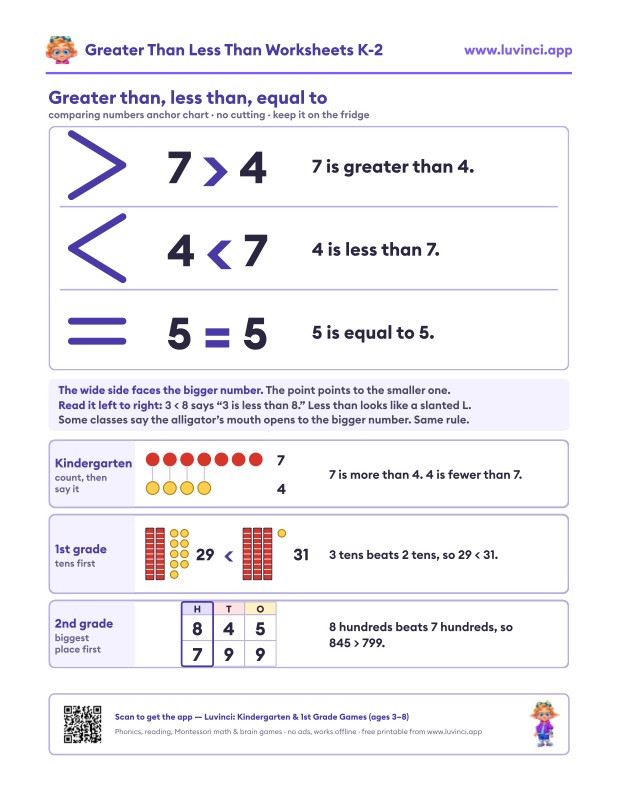
Free printable · PDF · 825 KB
Greater Than Less Than Worksheets for Kindergarten to 2nd Grade: Comparing Numbers (Free PDF)
No signup needed. Just print it.
Download PDFThese free greater than less than worksheets for kindergarten to 2nd grade follow the way comparing numbers is taught. Start with “which group has more?”, then two numbers to 10, then the tens, then the hundreds. The signs come in 1st grade. Until then, kids say it in words.
Everything is in one free greater than less than worksheets PDF of 9 pages: a comparing numbers anchor chart, three kindergarten pages, two 1st grade pages, a 3-digit page for 2nd grade, an ordering numbers page and an answer key. No signup, no email, no cutting.
Jump to: the worksheets · the anchor chart · kindergarten · 1st grade · 2nd grade · ordering · mistakes · FAQ
Using the greater than less than worksheets
The PDF is free. It prints in black and white, and every answer is in the back.
- Page 1. Anchor chart: the three signs and one example for each grade.
- Page 2. More or fewer? Pair up two rows of dots, then circle the row with more (4 boxes) or the row with fewer (4 boxes). Kindergarten.
- Page 3. Which number is bigger, 1 to 5? Dots under each number to count. Kindergarten.
- Page 4. Which number is bigger, 1 to 10? 12 pairs, with a number path to check. Kindergarten.
- Page 5. Tens first: 8 pairs drawn as sticks and dots. 1st grade.
- Page 6. 15 pairs of 2-digit numbers, then 6 “is it true?” sentences. 1st grade.
- Page 7. 15 pairs of 3-digit numbers. 2nd grade.
- Page 8. Put the numbers in order: 9 sets, to 10, to 100, then 3-digit.
- Page 9. Answer key for pages 2 to 8.
Where to start:
- Kindergarten: pages 1 to 4.
- 1st grade: pages 1, 5, 6 and the first two parts of page 8.
- 2nd grade: pages 1, 6 (as a warm-up), 7 and 8.
- About 10 minutes, one page a day, is plenty.
Most greater than less than equal to worksheets start with the signs. These start with dots, which is where comparing starts for a young child.
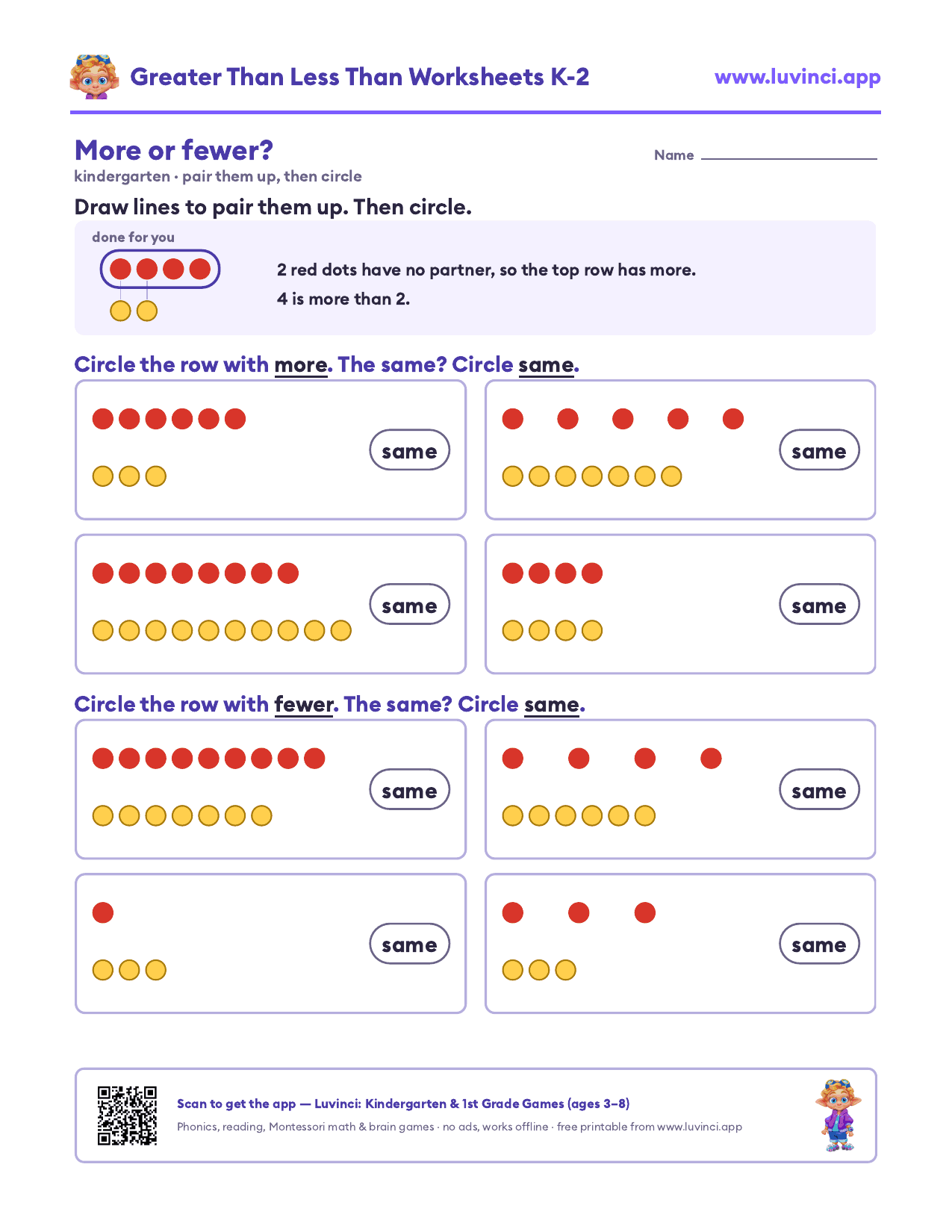
Page 2: pair them up, then circle. Answers are on page 9.
Greater than less than anchor chart
Page 1 is a comparing numbers anchor chart. Page 1 needs no cutting and no prep. Keep it on the fridge or by the homework spot.
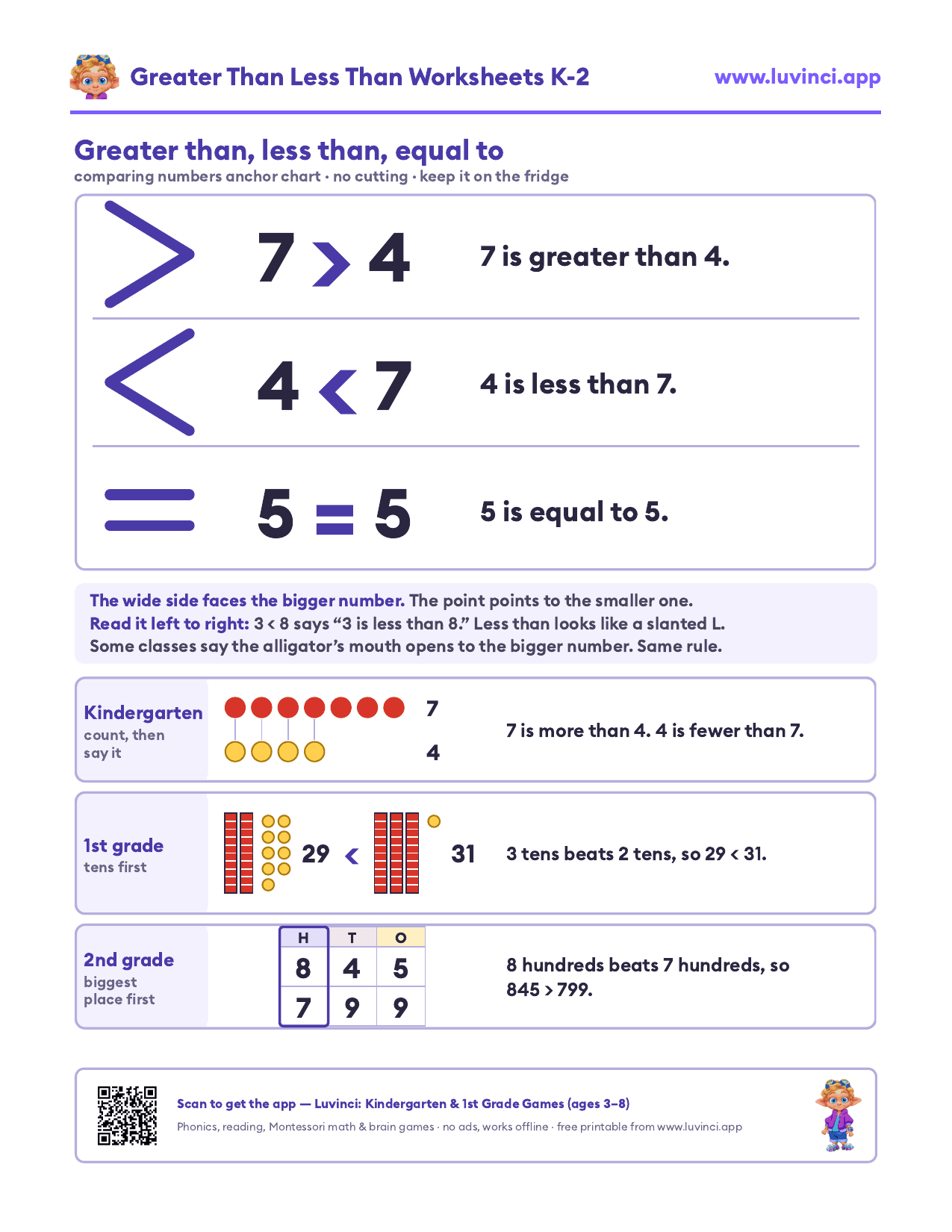
Page 1: the three signs, then one example for each grade.
This is what page 1 shows:
- The three signs, greater than, less than and equal to, each with a sentence to read aloud.
- A kindergarten row: 7 red dots and 4 yellow dots, paired up.
- A 1st grade row: 29 and 31 drawn as sticks and dots.
- A 2nd grade row: 845 and 799 in boxes, with the hundreds marked.
How to remember which sign is which
- The wide side faces the bigger number. The point faces the smaller one.
- The less than sign looks like a slanted L. L is for less.
- Read it left to right, like a sentence. 3 < 8 says “3 is less than 8.” Name both numbers and the sign, left to right.
- = means “the same amount” on both sides.
The greater than less than alligator
Many classes say the alligator’s mouth opens to eat the bigger number. That points the sign the right way, so it works as a start. It still leaves your child without the words to say. Use the alligator if your child likes it, then switch to the names and read it left to right: “3 is less than 8.”
Greater than less than worksheets for kindergarten
The Common Core kindergarten standards ask for the words, greater than, less than and equal to, not the signs. Kids compare two groups of up to 10 things by matching and counting, then two written numbers from 1 to 10. The signs first appear in the 1st grade standard. Plenty of kindergarten worksheets use them anyway, so page 4 works both ways. Circle the bigger number, or write the sign.
Comparing numbers in kindergarten goes in this order:
- Real things. Two plates of crackers: “Which plate has more?” Pair them up, one from each. The plate with crackers left over has more. The full activity is number 5 in our counting activities for kindergarten.
- Pictures. Page 2: two rows of dots to pair up.
- Numbers to 5, with dots. Page 3: count the dots under each number to check.
- Numbers to 10. Page 4.
Teach the words “more” and “fewer” first, then use counting to compare: “Six is more than five, because six comes after five when we count.”
More or less: which group has more, which has fewer?
Page 2 has two rows of dots in each box. Your child draws lines to pair them up, one red dot with one yellow dot. Then they circle the row with more (top half) or the row with fewer (bottom half). If every dot has a partner, they circle “same”.
These more or less worksheets for kindergarten use dots, which means only the count matters. The top half asks for the row with more and the bottom half for the row with fewer, which also makes it a more or fewer worksheet.
Three boxes are tricky. In each one, one row is spread out, so it looks longer. The dots are farther apart, but there aren’t more of them. Moving things around doesn’t change how many there are. Pairing up is how your child proves it.
Page 4 has 12 pairs of numbers from 1 to 10. Your child circles the bigger one, or circles both when they’re the same. Kids who know the signs write >, < or = in the middle instead. The number path at the top is the check. The number further along is bigger, just like on a number line to 20. Three of the pairs are next-door numbers, like 5 and 6, which are the hardest to see at a glance.
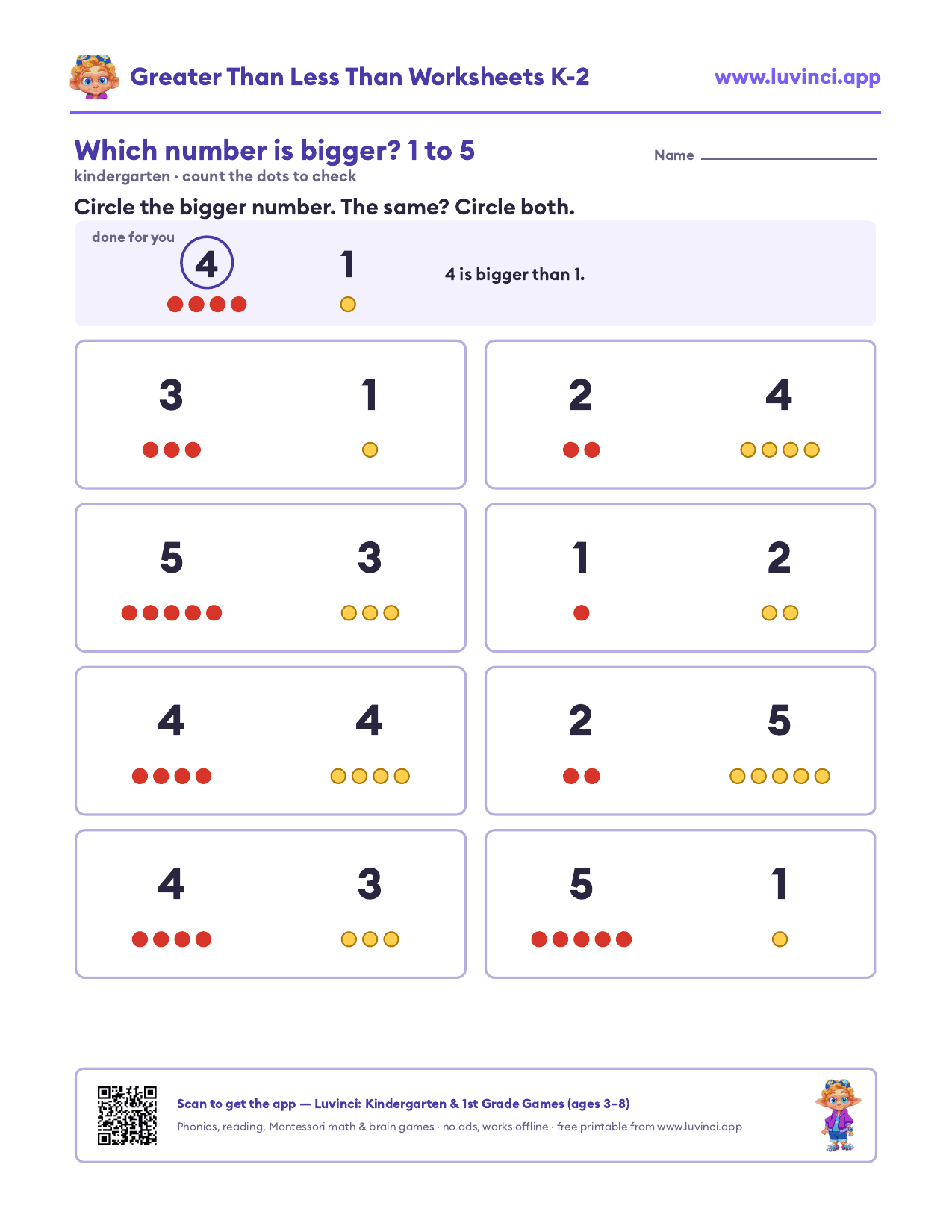
Page 3: count the dots to check. Answers are on page 9.
Tens first: comparing 2-digit numbers in 1st grade
In 1st grade the signs show up. Kids compare two 2-digit numbers by their tens and ones, and write the answer with >, = or <.
The rule is to look at the tens first. If the tens match, look at the ones.
The reason it works: 1 ten is more than any number of ones up to 9. So the tens digit matters most in a 2-digit number.
Draw the sticks and the reason shows up. A stick is a ten. A dot is a one. 29 is 2 sticks and 9 dots. 31 is 3 sticks and 1 dot. The extra stick wins, even though 9 dots look like a lot. So 29 < 31.
Page 5 draws 8 pairs as sticks and dots, with a circle in the middle for the sign. Page 6 has 15 pairs of numbers only, then 6 “is it true?” sentences. Circling true or false gives practice at reading the sign.
The pages hide a few traps on purpose:
- The same digits, swapped: 52 and 25, 14 and 41.
- Teens and tens: 16 and 60. If those get mixed up, see teen number mistakes.
- A zero in the ones: 60 and 58. 6 tens still beats 5 tens.
- The same tens: 47 and 43. Here the ones decide.
Some pairs are the same, like 37 and 37 on page 5. Page 6 asks if 88 = 88 is true. It is. = means the same amount, not “the answer comes next”. There’s more on the equal sign in our 1st grade addition guide.
For a 2-digit game, try Biggest Number Wins: make the biggest number from two dice, then write the two numbers with > or < between them.
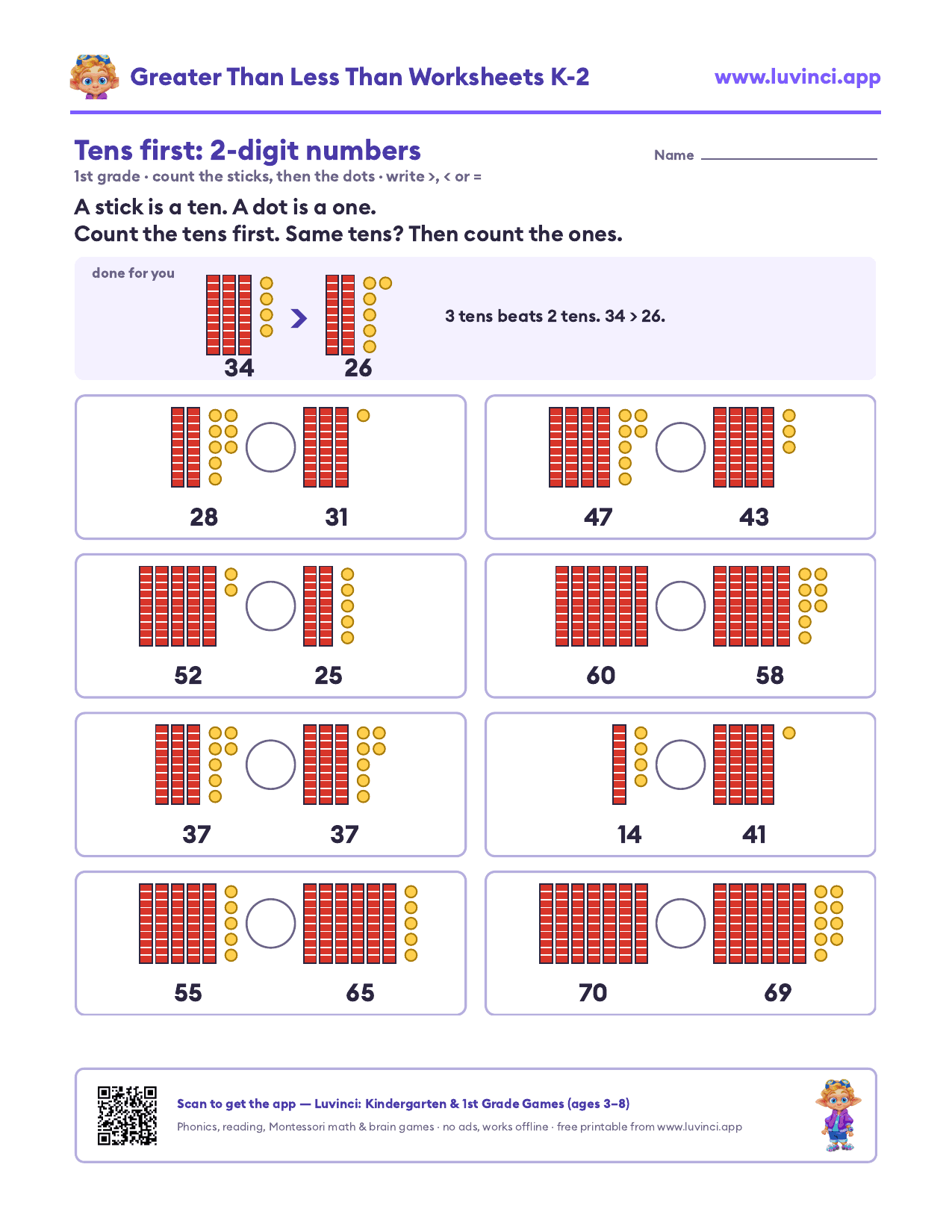
Page 5: count the sticks first. Answers are on page 9.
Comparing 3 digit numbers worksheets for 2nd grade
In 2nd grade the numbers reach the hundreds. Kids compare two 3-digit numbers by their hundreds, tens and ones, and write >, = or <.
It’s the same rule with a third place. Look at the biggest place first. A hundred is bigger than any 2-digit number, so the hundreds decide first. 845 > 799, because 8 hundreds beats 7 hundreds, even though 799 has more tens and ones. With 849 and 855 the hundreds are the same, so check the tens: 4 tens is less than 5 tens, so 849 < 855.
Page 7 has 15 pairs, and these are the ones to watch:
- 99 and 101. A 3-digit number beats any 2-digit number.
- Zeros: 306 and 360, 400 and 399.
- Only the ones are different: 526 and 529.
- Swapped digits: 913 and 139.
The tip on the page is to write them one under the other, hundreds under hundreds. Then the places line up and your child can read across.
In 2nd grade the same sticks and dots carry on into adding: when the ones make 10 or more, 10 dots become 1 new stick. That’s 2-digit addition with regrouping.
Ordering numbers worksheets
Ordering is comparing two at a time. Find the smallest, then the next, and keep going.
Page 8 has 9 sets: 3 sets to 10, 4 sets to 100, then 2 sets of 3-digit numbers to put from biggest to smallest. The signs are printed between the answer boxes, so the finished row reads as a sentence: 2 < 5 < 7.
One set is a trap: 15, 7, 10 and 1. Kids who sort by the first digit, the way you sort words by their first letter, write 1, 10, 15, 7. Count it out, or find the numbers on a hundreds chart. 7 comes before 10.
Common comparing numbers mistakes
| What you see | Why | What helps |
|---|---|---|
| 29 > 31 | Looked at the ones first | Tens first: draw the sticks |
| 3 > 8 | The sign points the wrong way | The wide side faces the bigger number. Read it aloud, left to right |
| Picks the longer row | Spread out looks like more | Pair them up, then count both. Page 2 |
| Orders 1, 10, 15, 7 | Sorting by the first digit | Count it out, or find them on a chart |
| Won’t accept 45 = 45, or reads = as “the answer is” | = means “the same as” | The equal sign: is it true? |
| 14 > 40, or writes 40 for “fourteen” | Teens and tens sound alike | Teen number mistakes |
| 99 > 101 | 99 “looks bigger” | Line them up by the ones: 99 has no hundreds, 101 has 1 hundred |
More free math pages, each with its own free PDF:
- Counting mats 0 to 10 for kindergarten
- Touch and count mats 1 to 10
- Ten frames to 10 and 20
- Teen numbers as ten and some more
- A hundreds chart for putting numbers in order
- Math War and three more card games
FAQ
What grade is greater than less than taught?
Comparing starts in kindergarten. Kids compare groups of up to 10 things, then numbers from 1 to 10, and say it in words. The signs >, = and < come in 1st grade, for 2-digit numbers. In 2nd grade kids use them for 3-digit numbers.
Should kindergartners write > and <? The Common Core kindergarten standards don’t ask for it. If your child is curious, show them. Page 4 works both ways.
How do you explain greater than and less than to a child?
Start with things. Ask “Which plate has more?” Then say the whole sentence: “7 is greater than 4.” Then show the sign, with a way to remember it: see how to remember which sign is which.
How do you compare numbers?
Count the digits first. More digits means bigger. Same number of digits? Compare the biggest place first (hundreds, then tens, then ones) and stop at the first place that is different. The wide side of the sign faces the bigger number.
What are some fun activities for comparing numbers?
The best greater than less than games are simple comparing numbers games you can play at the kitchen table:
- Pair-up crackers. Two plates, pair the crackers up, and see which plate has some left over (activity 5).
- Math War. Both flip a card, and the bigger number wins (Math War). In one small study, low-income preschoolers who played a War-style card game for about an hour over 3 weeks got better at comparing written numbers (72% to 80% correct), while Memory players with similar cards barely changed (82% to 83%) (Scalise, Daubert and Ramani, 2017).
- Which is taller? Build two block towers and compare them, then find out by how much: how many more.
The takeaways
- Kindergarten compares in words first: which group has more, then which number is bigger, to 10.
- The signs come in 1st grade. The wide side faces the bigger number.
- Read it left to right: “3 < 8” is “3 is less than 8.”
- Tens first, then ones. In 2nd grade, the hundreds first.
- Ordering is comparing, two at a time.
- Print the free greater than less than worksheets: an anchor chart, kindergarten to 2nd grade pages and an answer key. 9 pages, no signup.
Comparing happens on paper and at the table, with real things. The Luvinci app has no board for it. Its free counting board (Counting 1, in the Early Math row) has your child drag a card of 1 to 10 strawberries onto its matching number while a voice counts along. The adding and take-away boards are in the full app.
Sources
- Common Core State Standards for Mathematics (2010): kindergarten K.CC.4b, K.CC.6 and K.CC.7; 1st grade 1.NBT.3 and 1.OA.7; 2nd grade 2.NBT.4.
- Progressions for the Common Core State Standards in Mathematics: Number and Operations in Base Ten, K-5.
- Frye, D. and colleagues (2013). Teaching Math to Young Children. US Department of Education, Institute of Education Sciences.
- Maria Howard (2019). Teaching greater than and less than. WeAreTeachers.
More free math worksheets: ten frames, number charts, addition and subtraction, daily practice workbooks and more, all in one place. See the math printables →
