 Luvinci
October 8, 2026
2-Digit Addition with Regrouping Worksheets (Free PDF with Answers)
Free printable · PDF · 785 KB
2-Digit Addition with Regrouping Worksheets (Free PDF with Answers)
No signup needed. Just print it.
Download PDF2-digit addition with regrouping comes down to one rule. Add the ones first, and if they make 10 or more, trade 10 ones for 1 new ten and add it in with the tens. These free worksheets teach double digit addition with regrouping one small step at a time, with pictures before columns, so your second grader sees why the little 1 is there.
Everything is in one free 2-digit addition with regrouping worksheets PDF of 9 pages: a regrouping chart, a warm-up without regrouping, a draw-it page, a regroup-or-not page, four practice pages and an answer key. 90 problems in all. No signup, no email.
Jump to: the worksheets · what regrouping is · the chart · start without regrouping · step by step · regroup or not? · mistakes · what 2nd grade expects · FAQ
Using the double digit addition with regrouping worksheets
About 10 minutes on one page a day, in order, is plenty. The answer key is page 9. Say it out loud as you go: 7 ones and 5 ones make 12 ones. That’s 1 ten and 2 ones.
- Page 1. Addition with regrouping chart: the chart below.
- Page 2. Start without regrouping: 15 sums, no new ten anywhere.
- Page 3. Draw it: 3 sums to draw with sticks and dots, one done for you.
- Page 4. Regroup or not?: 12 sums; add the ones and circle yes or no.
- Page 5. Make a new ten: 15 sums adding a 1-digit number.
- Page 6. Two 2-digit numbers: 15 sums, all with a new ten, one done for you.
- Page 7. More practice: 15 more sums, all with a new ten.
- Page 8. Mixed review: 15 sums, some with a new ten and some without.
- Page 9. Answer key, every answer as a whole fact.
Every sum on pages 5 to 8 has a box over the tens for the new ten. On page 8 the box is on every card, even when the ones make 9 or less, so the box itself is never the hint. If your child gets stuck, go back one step: draw it with sticks and dots, like page 3.
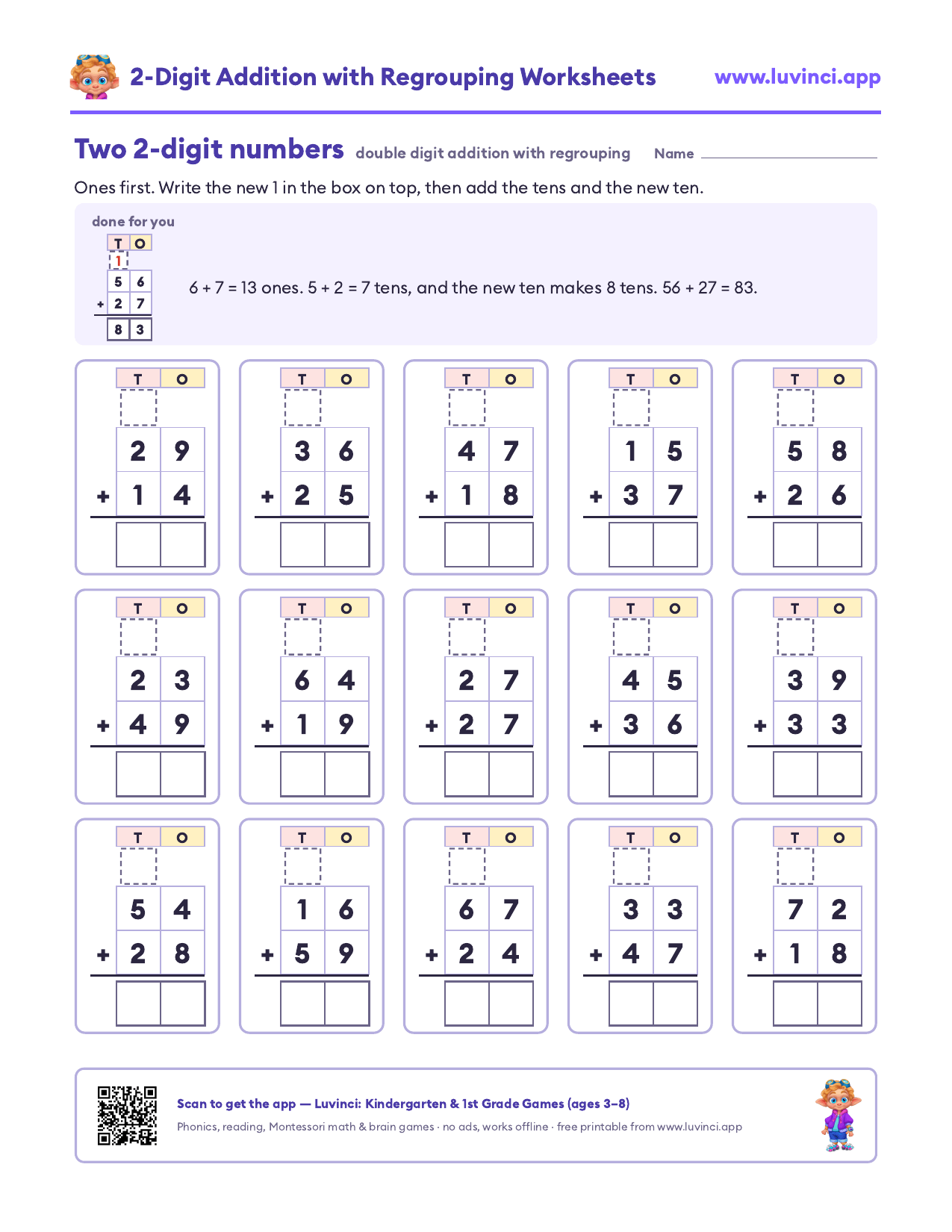
Page 6: two 2-digit numbers, every sum makes a new ten.
What is regrouping in math? (also called carrying)
Regrouping means 10 ones become 1 ten. When the ones in a sum make 10 or more, you trade 10 of them for a new ten and keep the rest as ones. The same idea is called carrying, regrouping or trading, and some classes call it bundling.
Work through one sum in words. Take 47 + 25:
7 + 5 = 12 ones. 12 ones is 1 ten and 2 ones. The tens: 4 + 2 = 6 tens, and the new ten makes 7 tens. So 47 + 25 = 72.
That trade is all addition with carrying is. The little 1 your child writes on top of the tens is that new ten, made from 10 of the ones.
It’s 10 or more, not more than 10. A ones sum of exactly 10, like 34 + 26, also makes a new ten, with 0 ones left: 60. Some worksheets online get this wrong.
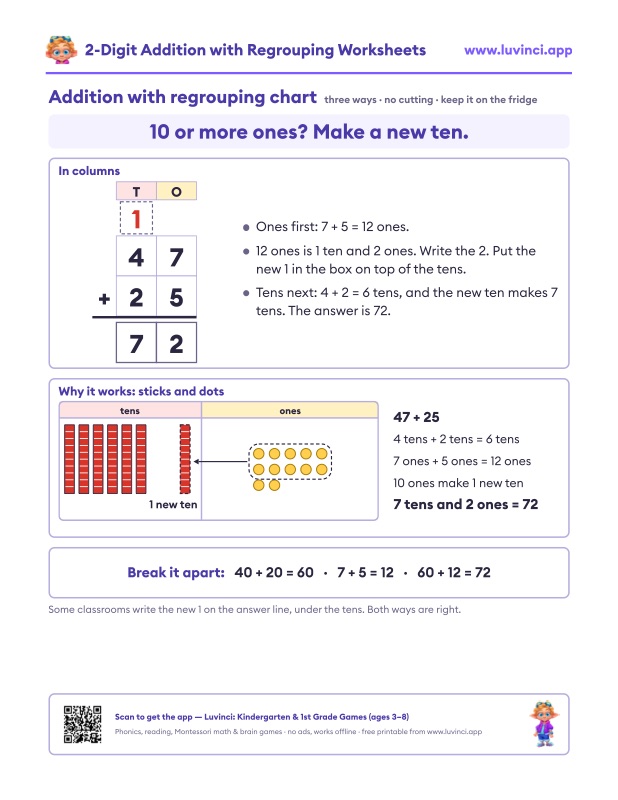
The addition with regrouping anchor chart (page 1)
Page 1 needs no cutting and no prep. Keep it on the fridge or in the homework folder.
It shows 47 + 25 three ways. First in columns, with the new ten in a box on top of the tens. Then the same sum with sticks and dots, where 10 dots are ringed and turned into a new stick. Then broken apart: 40 + 20 = 60, 7 + 5 = 12, 60 + 12 = 72. The rule runs across the top: “10 or more ones? Make a new ten.”
One pattern worth pointing out. If the ones make exactly 10, the answer ends in 0, like 57 + 13 = 70.
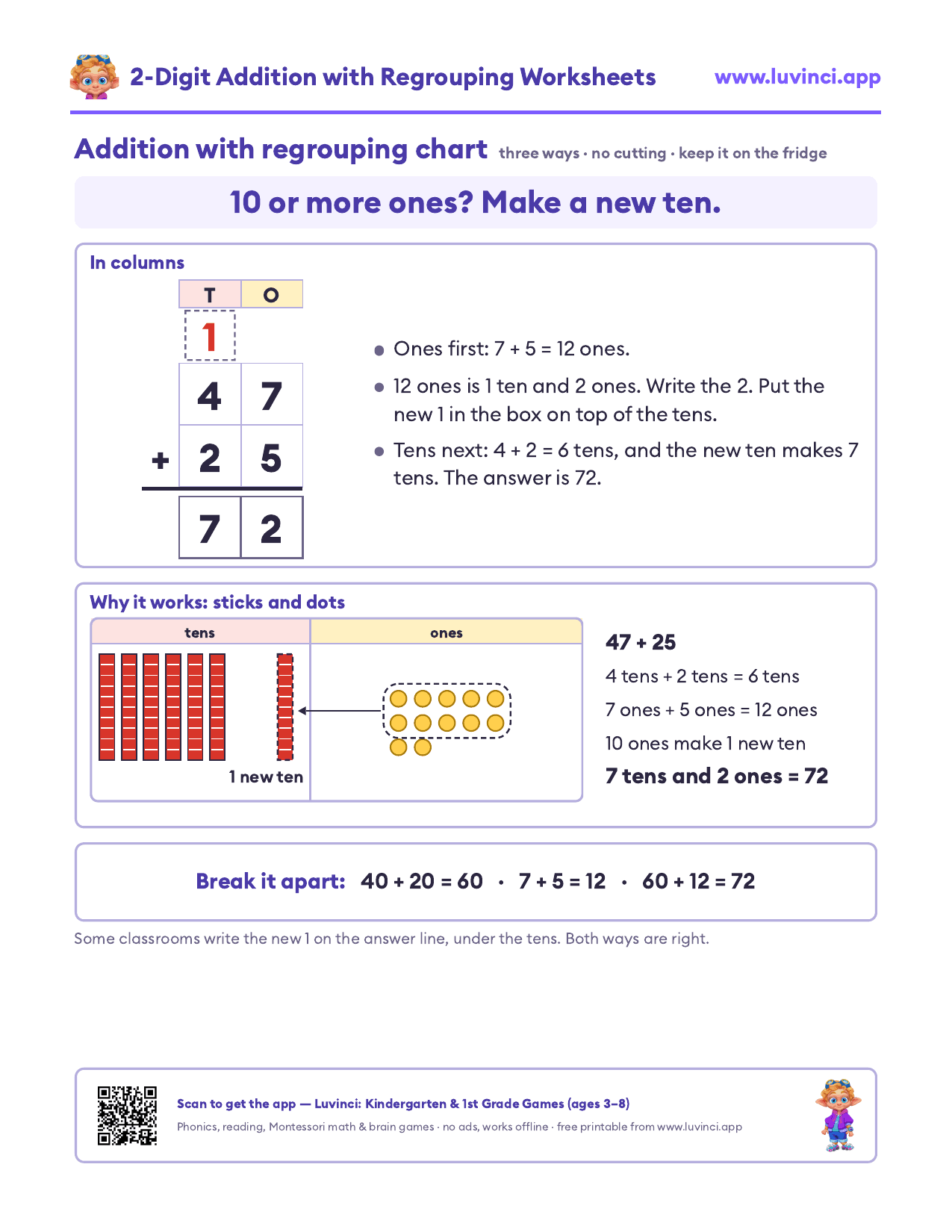
Page 1: one sum, three ways. No cutting.
Start with 2-digit addition without regrouping
2 digit addition without regrouping comes first, because it shows the big idea with nothing to trade. Tens add to tens, ones add to ones. Go in this order:
- Add a multiple of 10, like 34 + 20. Only the tens change: 3 tens and 2 tens make 5 tens, so 54. On a hundreds chart, adding 10 is one row down.
- Add a 1-digit number that doesn’t make a new ten, like 42 + 5. Only the ones change: 47.
- Add two 2-digit numbers whose ones make 9 or less, like 31 + 46. Ones: 1 + 6 = 7. Tens: 3 + 4 = 7. So 77.
Addition without regrouping feels easy, and that’s the point. Double digit addition without regrouping is also the quick check that your child lines the numbers up right. The 5 in 42 + 5 goes under the 2, not under the 4.
Before any adding, check that your child reads 47 as 4 tens and 7 ones. A quick test is which is bigger, 52 or 25, and why? If that takes a while, comparing 2-digit numbers, tens first uses the same sticks and dots.
Page 2 of the PDF is this warm-up.
Addition with regrouping, step by step
Go from things to pictures to numbers, and keep each step tied to the last. If the sticks and dots only become a way to get answers, they stop helping your child understand the column. So each step below points back to the one before.
With sticks and dots
A stick is a ten: 10 ones in a row. A dot is a one. Draw a mat with a tens side and a ones side, and build both numbers on it. For 47 + 25, that’s 4 sticks and 7 dots, then 2 sticks and 5 dots.
Now push the ones together and count them: 12 dots. Ring 10 of them. Those 10 dots become 1 new stick, so draw it on the tens side. Count again: 7 sticks and 2 dots. That’s 72.
Real things work too. Pick things where a ten is 10 ones you can count, like bundles of 10 straws with a rubber band, pennies and dimes, or base ten blocks. Give your child a sentence to say out loud: “7 ones plus 5 ones equals 12 ones. That’s 1 ten and 2 ones.”
Two older ideas help at this step. Teen numbers are “a ten and some more”, so 12 ones is a teen number in disguise. And knowing the ways to make 10 lets your child spot the 7 + 3 hiding inside 7 + 5.
Page 3 of the PDF is a draw-it page.
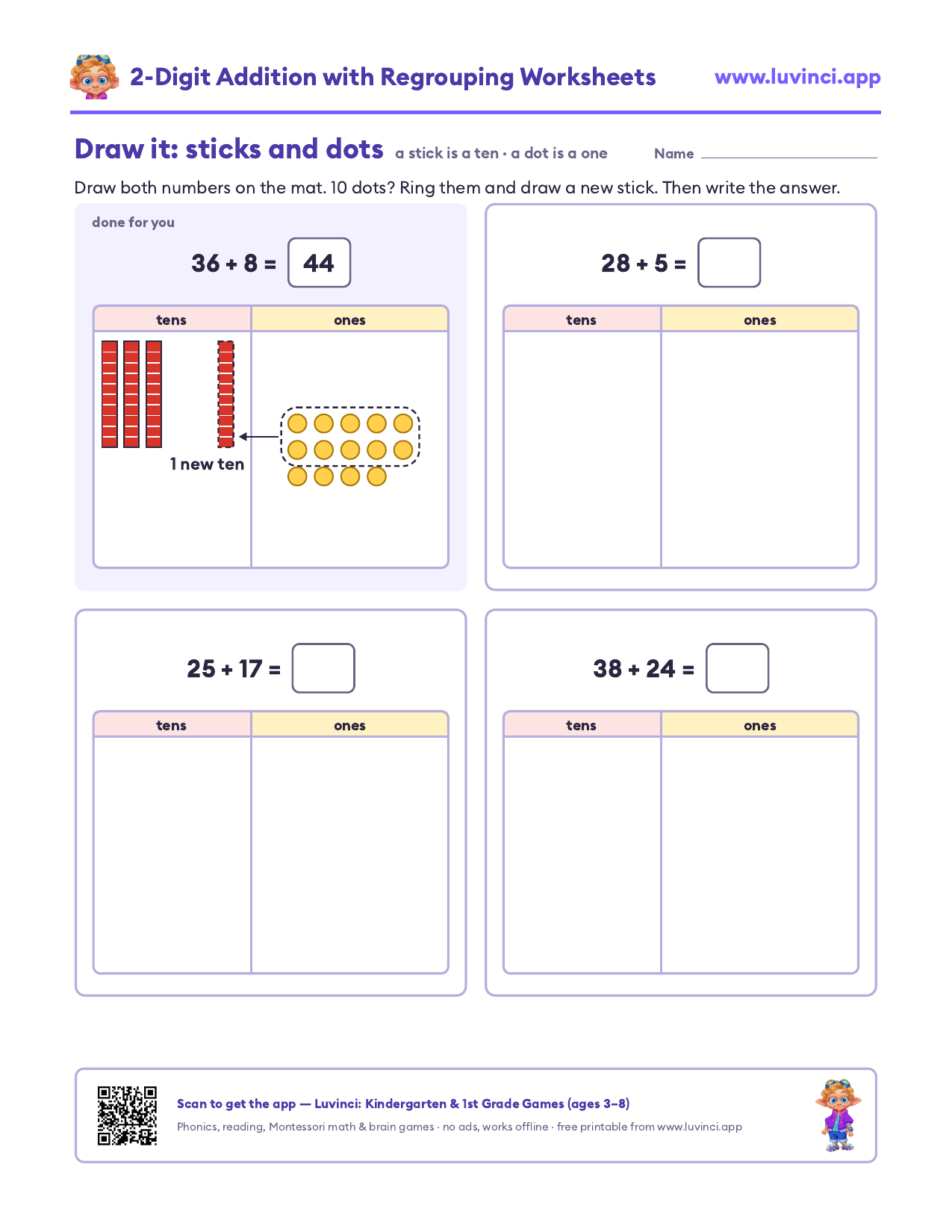
Page 3: draw it first. Answers are on page 9.
Break it apart
Add the tens first, then the ones, then put them together: 40 + 20 = 60, 7 + 5 = 12, 60 + 12 = 72. Many kids like this way because they read from left to right.
A mental version works too. Keep 47 whole and add 25 in two jumps: 47 + 20 = 67, then 67 + 5 = 72. An open number line is a good place to draw those jumps.
In columns: ones first, then tens
This is the vertical addition your child will see on most worksheets. Line up ones under ones and tens under tens. Add the ones. If they make 10 or more, write the ones digit in the answer and put the new 1 in the box on top of the tens. Then add the tens you see, 4 + 2 = 6 tens, and the new ten makes 7 tens.
The column follows the same 1st grade rule: “one adds tens and tens, ones and ones”. The column just keeps track of it.
Graph paper or a box per digit keeps the columns straight, which is why every column sum in the PDF sits in boxes with a T and an O on top.
If the column feels like too much, that’s fine. 2nd graders aren’t expected to use only the column. Pictures and breaking numbers apart count too.
Where does the little 1 go?
Most worksheets, and page 1 of the PDF, put the new 1 in a box on top of the tens. Some classrooms write it on the answer line, under the tens. Some kids find that easier: add the two tens digits you see, then add 1 more. Use whichever way your child’s class uses. Both are right.
Wherever it sits, call it the new ten, not just “a 1”. Naming it that way keeps it from turning into a habit.
Regroup or not? How to tell
One question decides it: do the ones make 10 or more?
- 9 ones: no new ten. 52 + 37: 2 + 7 = 9 ones, so the answer is 89.
- 10 ones: a new ten, 0 left. 34 + 26: 4 + 6 = 10 ones, so 1 new ten and 0 ones: 60.
- 13 ones: a new ten, 3 left. 48 + 25: 8 + 5 = 13 ones, so 1 new ten and 3 ones: 73.
That is the whole difference between addition with regrouping and addition without regrouping. The tens step stays the same. Only the ones decide whether a new ten joins it.
Mix sums that need a new ten with sums that don’t. Then writing a 1 is a decision each time.
Page 4 is a decide-only page. Add just the ones, then circle yes or no. The full sum comes later.
Common regrouping mistakes
| What you see | Why | What helps |
|---|---|---|
| 47 + 25 = 612 | 12 ones written whole in the ones place, often after adding the tens first. A place holds 9 at most. | Ones first in columns. With sticks and dots: ring 10 dots and trade them for 1 stick. “12 ones is 1 ten and 2 ones.” |
| 47 + 25 = 62 | Adds the two numbers they see and forgets the new ten. | Write the new 1 in its box every time, then say “and the new ten makes 7 tens”. |
| 38 + 5 = 88 | The 5 sits under the 3. | A box per digit; build 38 on the mat first. |
| A 1 on top when the ones made 7 | Habit, not a decision. | Page 4: decide first. |
| The new ten drawn as a dot | A ten looks like a one. | Ring 10 dots, then draw 1 stick. |
| 34 + 26 = 50 | Exactly 10 ones feels like “no new ten”. | 10 ones is a new ten with 0 ones left: 60. |
More free math pages, each with its own free PDF:
- 2nd grade word problems within 100
- A hundreds chart for adding tens
- Blank number lines for jumps of 10
Still working on the facts inside each column? Addition for first graders has a chart of the facts to 20.
2-digit addition with regrouping: what 2nd grade expects
Addition for second graders is mostly sums within 100, done quickly and with understanding. 1st grade starts it with pictures. Your child may use the column in 2nd grade, as long as they can explain it with tens and ones. Teachers may call regrouping composing a ten. After this comes 3 digit addition, where 10 tens make a new hundred the same way.
What about subtraction? Taking away has its own trade: when there aren’t enough ones, you break 1 ten into 10 ones first, which many families call borrowing. It’s a 2nd grade skill too, and it goes more smoothly once making a new ten feels easy. For taking away within 20, see subtraction for first graders.
FAQ
What grade is double digit addition with regrouping?
Mostly 2nd grade, around ages 7 to 8. Many 1st graders meet it earlier with pictures, and 1st grade already talks about making a new ten. Start with 2-digit addition without regrouping whenever tens and ones make sense to your child.
How do you know if you need to regroup?
Add the ones first. 10 or more ones means a new ten; 9 or fewer means none. Exactly 10 counts: 34 + 26 has 4 + 6 = 10 ones, so 1 new ten and 0 ones: 60.
Is carrying the same as regrouping?
Yes. Carrying, regrouping, trading and bundling all mean 10 ones become 1 ten, and teachers may say “compose a ten”. Saying “a new ten” instead of “carry the one” helps the 1 mean something.
Is there a trick to 2 digit addition?
Add the tens first in your head: 47 + 25 is 47 + 20 = 67, then 67 + 5 = 72. Or make a ten: 7 + 3 = 10, so 47 + 3 = 50, and 50 + 22 = 72. That second way is the make 10 strategy from 1st grade, used with bigger numbers.
What are some fun activities for learning addition with regrouping?
Trade 10 pennies for a dime whenever you have 10. Bundle straws in tens with a rubber band and add two piles. Roll a die 4 times to make two 2-digit numbers, then add them. Or play “Race to 100” from our place value games, where every full row on the grid is one ten.
The takeaways
- Ones first. 10 or more ones? Trade 10 of them for a new ten.
- Start without regrouping so tens-with-tens and ones-with-ones is solid.
- Pictures before columns: sticks and dots, then break it apart, then the column.
- Decide every time: mix sums that need a new ten with sums that don’t.
- Exactly 10 ones counts: 34 + 26 = 60.
- Print the free 2-digit addition with regrouping worksheets: a carrying chart, 90 problems and an answer key. 9 pages, no signup.
Two-digit sums happen on paper. The Luvinci app has no board for them. Its adding and take-away boards practice facts within 10, a first step toward the facts to 20 that every column here uses. None of those boards goes past 10. These boards are in the full app; the counting board is free. See the math boards.
Sources
- Common Core State Standards for Mathematics (2010): 1st grade 1.NBT.4; 2nd grade 2.NBT.5, 2.NBT.7 and 2.NBT.9.
- Progressions for the Common Core State Standards in Mathematics: Number and Operations in Base Ten, K-5.
- National Research Council (2001). Adding It Up: Helping Children Learn Mathematics, pages 198 to 203.
- Eureka Math (Great Minds), Grade 2 Module 4 parent tip sheets.
More free math worksheets: ten frames, number charts, addition and subtraction, daily practice workbooks and more, all in one place. See the math printables →
