 Luvinci
October 12, 2026
120 Chart Printable: Blank and Missing Numbers (Free PDF)
Free printable · PDF · 691 KB
120 Chart Printable: Blank and Missing Numbers (Free PDF)
No signup needed. Just print it.
Download PDFFree worksheets (2)
Printable PDFs, no signup.
A 120 chart puts the numbers 1 to 120 in 12 rows of 10. It’s a hundreds chart with two more rows, and people also call it a number chart 1-120. 1st graders use it to count, read and write numbers past 100.
One box right is 1 more. One box down is 10 more, even past 100. Look at 95, 105 and 115.
Everything is in one free 120 chart PDF of 9 pages. It has a color chart, missing numbers at three levels, cut and paste, matching, chart pieces, a black and white chart and a blank chart. This free printable 120 chart needs no signup and no email. You’ll find the counting maze and the 120 chart mat as their own free PDFs, in the box at the top.
Start with our number chart 1-20 or number chart 1-50 if 100 is still a long way off.
Jump to: the free PDF · what it is · how to use it · 101, not 1001 · missing numbers · blank chart · cut and paste · activities and puzzles · FAQ
Free 120 chart printable PDF
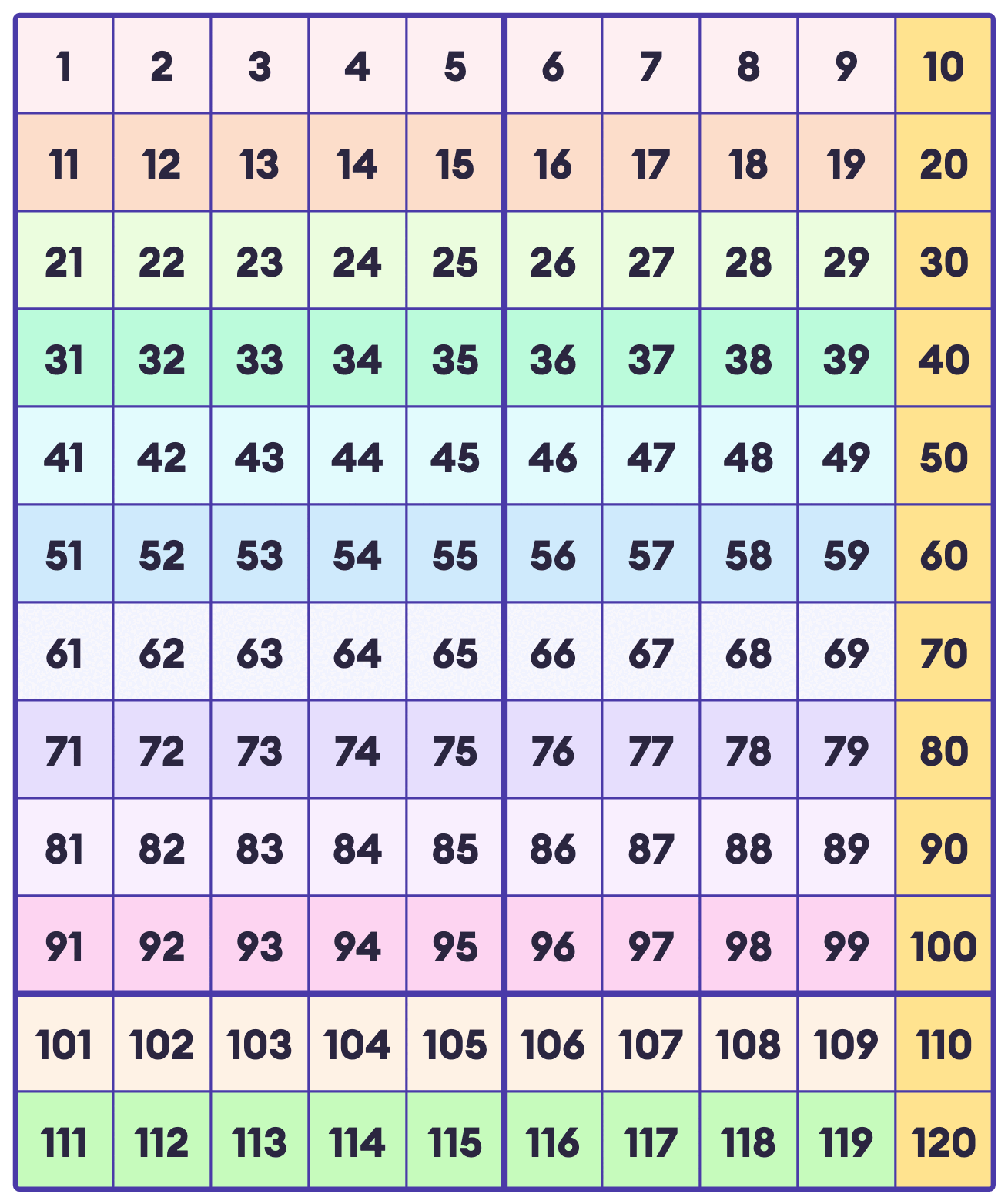
In the PDF, rows 101 to 120 are left white for your child to color.
The 120 chart PDF runs 9 pages, all portrait, US Letter.
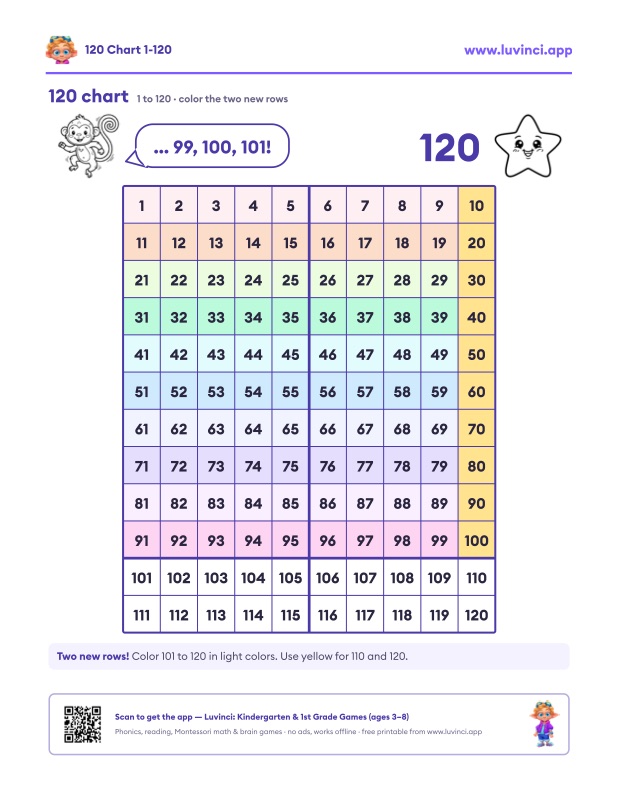
- Page 1. Color 120 chart. A filled chart with a monkey and star picture strip. Your child colors the two new rows, 101 to 120. K and 1st grade.
- Page 2. Count past 100. Rows 91 to 120 with 9 blanks, plus count-on and count-back strips. 1st grade, level 1.
- Page 3. 120 chart with missing numbers. A partly filled chart. 1st grade, level 2.
- Page 4. Fill in the 120 chart: 61 to 120. Only the 5s and 10s are given. 1st grade, level 3.
- Page 5. Cut and paste: 101 to 120. 20 tiles to paste in order. 1st grade.
- Page 6. 101, not 1001. Match and circle. 1st grade.
- Page 7. 120 chart pieces. Small shapes to fill in. 1st grade.
- Page 8. Black and white 120 chart. Ink only, for coloring.
- Page 9. Blank 120 chart. 120 empty boxes with the tens column in yellow.
Print at 100%, not “fit to page”. Page 5’s boxes then match the boxes in our hundreds chart PDF. Tape the finished rows right under it. Pages 1 and 8 are the answer keys. Page 6 has its own upside-down key.
What is a 120 chart?
A 120 chart is a number chart 1-120 in 12 rows of 10. Row 11 is 101 to 110, and the last row ends on 120.
Why stop at 120? Most states set counting to 120 as a 1st grade goal. 1st graders count to 120 from any number, and they read and write those numbers. Going to 120 also shows the pattern keeps going past 100. Kindergartners count aloud to 100 and write numbers to 20. The last two rows are new.
You’ll find the same numbers on a line in our number line to 100, which shows how to stretch it to 120.
This page also goes by a 120 number chart, a number chart to 120 or a 1-120 chart. Some people call it a hundreds chart to 120. All of those names mean numbers 1-120 in rows of ten, like our hundreds chart with two more rows.
A 120 chart is not a multiplication chart. For times tables, see our multiplication chart.
How to use a 120 chart
Step one box to the right and the number grows by 1. Step one box straight down and it grows by 10. Your child finds 10 more by dropping a row.
Every number in a column ends with the same digit. The 5 column runs 5, 15, 25 and on down to 105 and 115. That column doesn’t stop at 100. The line under 100 just marks where the new rows start.
Rows 101 to 120 end the same way as 1 to 20. 101 ends in 01, and 120 ends in 20. Page 8 shows it. Color 1 to 20 the same color as 101 to 120, and the two rows match. The 0 in 101 matters. It says there are no tens yet.
Count on from any number, not from 1. Put a finger on 97 and count to 103. After that, start at 106.
Counting back is harder. Keep those first back counts short, like 103 back to 97 on page 2.
For a dice game on a board that runs to 120, play 10 More, 10 Less from our first grade math games.
Counting past 100: 101, not 1001
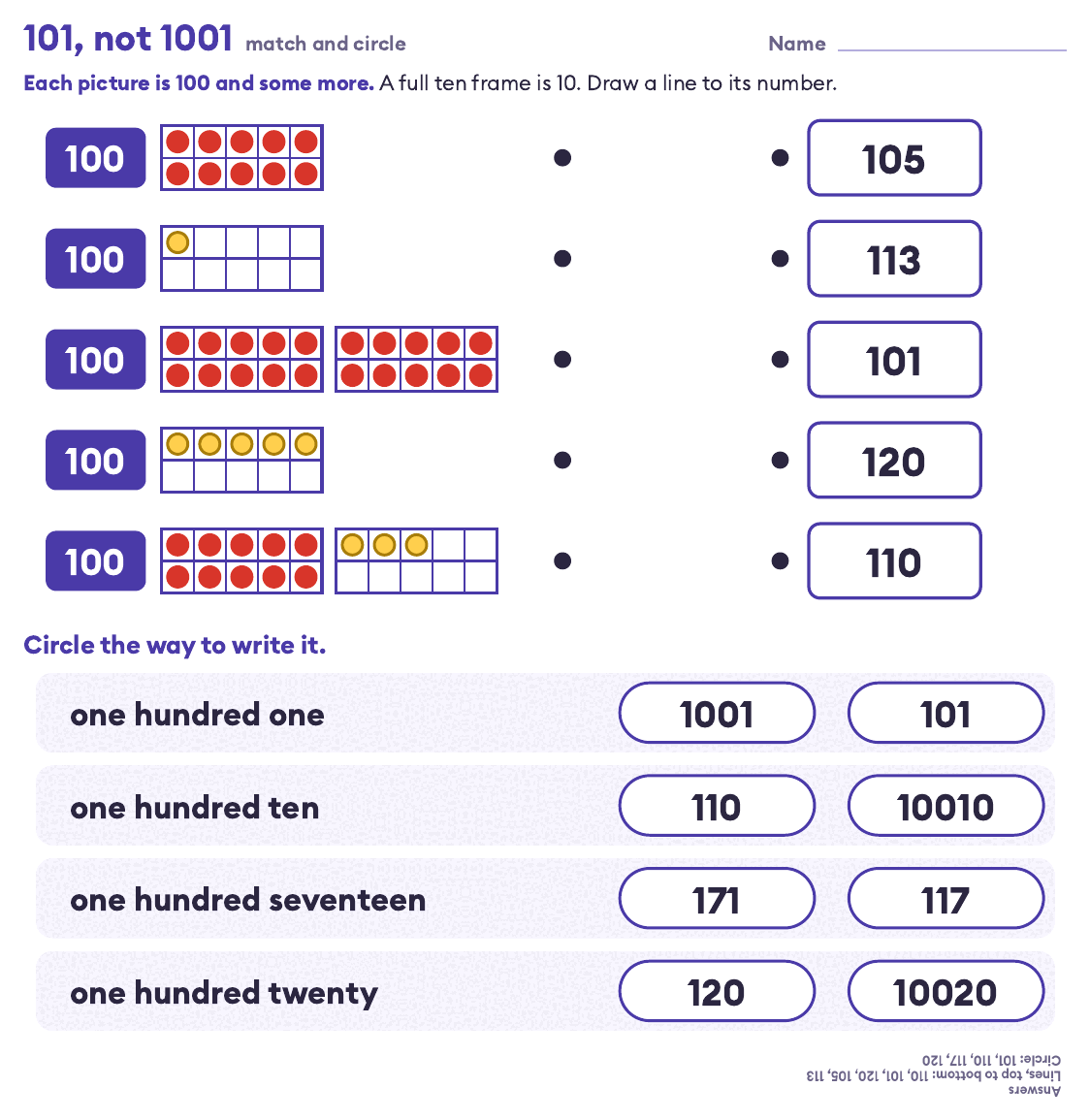
Page 6. Match, then circle.
Kids trip on three spots past 100. Those spots are 99 to 100, 109 to 110, and 119 to 120. Each one ends a row and starts a new ten.
Some kids say “one hundred, two hundred” after 100. If yours does, say the next number for them. “One hundred one.” Then they can keep going.
The bigger surprise is writing. Many kids write what they hear. One hundred one becomes 1001. One hundred ten becomes 10010. One hundred seventeen may come out as 171. This is a normal step. Young children write big numbers the way they sound.
The chart is the fix. 101 sits right under 91, and it has three digits like every number in its row. Point to it. Then practice short stretches, like 97 to 103, 107 to 113 and 115 to 120.
Page 6 puts this on paper. Each picture is a 100 card and some ten frames. A full frame is 10, and the yellow dots are the ones. Your child draws a line to the number. Then they circle 101 or 1001, and 117 or 171. The 117 and 171 mix-up comes from the teen names. See why eleven and twelve break the pattern.
The counting maze below puts 1001, 10010 and 171 right next to the real path.
120 chart missing numbers
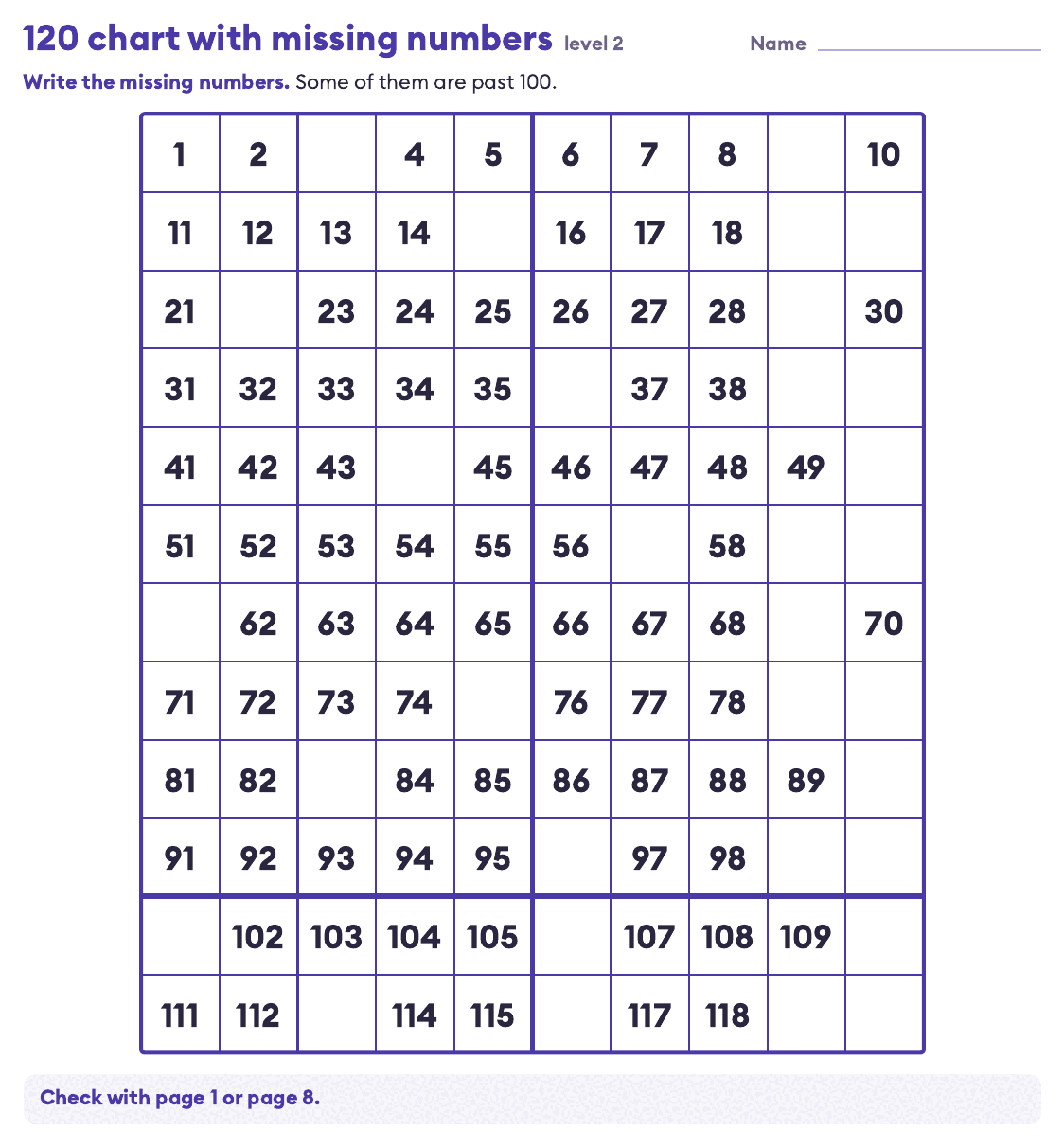
Page 3. 32 numbers to fill in.
Fill in the 120 chart a little at a time. Pages 2 to 4 are three levels.
- Level 1 (page 2). Rows 91 to 120 with 9 blanks. Then three count-on strips from 97, 106 and 114, and one count-back strip from 103.
- Level 2 (page 3). The whole chart with 32 blanks, about 1 in 4. Most hide in the 9s and 10s columns, near the ends of rows.
- Level 3 (page 4). 61 to 120 with only the numbers that end in 5 or 0.
These also work as counting to 120 worksheets. Check each one with page 1 or page 8.
Blank 120 chart
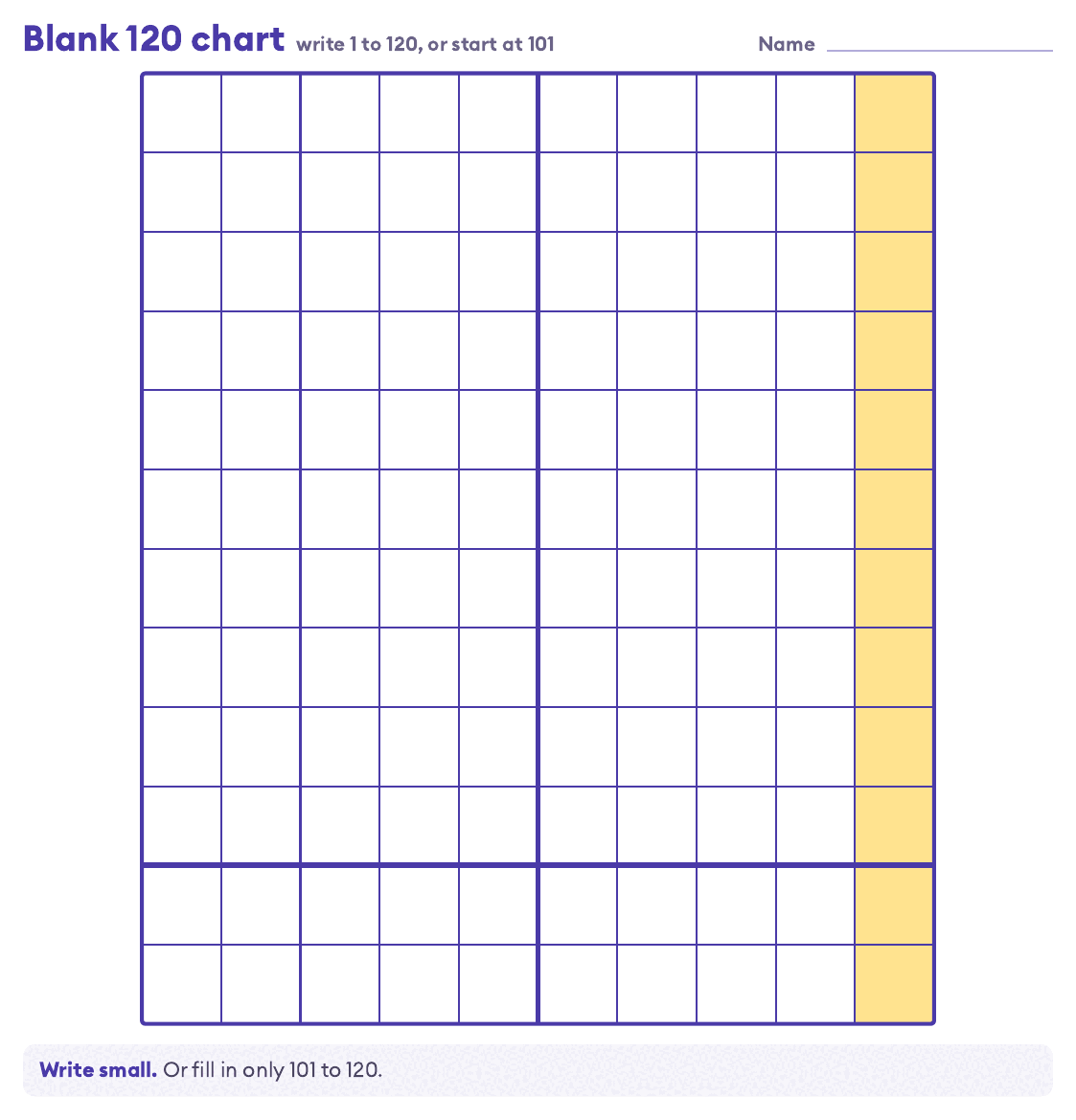
Page 9. The yellow tens column, the line down the middle and the line under 100 are the only marks.
Page 9 is a blank 1-120 chart. Your child can write 1 to 120 over a week, a few rows a day. Once 1 to 100 is solid, they can start at 101. The boxes are small. Big writers can do 101 to 120 only.
Cut and paste: finish the chart from 101 to 120
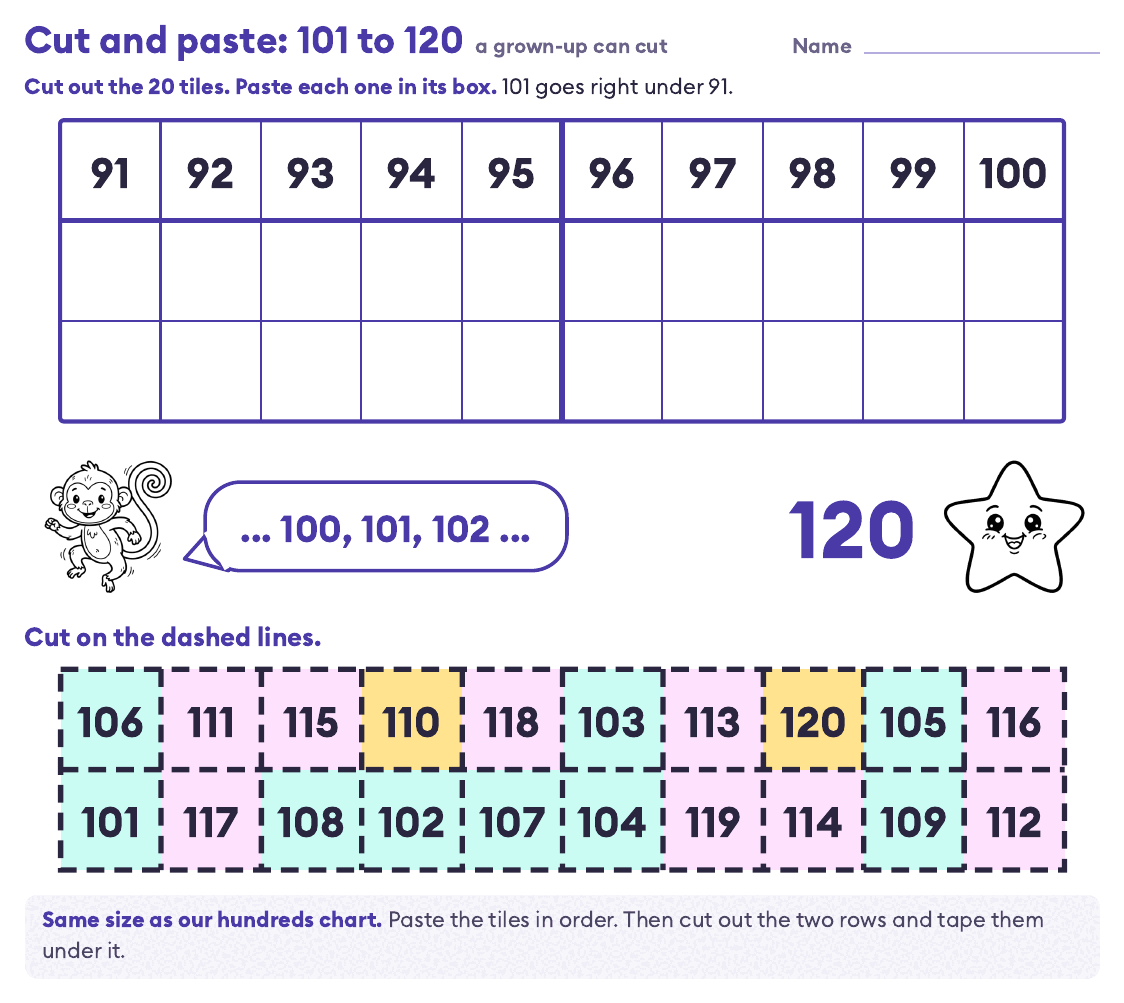
Page 5. 101 goes right under 91.
Page 5 prints the row 91 to 100, with two empty rows under it. Below are 20 mixed-up tiles, 101 to 120, in a grid with straight cuts. A grown-up can do the cutting.
Your child pastes each tile in its box, in order. Then cut out the two rows and tape them under our hundreds chart. Now it’s a 120 chart.
120 chart activities and puzzles
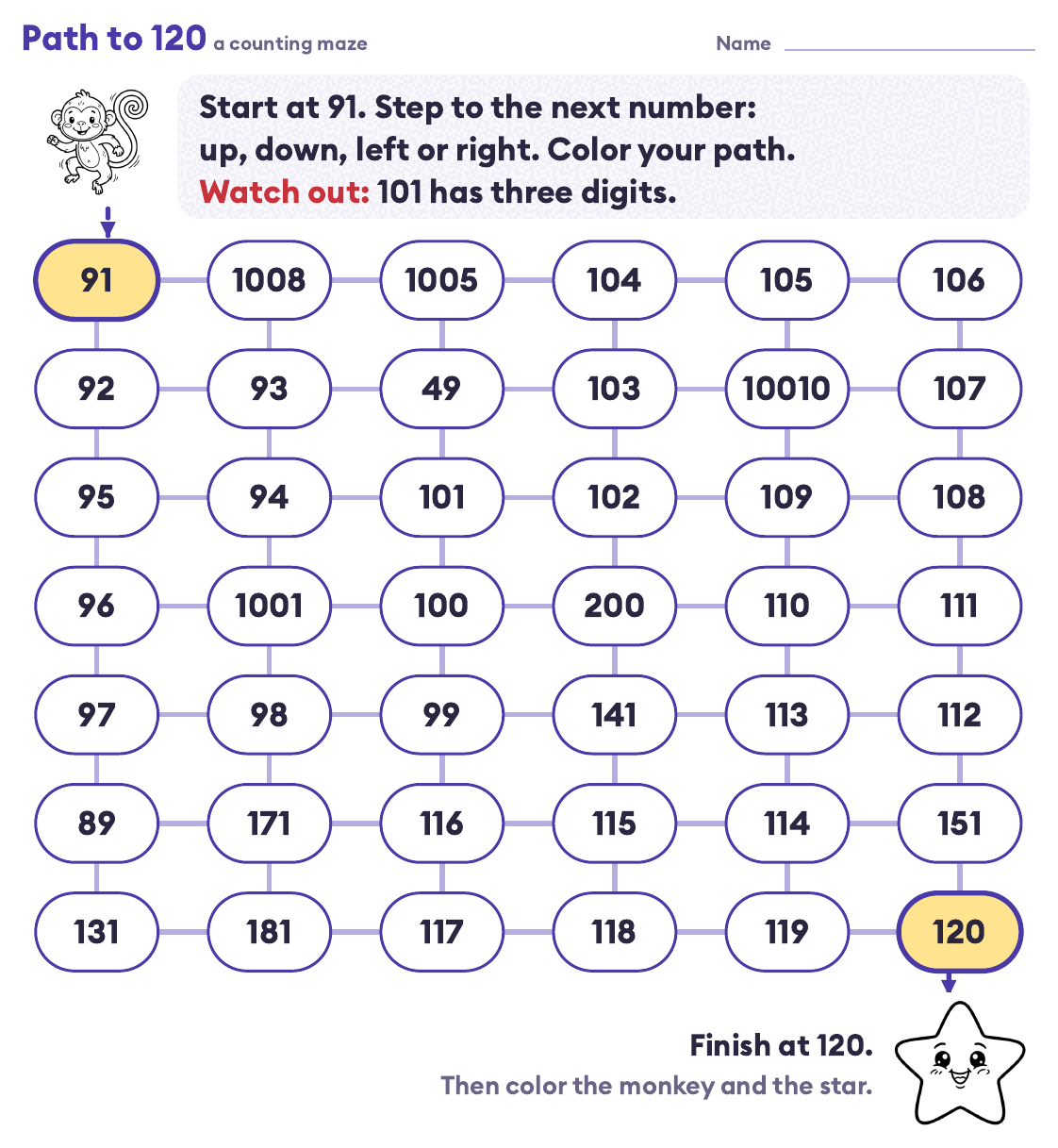
The maze PDF, page 1. From the monkey to the star.
You’ll find our free Path to 120 counting maze as its own 2-page PDF. Your child starts at 91, steps to the next number up, down, left or right, and colors the path to 120. Traps sit where kids slip, like 1001 next to 100. Page 2 is a longer path from 81, with both answer keys.
The free 120 chart mat and task cards is a color desk chart to laminate, with 16 task cards to cut out, like “Find 101” and “10 more than 95”. Your child marks each answer with a dry-erase marker, or with a bean while a grown-up stays close by. The answer is upside down in the card’s corner.
Page 7 holds a set of 120 chart puzzles. Each piece has one number given. Your child writes the rest. Right is 1 more. Left is 1 less. Down is 10 more. Up is 10 less.
Counting by 2s and 5s is on our skip counting chart.
Here are three quick 120 chart games to play at the table. They use only page 1.
- Find it fast. Say a number past 100. Your child points to it, then to the number above it.
- Down one, over two. Start on 95. Go down one row and two boxes to the right. Where are you? 107.
- Count on from a card. Write a number from 95 to 115 on a card. Count on from it to the end of its row.
For a hidden picture on a chart, our 100th day mystery pictures are the place.
FAQ
Is a 120 chart a good way to teach counting?
Yes, as one tool. It shows that the pattern keeps going past 100. Count real things alongside it, like snacks or toys.
What grade learns to count to 120?
1st grade. Kindergartners count aloud to 100, and 1st graders take it to 120 and write those numbers. A kindergartner can still point along and count past 100 on the chart with a grown-up. See at what age should a child count to 100.
Is a 0-119 chart better than a 1-120 chart?
A 1-120 chart matches the 1st grade goal and ends on 120. A 0-119 chart keeps each ten in one row. That chart stops short of 120. Pick one and stay with it. More on start at 0 or 1 in our hundreds chart guide.
How do you write 101 to 120 in words?
One hundred one, one hundred ten, one hundred twenty. Many people say “one hundred and one”. Some teachers drop “and” and save it for decimals later. Both are fine to say. On paper, what matters is three digits.
The takeaways
- A 120 chart is 1 to 120 in 12 rows of 10. One box down is 10 more, even past 100.
- 101 sits right under 91. That number has three digits, like every number in its row.
- Writing 1001 for 101 is a normal step. Point to the chart and practice short stretches.
- Print the free 120 chart PDF: color, missing numbers, cut and paste, matching and blank. 9 pages, no signup.
- Walk the Path to 120 maze from the monkey to the star, and watch for 1001.
- Laminate the 120 chart mat and use the task cards with a dry-erase marker.
Numbers past 100 happen on paper. In the Luvinci app, the counting boards stay within 10. Your child matches pictures of 1 to 10 things to their numbers while a voice says each one. The first counting board is free. See how Luvinci’s math games work.
Sources
- Common Core State Standards for Mathematics (2010): Kindergarten K.CC.1, K.CC.2 and K.CC.3; 1st grade 1.NBT.1 and 1.NBT.5.
- Texas Essential Knowledge and Skills for Mathematics, 19 TAC §111.3, Grade 1, 1.5A-C.
- Common Core Standards Writing Team (2011). Progressions for the Common Core State Standards in Mathematics: K-5, Number and Operations in Base Ten.
- Illustrative Mathematics. Task 681, “Start/Stop Counting II”, and task 405, “Crossing the Decade Concentration”.
- Byrge, L., Smith, L. B., and Mix, K. S. (2014). Beginnings of place value: How preschoolers write three-digit numbers. Child Development, 85(2), 437-443.
More free math worksheets: ten frames, number charts, addition and subtraction, daily practice workbooks and more, all in one place. See the math printables →
