 Luvinci
September 27, 2026
Number Chart 1-50: Free Printable Charts 1 to 50 (PDF)
Free printable · PDF · 622 KB
Number Chart 1-50: Free Printable Charts 1 to 50 (PDF)
No signup needed. Just print it.
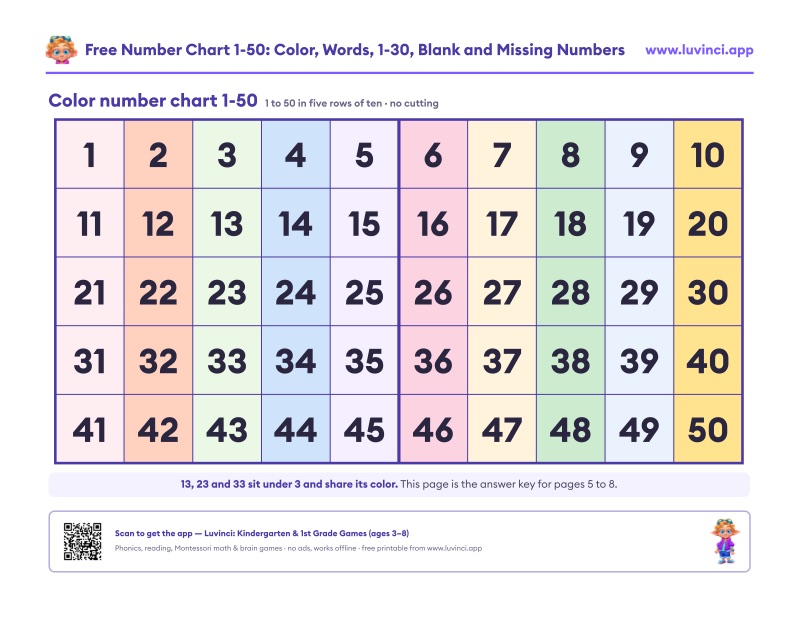
Download PDFOur number chart 1-50 puts the numbers 1 to 50 in five rows of ten, so every number sits right above the number that’s 10 more. The first two rows are the 1-20 chart your child may already know, and this page is the top half of a hundreds chart.
The free number chart 1-50 PDF has 10 pages: a color chart, a big 1-30 chart, a chart with number words, a black and white chart, missing numbers for kindergarten and 1st grade, a columns page, a blank chart, a cut-out puzzle and number cards 21 to 50. There’s no signup, and you don’t leave an email.
The one thing to practice is the end of each row. Most kids get from 19 to 20 fine, then stall at 29 and, most of all, at 39. Point to 29 and 39 and ask what comes next. More on that below.
When 50 feels easy, keep going on the hundreds chart, same rows, all the way to 100.
Jump to: the free PDF · how to read it · 1 to 30 first · number words · counting to 50 · worksheets · activities
Free number chart 1-50 printable PDF
All 10 pages are landscape, US Letter. This is what each page holds:
- Color number chart 1-50 (page 1). Five rows of ten, big numbers, no cutting. The page for the fridge, and the answer key for pages 5 to 8.
- Number chart 1-30 (page 2). Three rows of ten in bigger boxes, for kids still counting to 30.
- Number chart 1-50 with words (page 3). Each number with its name underneath, from one to fifty.
- Black and white number chart 1-50 (page 4). Ink only, for coloring.
- Say the missing numbers (page 5). 12 numbers hide in circles. Kindergartners say them.
- Missing numbers 1 to 50 (page 6). Three strips to write in, easiest first.
- Finish the columns (page 7). One number in each column. 1st graders write the rest: down is 10 more, up is 10 less.
- Blank number chart 1-50 (page 8). 50 empty boxes, with the tens column in yellow.
- Number chart 1-50 puzzle (page 9). The color chart with dashed lines for 5 chunky pieces. Build it again on page 8.
- Number cards 21 to 50 (page 10). 30 cut-out cards, the same size as the boxes on page 8. The number cards on page 8 of our number chart 1-20 PDF are the same size too, so together they fill the whole chart.
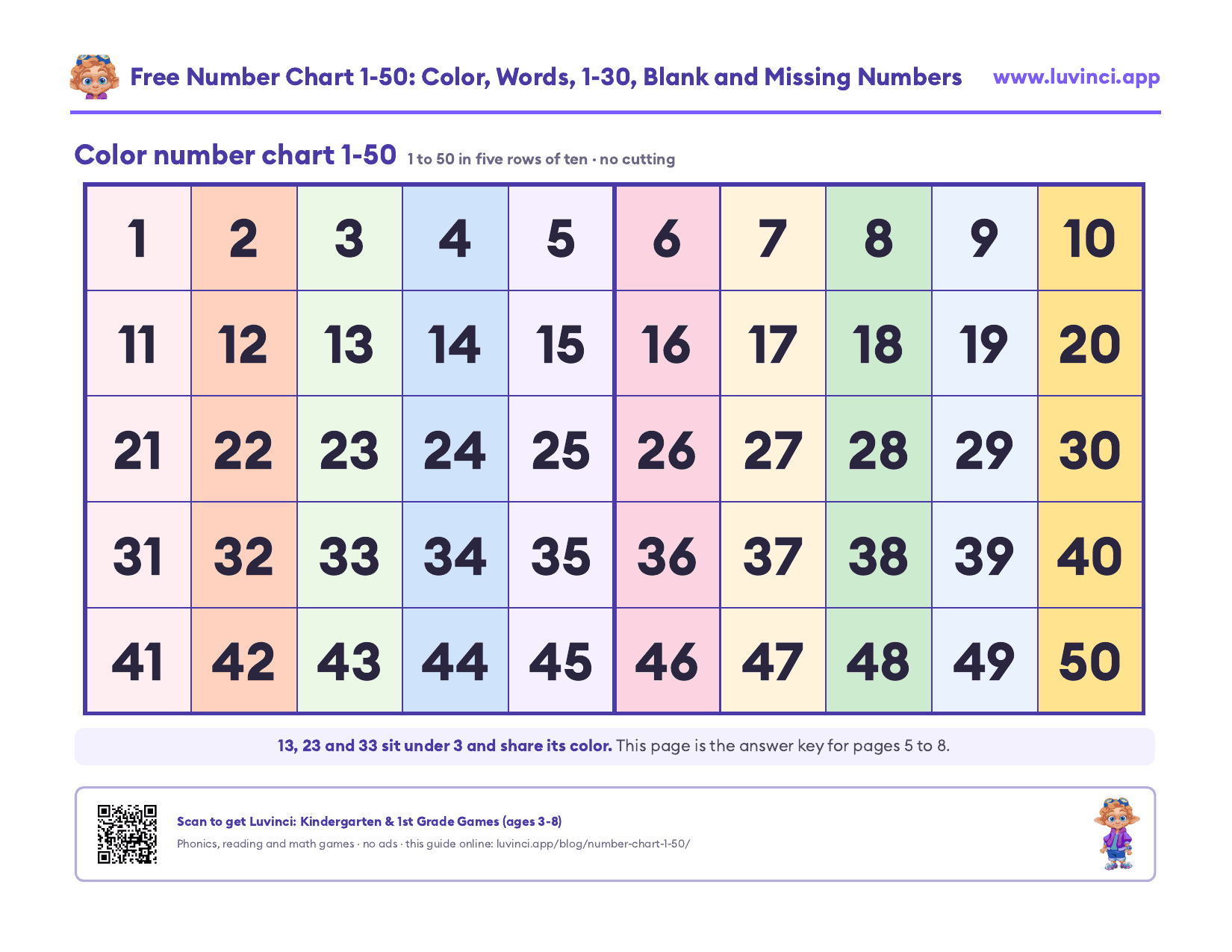
Page 1: 13, 23, 33 and 43 sit under 3 and share its color.
Print tips: set the printer to landscape and print at actual size (100%), not “fit to page”, so the puzzle pieces and cards fit page 8. The colors are light, so the PDF still prints fine in black and white, and the yellow column comes out light gray. Slip pages 5 to 8 into a sheet protector and they become dry-erase. Print pages 9 and 10 on cardstock.
How to read a number chart 1 to 50
Read each row left to right, the way you read a book. After 10, drop to the next row. That’s 11. 31 starts row 4, right under 21.
Then look down the columns. Every number in a column ends the same way: 4, 14, 24, 34, 44. On page 1 each column has its own color. In 1st grade, kids learn to find 10 more without counting by ones (1.NBT.5). On this chart, that move is one step down.
Each yellow number ends its row and finishes a ten. A new ten word starts there too: twenty, thirty, forty, fifty. The thick line down the middle splits each row into two fives. 37 sits two boxes to the right of that line, in the 30s row.
Why rows of ten? Children can see the groups of ten when they say the ten words (twenty, thirty, forty…) while looking at numbers in rows of ten (National Research Council, 2009, p. 147).
This 1-50 chart’s first two rows match our number chart 1-20, color for color. Need a 1-40 chart? Cover the rows you don’t need with a strip of paper. For a 1-25 chart, cover 26 to 50. Like our other charts, it starts at 1.
Number chart 1-30: where to start
Page 2 shows 1 to 30 in big boxes, in the same colors as page 1. Use it in early kindergarten, or with a child whose counting still stops in the 20s.
Once a child gets past 20, 21 to 29 usually come easily. The switch to 30 is the hard part.
Point to the yellow box at the end of each row and say the new ten word: “twenty-nine… thirty!” When 30 comes easily, move to page 1, the full number chart to 50.
Looking for a counting to 30 worksheet? Strip A on page 6 is 11 to 30, and page 2 is the chart to check it with.
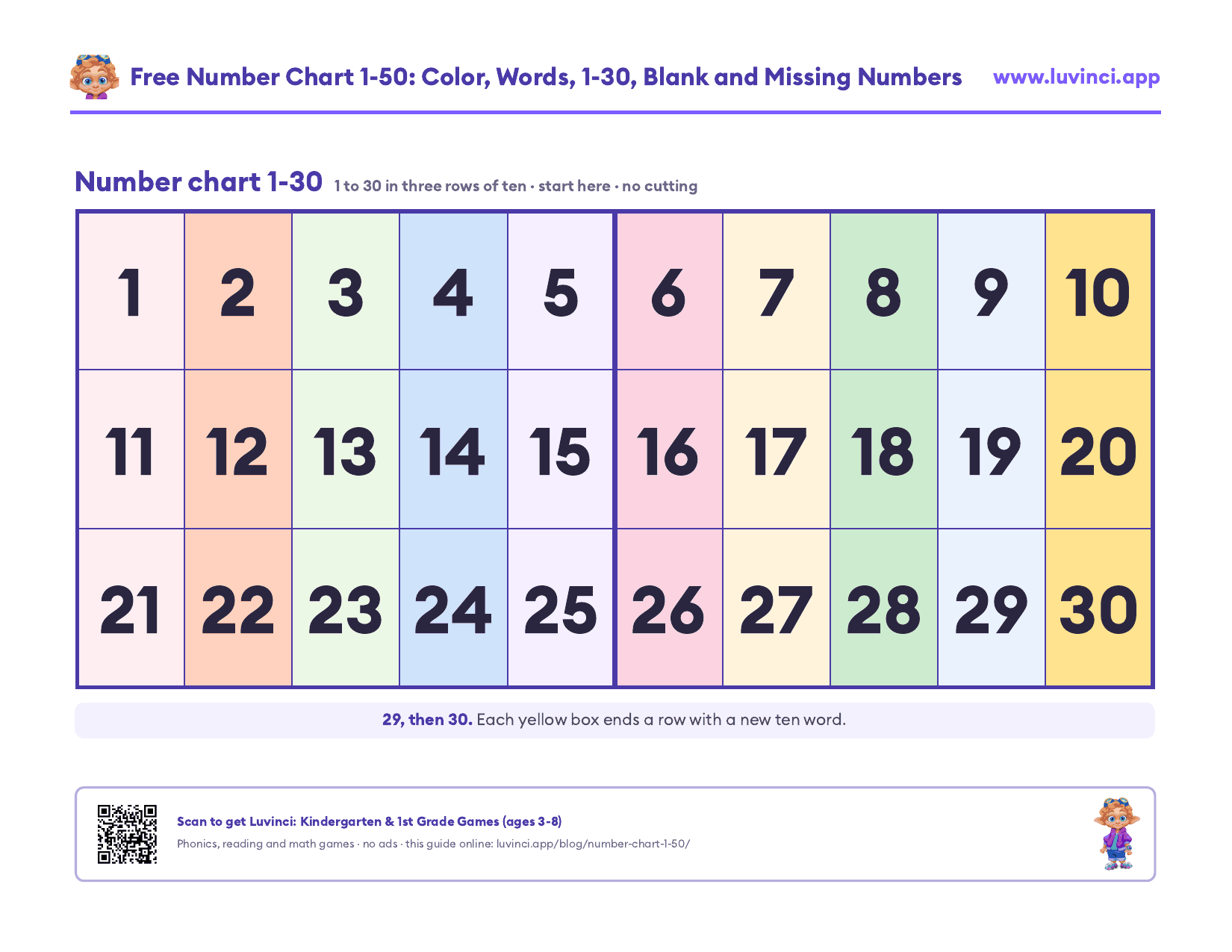
Page 2: 29, then 30. The yellow box ends the row with a new ten word.
Number chart 1-50 with words
Page 3 puts each number with its name underneath. Read the words. Spelling them can wait.
Watch the pattern. From twenty-one on, every name between the tens is a ten word plus a ones word, joined with a hyphen: twenty-one, thirty-four. On page 3 those names sit on two lines (“twenty-” over “seven”) so they fit the box.
The ten words trip kids up. Twenty, thirty, forty and fifty don’t clearly say “two tens, three tens, four tens, five tens” (National Research Council, 2009, p. 143). All four sit on this chart, so say them slowly and point to the yellow column.
Ways to use it:
- Cover and say. Cover a word with your finger. Your child reads the number above it, says the word, then lifts your finger to check.
- Find it. “Find forty-two.” Your child looks for the word, then reads the number.
Want to practice writing the words? The number tracing worksheets have number words to trace.
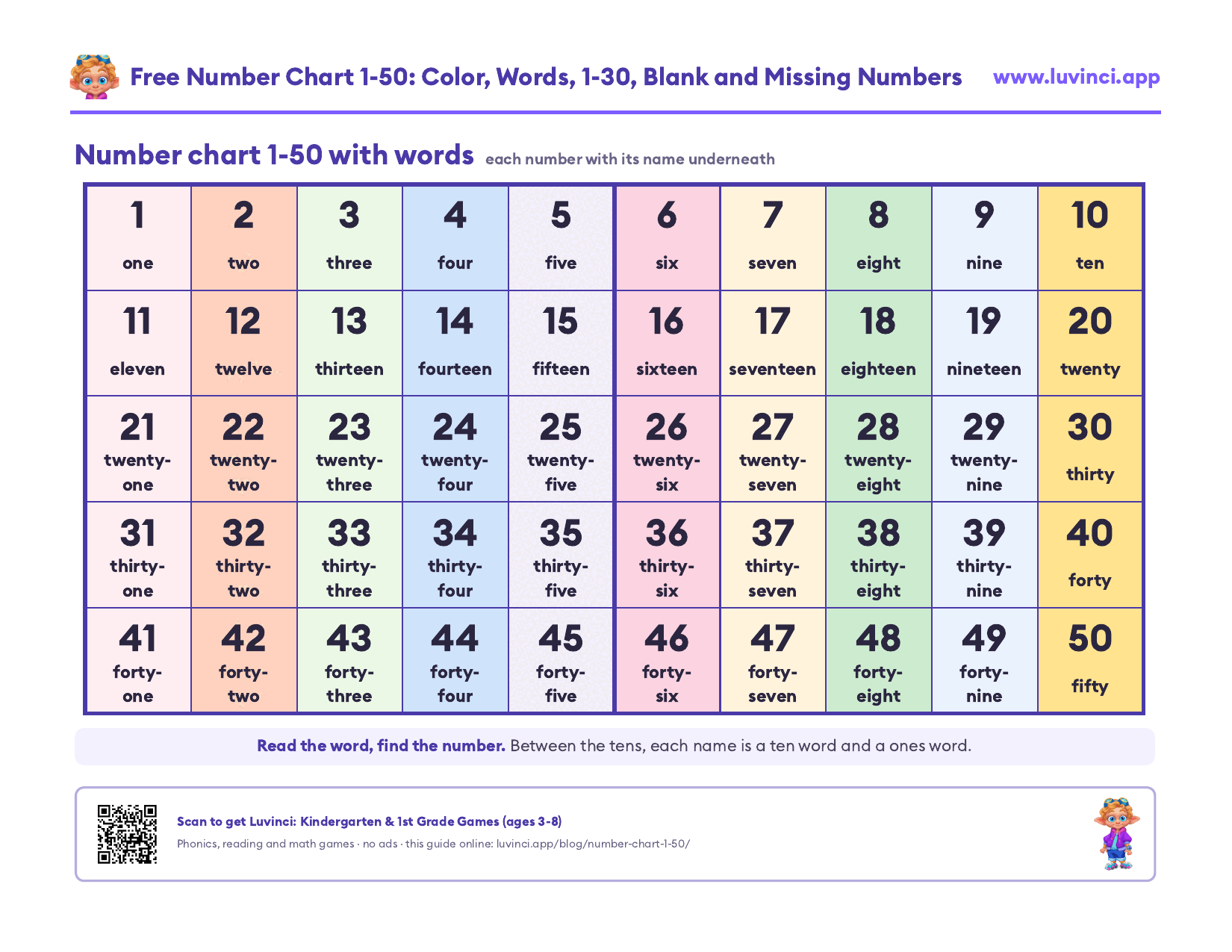
Page 3: between the tens, each name is a ten word and a ones word.
How to teach counting to 50
Counting to 50 is a mid-kindergarten step on the way to 100 (K.CC.1: “Count to 100 by ones and by tens.”). The hundreds chart guide covers the slips you’ll hear on the way to 100. Up to 50, these are the ones that matter.
19 to 20 is easy. 29 to 30 is not. In a study of more than 800 kindergartners in Australia (Gould, 2016, p. 275), more than twice as many stopped at 20 as at 19, and children who got past 20 “were unlikely to stop before reaching 29”. Knowing 30 comes after 29 was harder.
39 is the big one. In the middle of the second term, 17% of the children stopped at 39, and it was still the biggest stopping point in term 3 (Gould, 2016, pp. 276-277). A highest count of 49 climbed the list later, but only to fifth place (p. 276). Once children got past 39, they seemed to use the same pattern for the rest of the tens up to 100 (p. 277). For many children, getting the ten words in order is a kindergarten achievement (National Research Council, 2009, p. 143).
Practice the end of the row. Point to 9, 19, 29, 39 and 49 and ask what comes next. On the chart the answer is always the yellow box right next to it: 10, 20, 30, 40, 50. After the yellow box, the next row starts.
Fifteen or fifty? Gould (2016, p. 272) notes that “thirteen sounds similar to thirty, fourteen to forty, fifteen to fifty”. Say the pairs slowly and point: fifteen sits in the second row, fifty at the end of the last row. Our teen numbers guide has more on the mix-ups.
Begin at 27. Counting on from a number other than 1 is a kindergarten skill too (K.CC.2). Put a finger on 27, then count together to 35. If the count keeps going back to 1, lay a strip of paper over the first two rows and 21 to 26.
Fifty real things. Count 50 real things in groups of ten, like cups or blocks, then find 50 on the chart. Saying the numbers is one skill. Counting things is another. Counting things needs one number for each thing, which is one to one correspondence.
Counting to 50 worksheets: missing numbers 1-50
Kindergarten: page 5. Your child touches each circle, says the hidden number out loud, and checks it on page 1. Kindergartners are only expected to write numbers to 20 (K.CC.3), so this page is for saying. The 12 hidden numbers include 20, 30, 40 and 50, while 19, 29, 39 and 49 stay printed. So every switch to a new ten gets said out loud. Once writing to 50 comes, the circles are big enough to write in.
1st grade: page 6. In 1st grade, kids learn to read and write numbers up to 120 (1.NBT.1). Page 6 has three strips to fill in:
- Strip A: 11 to 30, five missing numbers.
- Strip B: 21 to 40, seven missing, including 29 and 30 side by side.
- Strip C: 31 to 50, with only 31, 35, 40, 41, 45 and 50 given.
If they’re stuck, hold back the answer. Count on together from a number your child can see, or, in a strip’s bottom row, look one row up. The number above is 10 less. Then check with page 1.
These counting 1-50 worksheets get harder strip by strip. Still learning to form the numbers? Start with our number tracing pages.
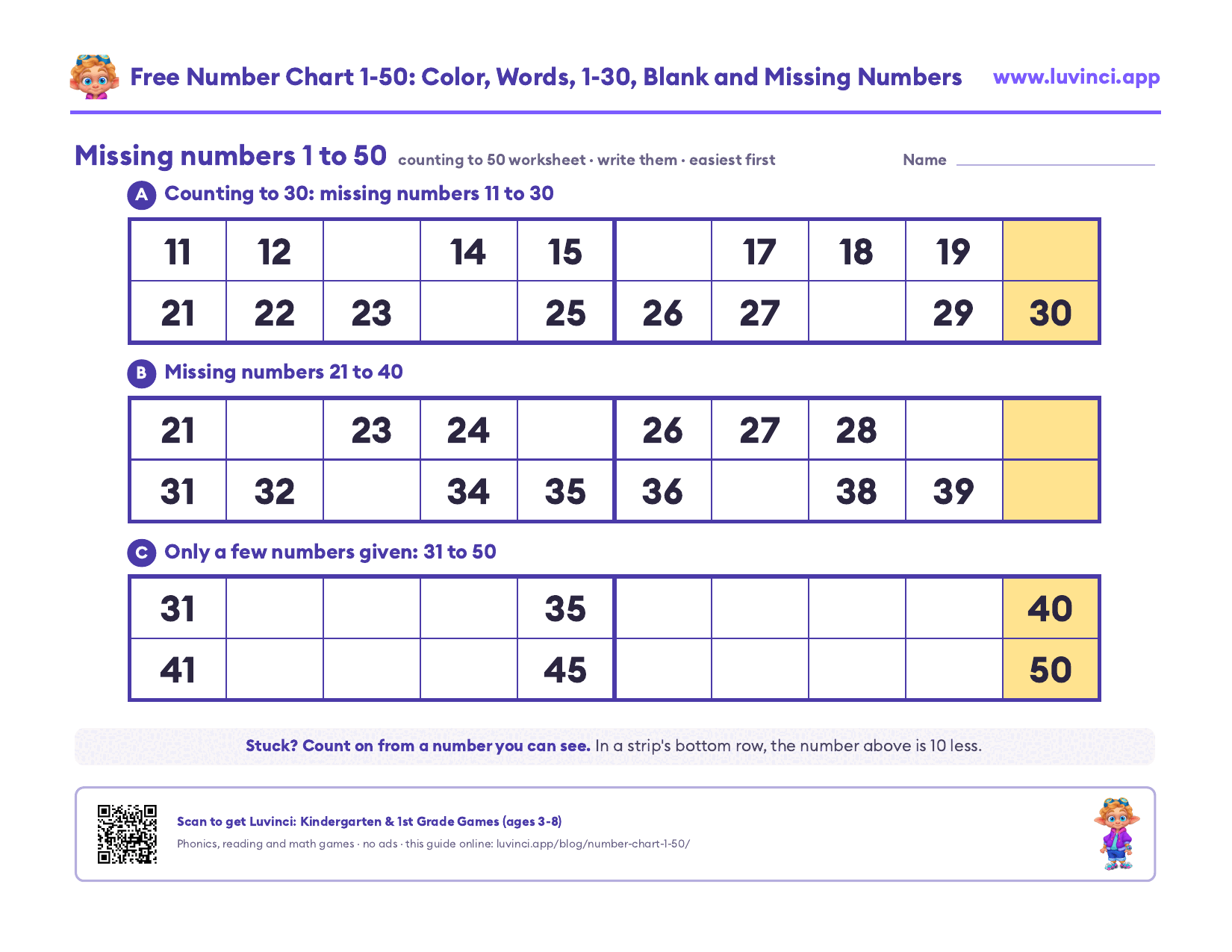
Page 6: in a strip’s bottom row, the number above is 10 less.
Number chart 1-50 activities
Five short ones, each 5 minutes or less:
- Finish the columns (page 7, 1st grade). Each column has one number. Down is 10 more, up is 10 less. Start with the 2 column (2 is at the top), then the 30 column (30 is in the middle). The 43, 46 and 47 columns start in the bottom row, so your child works all the way up.
- Build the puzzle (pages 8 and 9). A grown-up cuts page 9 into 5 pieces. Mix them and build the chart on page 8. Start with the piece that has 1 in it. The tall piece on the right holds every 9 and every ten: 29 and 30, 39 and 40, 49 and 50.
- Color as you go (page 4). Color a row each time your child counts it out loud alone. Then color the 9s column: 9, 19, 29, 39, 49. Coloring every 2nd or 5th number is a different job: see our skip counting chart.
- Count-On Race to 50 (page 1). Each player puts a paper square just before 1. Roll a die: 1, 2 and 3 move that many, 4 moves 1, 5 moves 2 and 6 moves 3. Say only the numbers you step on: on 27, roll 2, say “28, 29”. First to 50 wins. Why counting on matters is in our hundreds chart guide.
- Number cards (pages 8 and 10). A grown-up cuts page 10. Your child writes 1 to 20 in the top two rows of page 8, then lays the cards from 21 on: the yellow cards (30, 40, 50) first, then each row. Got the number chart 1-20 PDF? Its number cards are the same size, so the top two rows can be cards too. Mixed up and turned face down, the cards make a find-its-place round for 1st graders.
For markers on the chart, use paper squares or crayon dots. Small counters are a choking hazard for young children.
FAQ
At what age should a child count to 50?
About halfway through kindergarten, around age 5 or 6. One New York school’s kindergarten report card guide marks 50 as on track by the end of the second quarter and 100 by the end of the year. In Gould’s study, the middle child counted to 50 by the end of term 2, halfway through the school year (2016, Table 1, p. 277). At the same point, a quarter of the children stopped at 30 or below, so a child counting to 30 mid-year has plenty of company. Counting to 100 is the end-of-kindergarten goal (K.CC.1).
How do you count from 1 to 50?
Count 1 to 10 along the top row, then the teens in the second row. From 21 on, each row says its ten word with 1 to 9 and ends on the next ten word: thirty, forty, fifty.
How do you figure out a missing number?
Count from the last number you know. Or use the column. The number above is 10 less, and the number below is 10 more.
What are some fun ways to practice counting to 50?
The Count-On Race above, the puzzle and the number cards. For 1st graders, try Race to 50 from our first grade math games.
When is my child ready for a bigger chart?
When 50 comes easily and 39 to 40 gives no trouble. Then use the hundreds chart. Same rows of ten, all the way to 100.
The takeaways
- Our number chart 1-50 is five rows of ten. 23 sits under 13, and one step down is 10 more.
- 50 is a mid-kindergarten step, and 100 comes by the end of the year.
- 39 is the big stopping point. 19 to 20 is easy, so practice the end of each row.
- Kindergartners say the hidden numbers on page 5. 1st graders write the strips and the columns.
- Print the free number chart 1-50 PDF: a color chart, a 1-30 chart, number words, missing numbers, columns, a blank chart, a puzzle and cards.
In the app’s free counting board (Counting 1, in the Early Math row), your child matches cards of 1 to 10 strawberries to their numbers while a voice says each number. None of the counting boards goes past 10, so counting to 50 happens on this chart. See how Luvinci’s math games work.
More free math worksheets: ten frames, number charts, addition and subtraction, daily practice workbooks and more, all in one place. See the math printables →
