 Luvinci
September 14, 2026
1st Grade Word Problems with Pictures (Free PDF with Answers)
Free printable · PDF · 1156 KB
1st Grade Word Problems with Pictures (Free PDF with Answers)
No signup needed. Just print it.
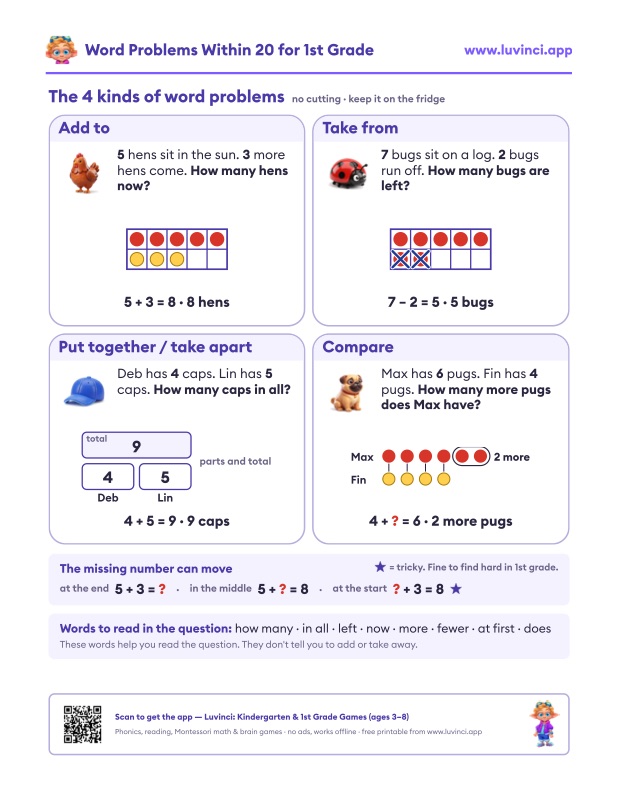
Download PDFThese 1st grade word problems come with pictures, a box to draw in and an answer key, so they are math word problems for 1st graders that your child can act out, draw and solve. Many teachers call word problems story problems. Each one is a tiny story that ends with a question, like “5 hens sit in the sun. 3 more hens come. How many hens now?” There are only 4 kinds in 1st grade, and the missing number can sit at the end, in the middle or even at the start.
Everything is in one free word problems PDF of 12 pages: a chart of the 4 kinds, read-aloud kindergarten problems, picture problems within 10 and within 20 with ten frames to draw in, a parts-and-total page, a compare page, a challenge page, three-number problems, a “which kind is it?” page, problems with no numbers, and a 2-page answer key. No signup, no email.
You’re in part 1 of our word problems series. Part 2 takes the same 4 kinds up to 100 in 2nd grade.
Jump to: what 1st grade expects · the 4 kinds · 12 examples · how to teach them · kindergarten · the PDF · mistakes · FAQ
1st grade word problems: what the standards expect
First grade word problems all sit under one Common Core standard, and the wording is precise. The full text (1.OA.1):
“Use addition and subtraction within 20 to solve word problems involving situations of adding to, taking from, putting together, taking apart, and comparing, with unknowns in all positions, e.g., by using objects, drawings, and equations with a symbol for the unknown number to represent the problem.”
- Within 20. Every number in the story and the answer is 20 or less.
- Four kinds of stories: add to, take from, put together (or take apart), and compare. The next section shows each.
- “Unknowns in all positions.” The missing number can be at the end, in the middle (how many came or went) or at the start. “5 hens. Some more came. Now 8. How many came?” is a middle-missing problem.
- Three numbers (1.OA.2): “Solve word problems that call for addition of three whole numbers whose sum is less than or equal to 20”. Page 8 of the PDF has these.
- Objects, drawings and equations. Act it out, draw it, then write it with a box or “?” for the missing number: 5 + ? = 8.
Practice now, master later
Most versions of these 4 kinds get mastered in 1st grade. Four tricky ones are practiced now and mastered in 2nd grade: add to with the start missing, take from with the start missing, and two compare wordings that point to the wrong operation. Here is one: “Ren has 3 fewer cubs than Tash. Ren has 7 cubs. How many cubs does Tash have?” The story says “fewer”, but you add.
Written by the standards’ authors, the Progressions say children in 1st grade “should have an opportunity to solve and discuss such problems, but proficiency on grade level tests with these most difficult subtypes should wait until Grade 2” (Common Core Standards Writing Team, 2011, p. 14). Page 7 of the PDF has 6 of these, under a star.
Word problems in kindergarten stay within 10 and are read aloud (see kindergarten word problems below). In 2nd grade, the numbers grow to 100 and the 4 tricky ones are mastered (2.OA.1; Progressions p. 21).
The 4 kinds of word problems
Each 1st grade word problem is one of 4 kinds. The kind matters more than spotting a word like “more” or “left”, because the same word can mean adding in one story and subtracting in another. A practice guide from the Institute of Education Sciences puts it this way: “Identifying a problem type is different from determining the operation used to solve the problem” (Fuchs et al., 2021, Rec. 5).
In the table, ★ means “practice now, master in 2nd grade”.
| Kind | Example 1 | Example 2 | Example 3 |
|---|---|---|---|
| Add to | End missing: 5 hens sit in the sun. 3 more come. How many now? 5 + 3 = ? | Middle missing: 5 hens. Some more come. Now 8. How many came? 5 + ? = 8 | ★ Start missing: Some hens. 3 more come. Now 8. How many at first? ? + 3 = 8 |
| Take from | End missing: 7 bugs. 2 run off. How many are left? 7 - 2 = ? | Middle missing: 7 bugs. Some run off. 5 are left. How many ran off? 7 - ? = 5 | ★ Start missing: Some bugs. 2 run off. 5 are left. How many at first? ? - 2 = 5 |
| Put together / take apart | Total missing: Deb has 4 caps. Lin has 5 caps. How many in all? 4 + 5 = ? | One part missing: 9 caps. Deb has 4. How many does Lin have? 4 + ? = 9 | Both parts missing: Deb hangs 9 caps on 2 hooks. How many on one hook and how many on the other? (a kindergarten “all the ways” problem) |
| Compare | Difference missing: Max has 6 pugs, Fin has 4. How many more does Max have? 4 + ? = 6 | Bigger one missing: Max has 2 more than Fin. Fin has 4. How many does Max have? (★ when it says “Fin has 2 fewer than Max”) | Smaller one missing: Max has 6. Fin has 2 fewer. How many does Fin have? (★ when it says “Max has 2 more than Fin”) |
Add to
The group grows because something is added. End missing is the easiest version of all, and kindergartners do it too. For middle missing, count on from the start number: “Fiiive… 6, 7, 8. 3 came.” Start missing is ★.
Take from
Part of the group goes away. For end missing, cross them out. For middle missing, ask “How many ran off?” Start missing is ★, and it is the classic trap: the story says “left”, but you add. The Progressions suggest turning it around, so ? - 2 = 5 becomes 5 + 2 = ? (p. 16).
Put together and take apart
Nothing moves in this kind; two parts make a total. Total missing is easy. One part missing is solved by counting up or subtracting: “13 cats sit on a step. 6 cats are big. The rest are little. How many cats are little?” That is 6 + ? = 13, so 7 little cats.
The parts-and-total box on page 5 works like a number bond. When one part is hidden, as in 6 + ? = 13, the hidden number is called a missing addend; our fact families guide has a whole section on finding it.
Compare
Two groups, and the question is how many more or how many fewer. This kind is the newest in 1st grade and the hardest to picture, because the difference is not a group you can see (Progressions p. 12).
Matching helps. Line the two groups up in two rows and count the extras, the ones with no partner (page 6). The Progressions note that many children “do not initially hear the part about how many more”, and that “some children think that ‘less’ means ‘more’” (p. 12). Say the two parts as two sentences: “Max has more. He has 2 more.”
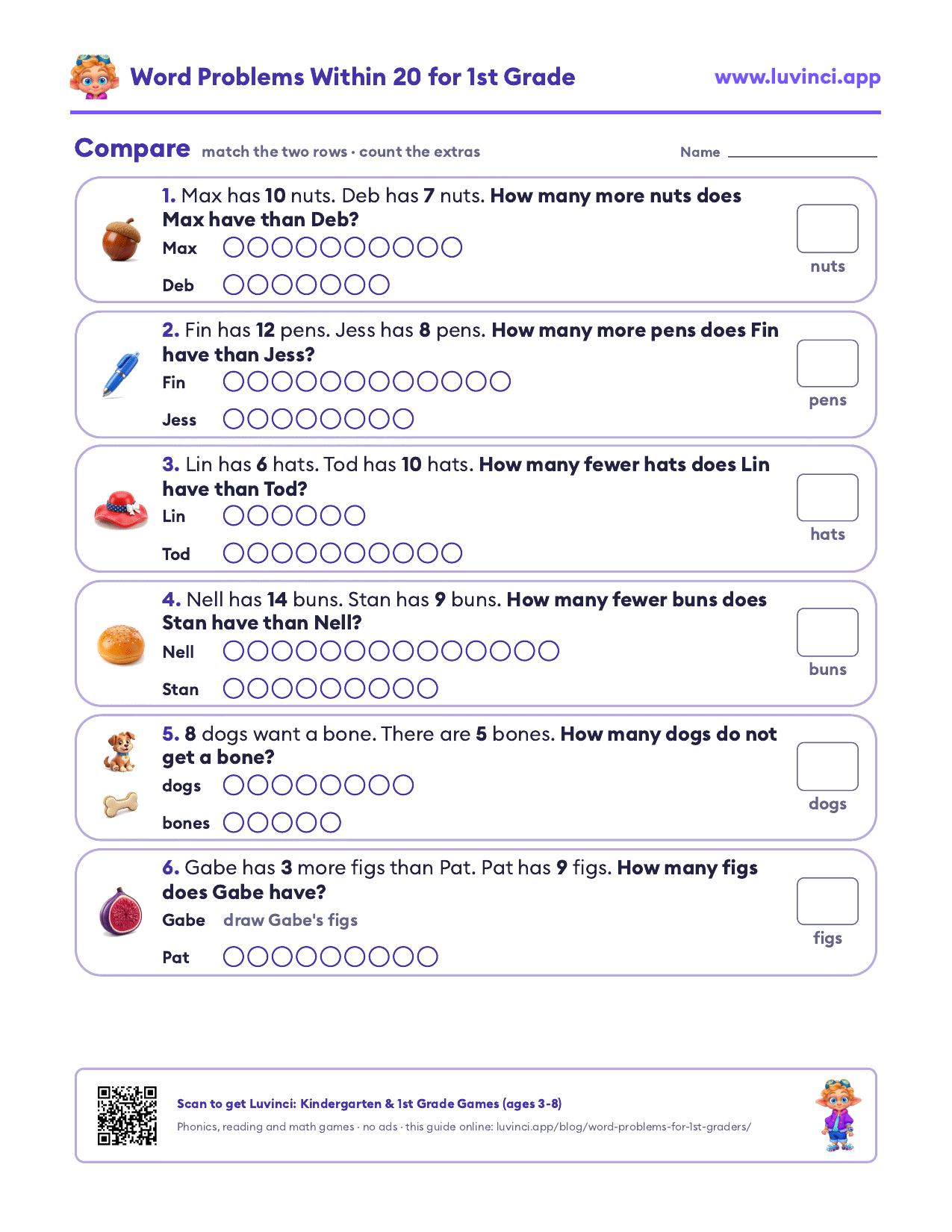
Page 6: match the two rows, then count the ones with no partner.
For the same idea without a story, using block towers and cube trains, see how many more? finding the difference.
Hunting for words like “more” or “left” backfires for this reason too. Part 2 of this series, 2nd grade word problems, has a poster of the words that trick children.
1st grade word problems: 12 examples with answers
These 12 1st grade math word problems go three per kind, all within 20. The ★ ones are the tricky kinds, and finding them hard is fine.
- Add to. Pat has 8 caps. He gets 5 more caps. How many caps does Pat have now? Answer: 8 + 5 = 13, so 13 caps.
- Add to. Brit had 9 jets. She got some more. Now she has 15 jets. How many jets did she get? Answer: 9 + ? = 15, so 6 jets.
- Add to ★. Some pugs sat on a rug. 6 more pugs came. Now 10 pugs sit on the rug. How many pugs sat on the rug at first? Answer: ? + 6 = 10, so 4 pugs.
- Take from. 17 nuts are in a sack. Dad takes 8 nuts. How many nuts are left? Answer: 17 - 8 = 9, so 9 nuts.
- Take from. 12 hens sat on a hill. Some hens ran off. Now 7 hens sit on the hill. How many hens ran off? Answer: 12 - ? = 7, so 5 hens.
- Take from ★. Tod had some pins. He gave 4 pins to Nell. Now he has 9 pins. How many pins did Tod have at first? Answer: ? - 4 = 9, and 9 + 4 = 13, so 13 pins.
- Put together. Jess has 6 big mugs and 8 little mugs. How many mugs does Jess have in all? Answer: 6 + 8 = 14, so 14 mugs.
- Take apart. Stan has 16 buns. 7 buns have jam. The rest have no jam. How many buns have no jam? Answer: 7 + ? = 16, so 9 buns.
- Put together, three numbers. Deb has 5 pens, Max has 3 pens and Lin has 5 pens. How many pens in all? Answer: 5 + 5 = 10, then 10 + 3 = 13, so 13 pens.
- Compare. Fin has 13 eggs. Gabe has 8 eggs. How many more eggs does Fin have than Gabe? Answer: 8 + ? = 13, so 5 more eggs.
- Compare. Nell has 9 bones. Tash has 16 bones. How many fewer bones does Nell have than Tash? Answer: 16 - ? = 9, so 7 fewer bones.
- Compare ★. Peg has 4 more nuts than Tash. Peg has 12 nuts. How many nuts does Tash have? Answer: 12 - 4 = 8, so 8 nuts. “More” is in the story, but you subtract.
The PDF has 52 more, and most pages give your child a ten frame or a box to draw in.
How to teach word problems in 1st grade
One problem a day is plenty. Spend about 10 minutes on it, and you read the question out loud. Start with add to and take from stories with the missing number at the end, then move on to the other kinds as those feel easy.
Act it out first
You read the story. Your child retells it with toys or acts it out. The Progressions describe children acting out situations “with objects, their fingers, and math drawings” (p. 8).
Try a home version of the classroom “three reads” routine:
- Read 1: What happens? No numbers yet.
- Read 2: What is the question?
- Read 3: Which numbers matter?
The Institute of Education Sciences guide also recommends rereading and restating “the problem in their own words” (Fuchs et al., 2021, Rec. 5). Then name the kind before solving: add to, take from, parts and total, or compare. Page 9 has tick boxes for exactly that.
Draw circles, not cats
Some children use the whole 10 minutes drawing a beautiful cat. The same guide, written about children who find math hard, has advice for them: “draw simpler sketches, such as stick figures for people or circles to represent rocks or apples” (Fuchs et al., 2021, Rec. 5, p. 50).
The box on pages 3 and 4 is an empty ten frame. Draw the first number in one color and the second in another, and fill the top row first. Within 20, use two frames and fill the left one first, so 9 + 4 shows up as one full ten and 3 more.
Drawings have one more job: “Math drawings facilitate reflection and discussion because they remain after the problem is solved” (Progressions p. 8). When an answer is wrong, the drawing shows you where.
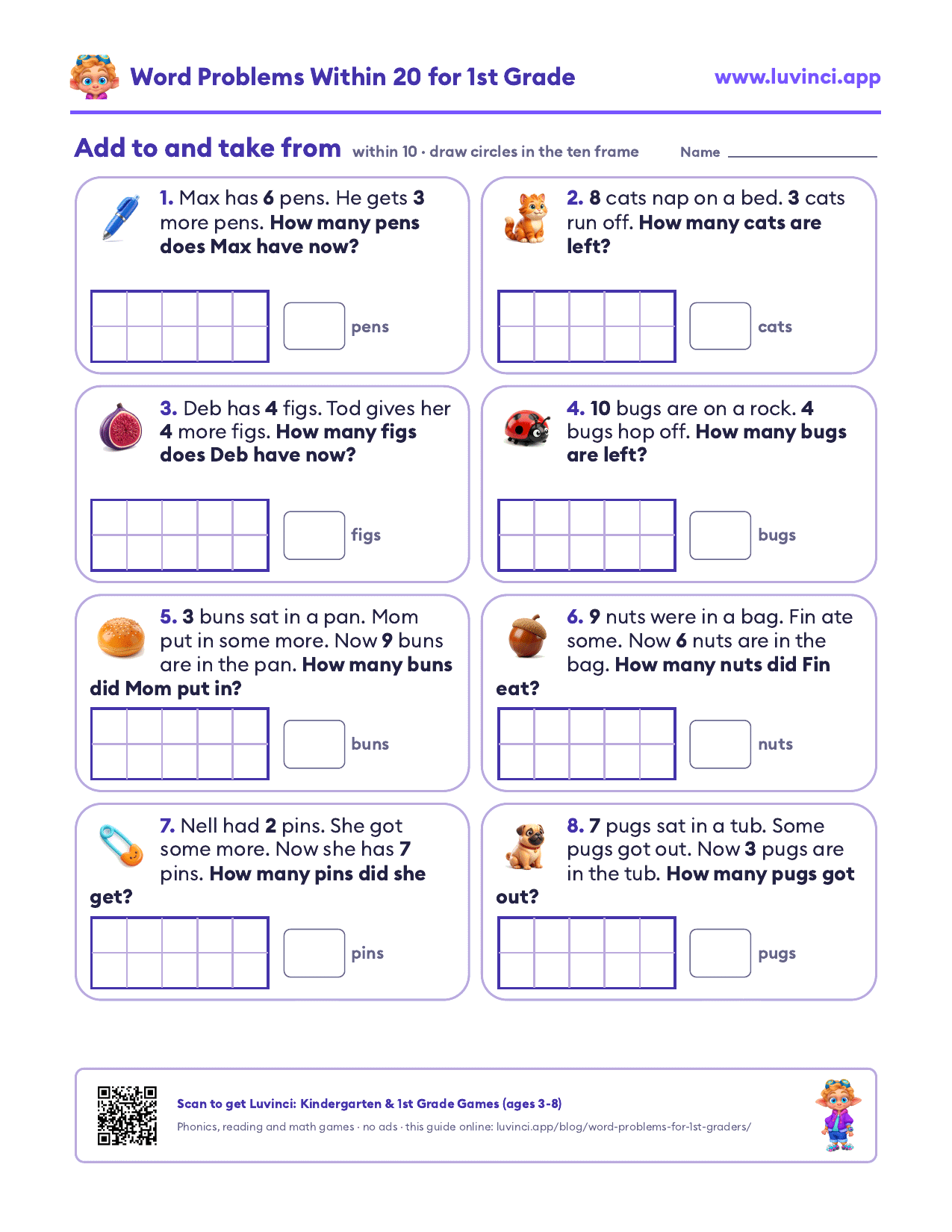
Page 3: read the story, draw circles in the ten frame, write the answer with its word.
Talk first: problems with no numbers
Your child hears the story with “some” where the numbers go, and you ask, “What could the question be?” Then show the numbers. Your child thinks about the story before grabbing numbers. Teachers call these numberless word problems.
Page 10 folds so the numbers stay hidden, and your child says the question out loud (no writing). Then unfold the page and solve the same stories with the numbers in.
Write it and say it
- Write the number sentence the way the story goes: 5 + ? = 8 for “some more came”. The standard asks for “a symbol for the unknown number” (1.OA.1).
- Answer with a word: “3 hens”, not “3”. The word shows your child knows what was counted.
- Say “total”, not “sum”: the Progressions point out that “‘Sum’ sounds the same as ‘some,’ but has the opposite meaning” (p. 8), and “some” is all over word problems.
Kindergarten word problems (read aloud, within 10)
Kindergarten has its own standard (K.OA.2): “Solve addition and subtraction word problems, and add and subtract within 10, e.g., by using objects or drawings to represent the problem.” Kindergartners hear the problem; nobody expects them to read it.
Kindergarten uses 3 of the 4 kinds (no compare), in 4 versions (Progressions pp. 8-9, 20): add to with the end missing, take from with the end missing, put together with the total missing, and both parts missing (“all the ways”). Counting every object is the method at this age; the Progressions call these concrete methods “Level 1 methods” (p. 8).
- Addition word problems for kindergarten: “2 vans are in a lot. 5 more vans come. How many vans now?” (7 vans). Push the toys together and count them all.
- Subtraction word problems for kindergarten: “8 pins are on a mat. 3 pins fall off. How many pins are left?” (5 pins). Take them away and count what is left.
- Put together: “Ren has 3 cubs. Tash has 4 cubs. How many cubs in all?” (7 cubs).
- All the ways: “Tod has 6 figs. He puts some in a cup and the rest in a bag. How many go in the cup and how many in the bag?” The answers are 0 and 6, 1 and 5, 2 and 4, 3 and 3, and the turn-arounds: 7 ways counting 0. These are the same pairs as number bonds.
Kindergarten math word problems stop at 10, and that line is the split between kindergarten and 1st grade. If 4 + 3 or 6 - 2 is still new, start with addition for kindergarten and subtraction for kindergarten.
Page 2 of the PDF has 6 kindergarten word problems with big pictures to count.
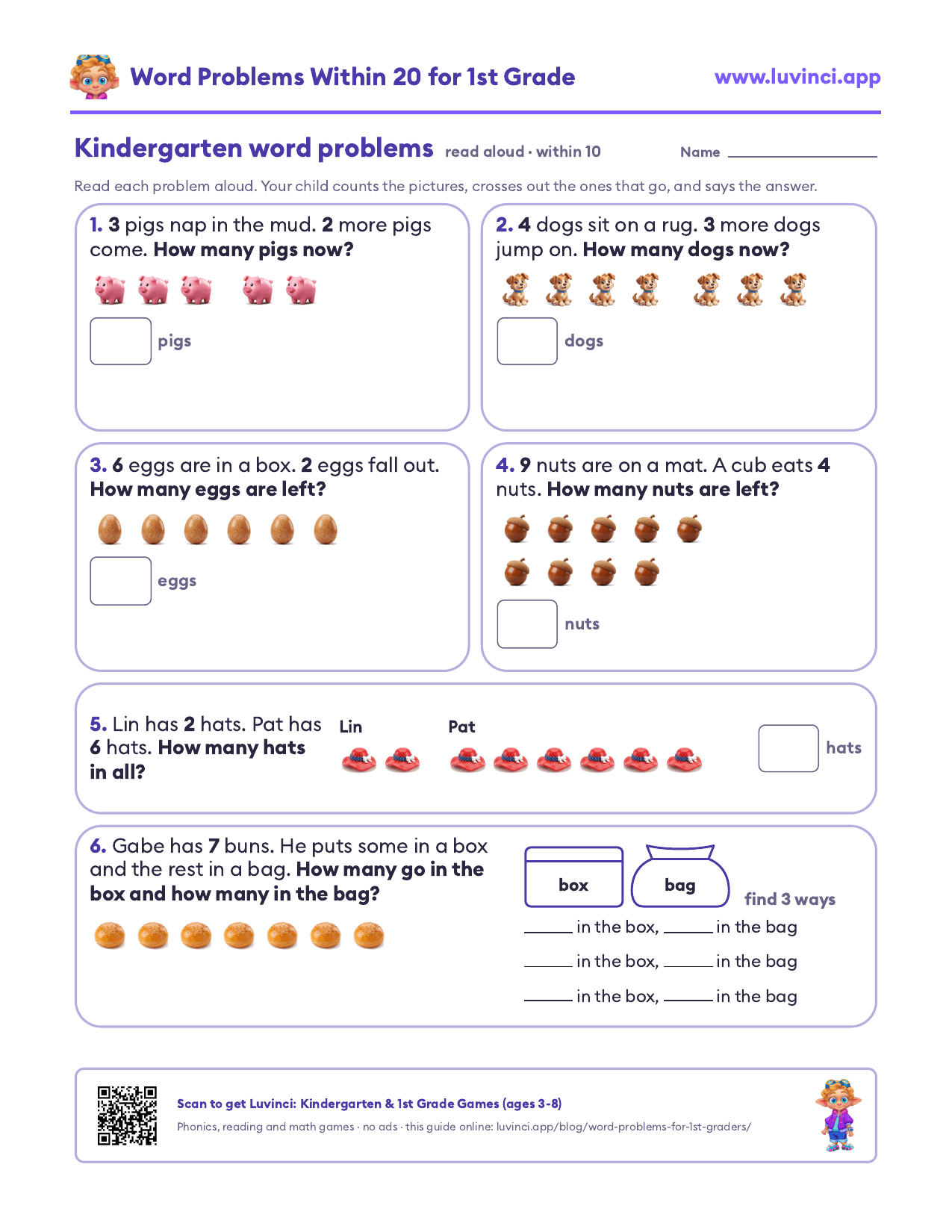
Page 2: read each one aloud. Your child counts the pictures.
The free PDF: picture word problems within 20
The PDF is free, prints in black and white, and every answer sits at the back. The story words are short, so many children can read the story part themselves by the middle of 1st grade, but the question often needs a grown-up.
- Page 1: The 4 kinds of word problems (a chart; no cutting).
- Page 2: Kindergarten word problems: 6 read-aloud problems within 10.
- Page 3: Add to and take from, within 10: 8 problems with a ten frame to draw in.
- Page 4: Add to and take from, 11 to 20: 6 problems with two ten frames.
- Page 5: Put together and take apart: 6 problems with a parts-and-total box.
- Page 6: Compare: 6 problems with two rows to match.
- Page 7: ★ Challenge: 6 of the tricky kinds, each with a box to draw in.
- Page 8: Three numbers: 6 problems with a total up to 20.
- Page 9: Which kind is it? 6 mixed problems: tick the kind, then solve.
- Page 10: Talk first: 2 problems with the numbers folded away, then make up your own.
- Pages 11-12: Answer key (for grown-ups).
You’ll have 52 word problems in all. Word problems within 10 come first, then within 20, so start at the front and go at your child’s pace. Many word problem worksheets are text only; here every problem has a picture, and most pages have a ten frame or a box to draw in.
Page 1 has a box of words to read in the question: how many, in all, left, now, more, fewer, at first, does. These words help your child read the question. They don’t tell you to add or take away. How is on the 1st grade sight words list, and many is a heart word.
If reading is the hard part, read it to them: the math is the point. For reading practice with questions, see our decodable passages.
Common word problem mistakes in 1st grade
| What you see | Why | What helps |
|---|---|---|
| Adds the two numbers every time | Grabs the numbers before the story | Read it twice, act it out, and name the kind first (Fuchs et al., 2021, Rec. 5) |
| Adds on “how many more?” (Tash has 8 cubs, Pat has 5: writes 13) | Hears “more” | Match two rows and count the extras (Progressions p. 12); page 6 |
| Mixes up “fewer” and “more” | The words are new | Say two sentences: “Pat has fewer. He has 3 fewer.” (Progressions p. 12) |
| Gives up when the start is missing | The start isn’t on the page | Turn it around: ? + 5 = 13 becomes 5 + ? = 13, then count on (Progressions p. 16); page 7 |
| Spends 10 minutes drawing a perfect cat | Draws detail, not amounts | Circles (Fuchs et al., 2021, p. 50) |
| Uses every number | Didn’t reread the question | Cross out the number the question doesn’t need; page 9, problem 4 has one |
| Writes “8”, not “8 hens” | Habit | Say the answer as a sentence |
| On three-number problems, writes 3 + 7 = 10 + 4 = 14 | Reads = as “the answer comes next” | Write 3 + 7 = 10, then 10 + 4 = 14 (page 8); see the equal sign section |
FAQ
What are word problems in 1st grade?
Short stories with a question that you answer by adding or subtracting within 20. They’re also called story problems. There are 4 kinds: add to, take from, put together (or take apart) and compare (1.OA.1). Example: “7 bugs sit on a log. 2 bugs run off. How many bugs are left?”
What word problems should a 1st grader be able to solve?
Good word problems for first graders cover all 4 kinds within 20, with the missing number at the end or in the middle, plus adding three numbers (1.OA.2). Start-missing problems and the two compare wordings that point the wrong way are practiced in 1st grade and mastered in 2nd (Progressions pp. 14, 20).
Should my 1st grader read word problems alone?
Many can read the story part by the middle of 1st grade, because the PDF uses short words to sound out, plus common sight words. The question often needs a grown-up in 1st grade, so read it together: the goal is the math. The question words are on page 1.
Why does my child add when the problem says “more”?
Because “more” sounds like adding, and sometimes it is. “Tash has 8 cubs. Pat has 5 cubs. How many more cubs does Tash have?” is solved by 8 - 5 or 5 + ? = 8. Teach the kind of story, not the word; part 2 of this series explains why key-word lists backfire.
What is a numberless word problem?
A word problem with the numbers taken out, so your child talks about the story first. “Some cats sat on a mat. Then some more cats came. What could the question be?” Page 10 has two, with the numbers folded away.
The takeaways
- 1st grade word problems stay within 20 and come in 4 kinds: add to, take from, put together (or take apart), compare.
- The missing number moves: end, middle or start. Start-missing ones are fine to find hard until 2nd grade.
- Act it out, then draw circles, then write a number sentence with a box for the missing number.
- Teach the kind, not the word: “more” and “left” can point either way.
- Kindergarten word problems are read aloud and stay within 10.
- Print the free math word problems: 52 picture problems, a chart of the 4 kinds and an answer key.
Word problems live on paper; Luvinci has none. The app practices the adding and take-away facts within 10, the first part of the facts these stories use. On the app’s Singapore Math boards, each adding fact is shown as pictures on two ten frames, and each take-away as one ten frame with the taken-away pictures crossed out. That is close to what your child draws in the box on pages 3 and 4. None of the adding or take-away boards goes past 10. These boards are in the full app; the counting board is free. See the math boards.
More free math worksheets: ten frames, number charts, addition and subtraction, daily practice workbooks and more, all in one place. See the math printables →
