 Luvinci
September 16, 2026
Addition for First Graders: Free Addition Worksheets for First Graders (Within 20)
Free printable · PDF · 1155 KB
Addition for First Graders: Free Addition Worksheets for First Graders (Within 20)
No signup needed. Just print it.
Download PDFThese free addition worksheets for first graders cover the big adding goal of 1st grade: adding within 20. Addition for first graders is less about memorizing every fact and more about smart ways to work them out. The sums to 10 get quick, and the sums from 11 to 20 get worked out by counting on from the bigger number, using a fact your child already knows, or filling up a ten first.
Everything is in one free addition within 20 PDF of 11 pages: a chart of the addition facts to 20, adding on two ten frames, counting on, a “which way is quickest?” page, three practice pages, an “is it true?” page, 15 flash cards with answer cards, and an answer key. No signup, no email.
You’re in part 3 of our adding and taking away series. Start with addition for kindergarten if sums within 10 are still slow. Every way here leans on them.
Jump to: what 1st grade expects · how to teach it · ways to add · addition facts to 20 · the worksheets · mistakes · FAQ
Addition within 20: what 1st grade expects
Under the Common Core standards, 1st grade adds within 20, and the standard is precise about which part gets quick. Read the full text (1.OA.6):
“Add and subtract within 20, demonstrating fluency for addition and subtraction within 10. Use strategies such as counting on; making ten (e.g., 8 + 6 = 8 + 2 + 4 = 10 + 4 = 14); decomposing a number leading to a ten (e.g., 13 - 4 = 13 - 3 - 1 = 10 - 1 = 9); using the relationship between addition and subtraction (e.g., knowing that 8 + 4 = 12, one knows 12 - 8 = 4); and creating equivalent but easier or known sums (e.g., adding 6 + 7 by creating the known equivalent 6 + 6 + 1 = 12 + 1 = 13).”
By the end of 1st grade, most kids are expected to show:
- Quick within 10 (1.OA.6). The Progressions, a guide to the standards, define fluent as “fast and accurate”, a “mixture of just knowing some answers, knowing some answers from patterns … and knowing some answers from the use of strategies” (Common Core Standards Writing Team, 2011, p. 18).
- Sums from 11 to 20 with a strategy (1.OA.6). Not from memory yet.
- Counting on (1.OA.5): “Relate counting to addition and subtraction (e.g., by counting on 2 to add 2).”
- Order doesn’t matter, and three numbers can be grouped (1.OA.3): “If 8 + 3 = 11 is known, then 3 + 8 = 11 is also known”, and 2 + 6 + 4 = 2 + 10 = 12. These are turn-around facts, which the standards call the commutative property, though “Students need not use formal terms for these properties.”
- The equal sign means “the same as” (1.OA.7).
An end-of-2nd-grade goal is knowing all the sums of two one-digit numbers from memory (2.OA.2). So a 1st grader who still counts on for 8 + 5 is right on track.
The standard covers addition and subtraction within 20 together. Taking away within 20 has its own ways, like counting up. See subtraction for first graders.
The equal sign: is it true?
The = sign means “is the same as”, not “the answer comes next”. The standard (1.OA.7) gives four examples: “6 = 6, 7 = 8 - 1, 5 + 2 = 2 + 5, 4 + 1 = 5 + 2”. The first three are true. The last is false, because 5 is not 7.
The tell-tale slip is a running total like 3 + 5 = 8 + 2 = 10. 8 and 10 are not the same. Item 9 on page 8 (3 + 5 = 8 + 2) is the first half of that chain.
At home, build both sides with counters and see whether they match. A practice guide from the Institute of Education Sciences uses the same move to show that “equal means the same amount” (Fuchs et al., 2021, Example 2.2). Page 8 has 12 number sentences to check.
Addition for first graders: how to teach it
The steps are the same as in kindergarten: real things, then pictures, then numbers. Past 10, everything gets sorted into tens.
- Real things, in tens. You’ll need 20 small things, plus two egg cartons cut down to 10 cups, or two ten frames drawn on paper.
- Pictures on two ten frames. Classrooms put the first number in red and the second in yellow right after it. The left frame fills first, top row first. So 9 + 3 is one full frame (9 red, 1 yellow) and 2 yellow in the second frame: 10 and 2 more, 12. That’s page 2.
- Numbers. Write 9 + 3 = 12 and ask, “How do you know?”
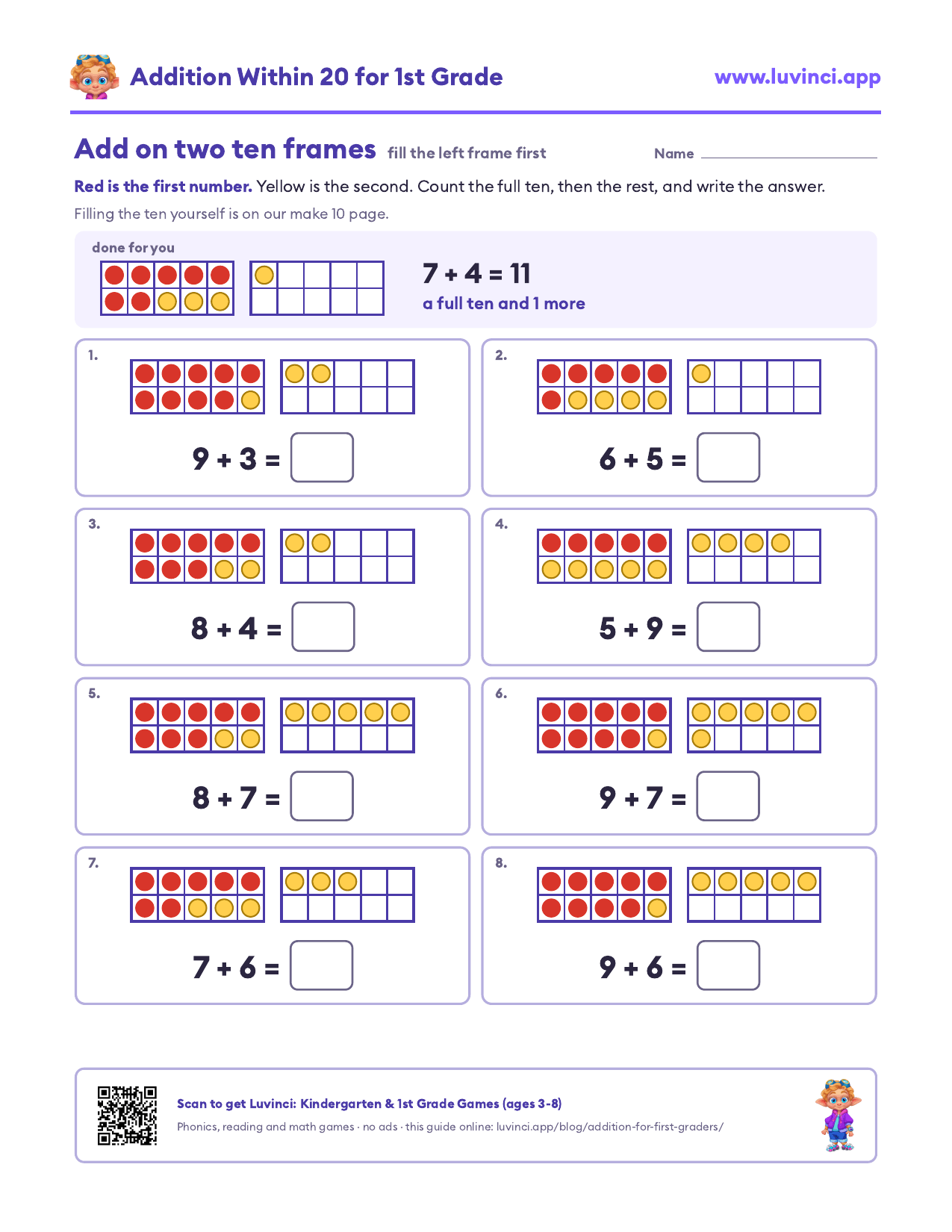
Page 2: the counters are already drawn. Count the full ten, then the rest.
The teen number idea is “10 and 2 more is 12”. If that is new, start with teen numbers on two ten frames.
Teaching counting on in a conceptual way “makes all single-digit sums accessible to U.S. first graders, including children who are learning disabled and those who do not speak English as their first language” (National Research Council, 2001, Adding It Up, p. 189).
Ways to add within 20
Kids use three main ways. Counting on usually comes first.
Count on from the bigger number. For 4 + 9, start at 9 and say it long, “Niiiiine”, then “ten, eleven, twelve, thirteen”. That’s the Progressions’ own example (p. 14). Kids keep track of the counts “with fingers, mental images, or physical actions such as head bobs”, and they count on from the larger addend “even if it is second”. Adding 1 to 4 is where it works best. Page 3 has 12 of these.
Use a fact you already know. If 6 + 6 = 12, then 6 + 7 is one more, 13 (the 1.OA.6 example). Doubles “are learned very quickly” (National Research Council, 2001, p. 188), so they make good stepping stones. Our doubles plus one guide has the full table.
Fill up a ten first. For 8 + 6, 8 needs 2 to make 10, so 8 + 6 = 8 + 2 + 4 = 10 + 4 = 14, the standard’s example again. The make 10 strategy shows it step by step on two ten frames. It rests on three things (Progressions, p. 15):
- knowing the partner that makes 10 for each number (the number bonds to 10),
- splitting a small number into two parts, like 6 into 2 and 4,
- seeing a teen number as 10 and some more.
Which way is quickest?
Any way that gets the right answer is fine. “Several procedures for single-digit addition typically coexist for several years” (National Research Council, 2001, p. 188). For 7 + 8, one child says, “I know 7 + 7 = 14, so 15.” Another says, “8 + 2 = 10, then 5 more, 15.” Both are right.
On page 4, your child ticks count on, double or ten, then writes the answer. Talking about why is the real practice.
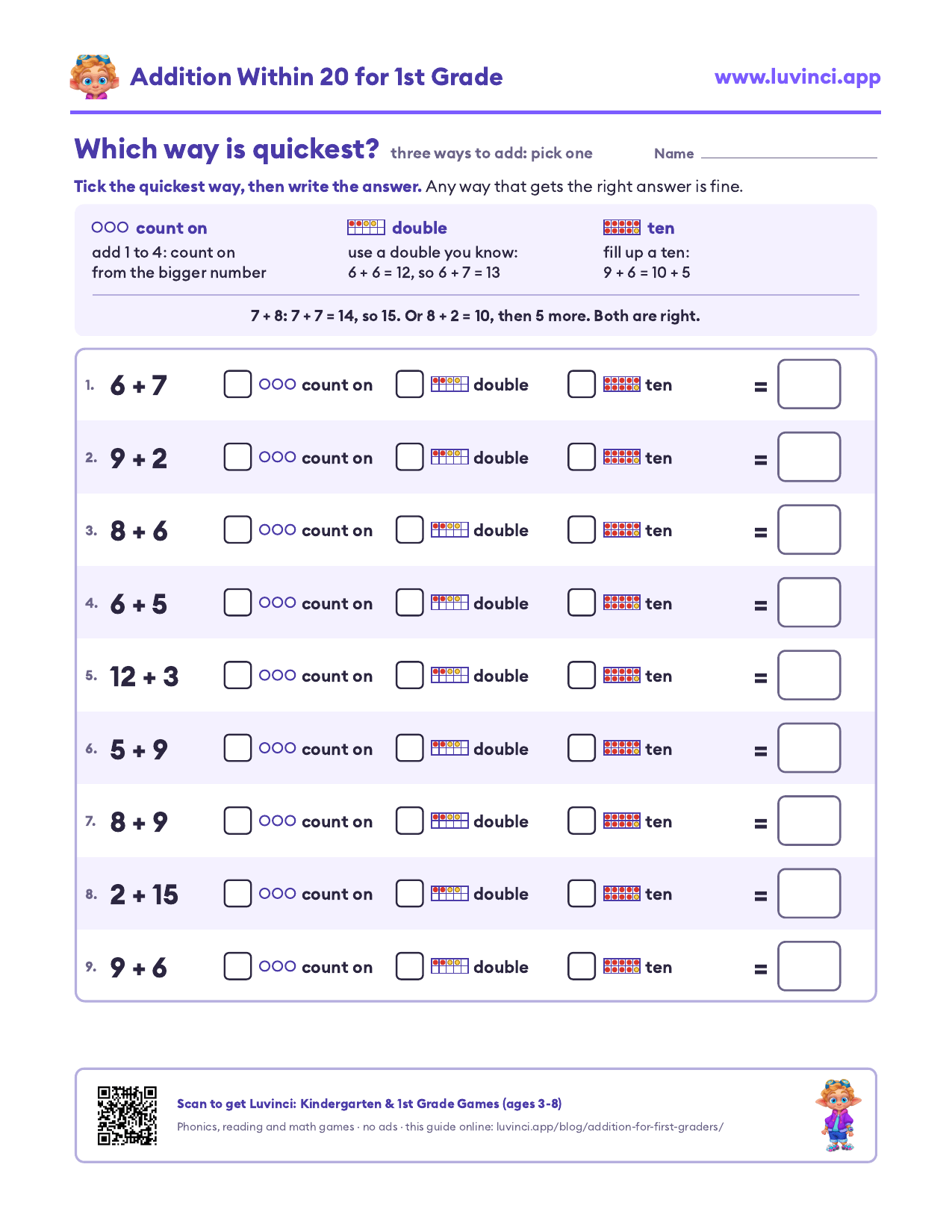
Page 4: tick a way, then solve. The answer key lists a quick way for each, but any way that works is fine.
Addition facts to 20
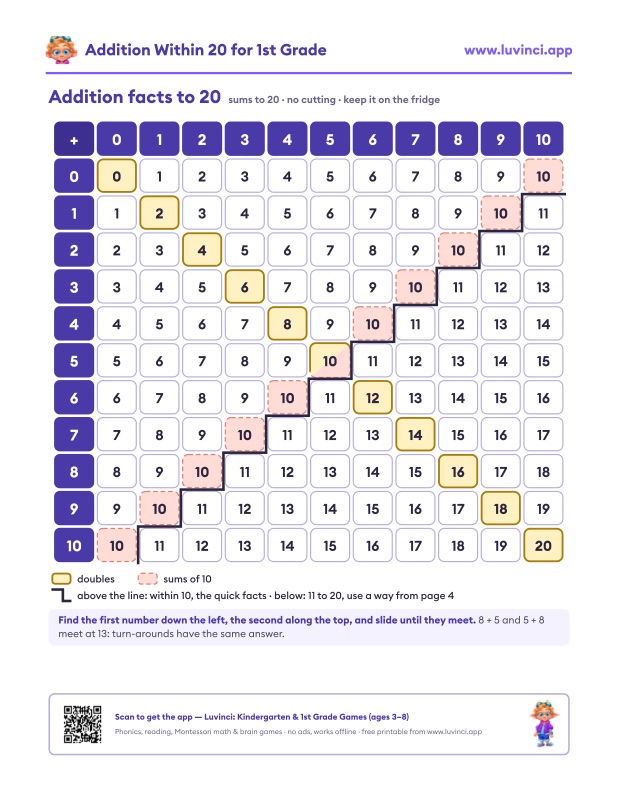
The sum of two one-digit numbers is an addition fact, from 0 + 0 up to 9 + 9. That’s 100 facts, or 55 if a turn-around pair like 3 + 8 and 8 + 3 counts once. The chart on page 1 adds the 10s too, so it runs to 10 + 10 = 20 and has 121 squares. Some sites call it an addition chart to 20.
There’s no cutting and no prep on page 1. Find the first number down the purple column and the second along the top, then slide until they meet. Patterns to spot:
- The thick line. Above it are the sums within 10, the ones that get quick in 1st grade. Below it, 11 to 20 get worked out with one of the ways above.
- Yellow diagonal: doubles to 10 + 10 (see our doubles chart).
- Pink slanting line with a dashed edge: sums of 10, just above the thick line.
- Every slanting line has one answer. Turn-arounds mirror each other across the yellow diagonal: 8 + 5 and 5 + 8 meet at 13.
The math facts for first graders are the addition and subtraction facts within 20, with the ones within 10 quick by the end of the year (1.OA.6).
Using the addition worksheets for first graders
The PDF is free and prints in black and white, with every answer in the back. What’s inside:
- Page 1. Addition facts to 20 chart (no cutting).
- Page 2. Add on two ten frames: 8 sums, counters already drawn.
- Page 3. Count on: 12 sums, adding 1 to 4.
- Page 4. Which way is quickest?: 9 sums; tick a way, then solve.
- Page 5. Practice: 20 sums in a row.
- Page 6. Practice: 15 sums in a column, then 6 three-number sums.
- Page 7. Mixed review: 20 more sums.
- Page 8. Is it true?: 12 number sentences to check.
- Page 9. 15 cut-out cards.
- Page 10. Their answer cards.
- Page 11. Answer key for pages 2 to 8.
Page 5 has 20 sums in rows, 8 of them within 10. For those, say “this is the quick within 10 part”. Page 6 has 15 sums in columns, the way they will see them later, with a few like 12 + 5 where the ones just add. Then come 6 three-number sums: “look for a ten or a double first”, as in the standard’s 2 + 6 + 4. Page 7 is 20 more sums, none repeated from page 5.
Want a page a day after school? Our free Addition Facts to 20 Workbook has 20 pages of plain facts, one way at a time (count on, doubles, make 10, three numbers), with earlier facts mixed back in as it goes and the answers at the back. No timer: do the ones you know first.
About 10 minutes, one page a day, is plenty. The answer key on page 11 is for grown-ups.
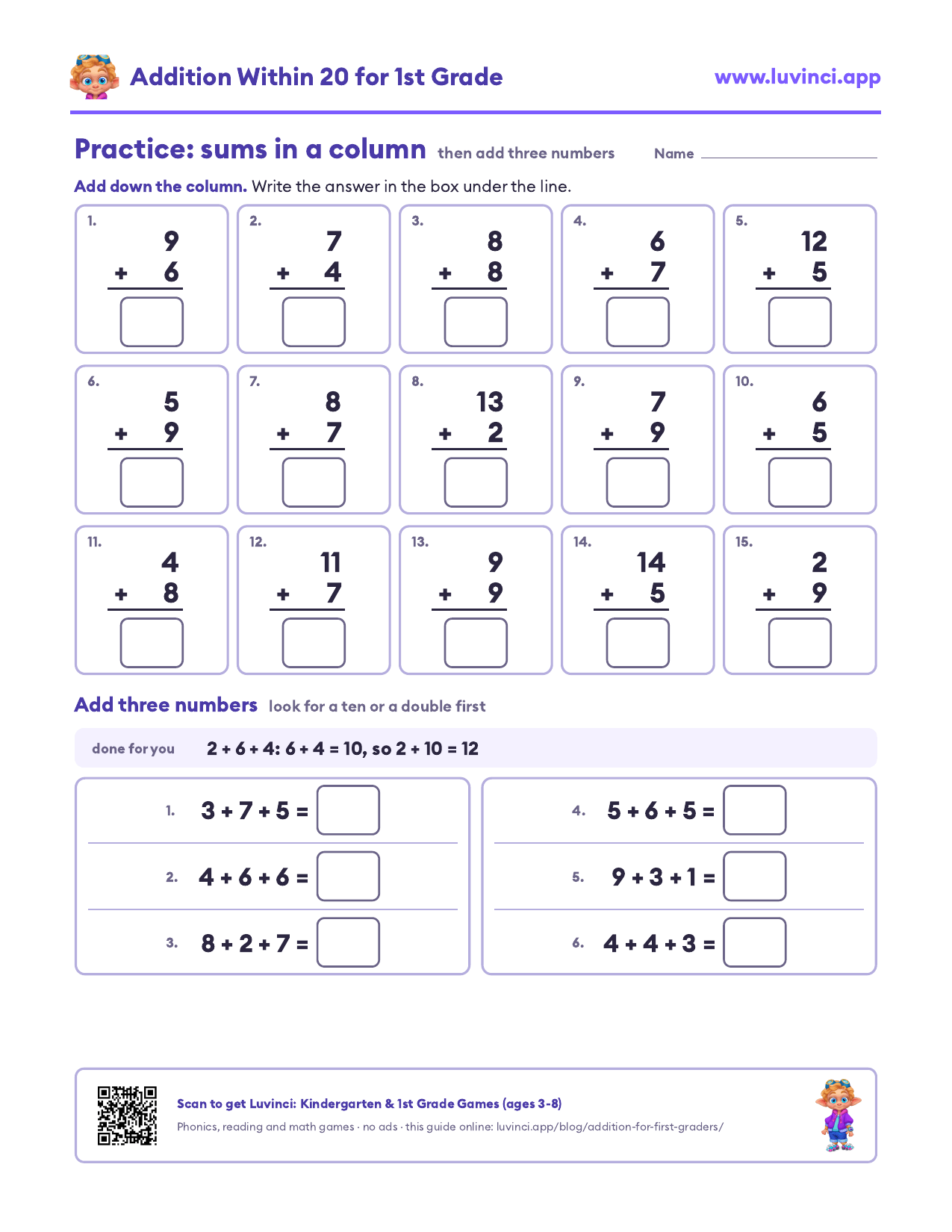
Page 6: sums in columns, then three numbers. Answers are on page 11.
Practice works best after the teaching, not instead of it: “drill must be preceded by sound instruction” (Brownell and Chazal, 1935, as summarized by the National Research Council, 2001, p. 219).
More free addition pages, each with its own free PDF:
- Two ten frames and a double ten frame
- Make 10 first, adding to 20
- Doubles flash cards to 10 + 10
- Counting on with a number line to 20
- Number line addition worksheets with jumps to 10
- Teen numbers as ten and some more
Print this PDF with the one in part 4 and you have a full set of addition and subtraction worksheets for first graders, all within 20.
The 15 cards: sums 11 to 17
Pages 9 and 10 are 15 cut-out flash cards with answer cards. Print page 10 on the back of page 9, flipping on the long edge. Each card then has its answer behind it, drawn on two small ten frames.
Why 11 to 17? Every other sum from 11 to 20 is a double (6 + 6 to 10 + 10, on our doubles flash cards) or 10 and some more (teen numbers). 2 + 9 is left off because counting on 2 is quick; it is on pages 3 and 4.
- Quick look. Hold up a card, your child says the answer, then flips it to check.
- Two piles. Quick answers go in a “know it” pile. The rest come back tomorrow.
- Say how you got it. “13, because 6 + 6 is 12 and one more.” On a miss, ask which way they used.
Short practice comes after you teach the strategy. Two Institute of Education Sciences guides, both about children who find math hard, agree. One says that for kindergarten through grade 2, “explicitly teach strategies for efficient counting”, with flash cards as follow-up practice (Gersten et al., 2009). The other: “Do not use timed activities to introduce and teach mathematics concepts and operations” (Fuchs et al., 2021). Keep it to five minutes.
For dice games with sums to 20, see our first grade math games.
Common addition mistakes in 1st grade
| What you see | Why | What helps |
|---|---|---|
| 8 + 3 = 10 (“eight, nine, ten”) | Counts the start number as a count | Say the first number long, “eiiight”, then count 3 more, one finger per count. On a number line: count the hops, not the marks |
| Counts on from the small number (2 + 9 takes nine counts) | Not sure yet that order doesn’t matter | “Start with the bigger number.” |
| Counts all from 1 every time | Still counting both groups; normal on new sums | Two ten frames, then cover the first group with a cup and start from its number. The National Research Council describes hiding one of the sets (2001, p. 189) |
| 8 + 6 by filling a ten goes wrong | One piece isn’t solid yet: the partner of 8, splitting 6, or 10 + 4 as fourteen | Practice the missing piece on its own (Progressions, p. 15) |
| 6 + 7 = 12 or 14 | Knows the double, unsure which way to adjust | “Double the smaller one, then one more.” |
| Writes 31 for 13 | Teen numbers sound backwards | See common teen number mistakes |
| 3 + 5 = 8 + 2 = 10 | Reads = as “the answer comes next” (1.OA.7) | Page 8; check both sides with counters (the equal sign) |
Addition in the app
The app’s adding boards practice the facts within 10 that every sum to 20 is built on. On its Singapore Math boards, each sum sits on two ten frames of pictures, one frame for each number. Addition Level 1 shows the numbers as raindrop pictures, and Levels 2 to 5 are number sentences. None of the adding or take-away boards goes past 10, so the sums from 11 to 20 live on the PDF. These boards are in the full app. See our early math page for the rest of the math games.
FAQ
What is addition within 20?
It means adding two or three numbers when the total is 20 or less, like 9 + 6 = 15 or 2 + 6 + 4 = 12. It’s the 1st grade adding standard (1.OA.6).
What are the addition facts to 20?
The 100 sums of two one-digit numbers, from 0 + 0 to 9 + 9; see addition facts to 20 for the chart and its patterns.
What addition should a 1st grader know by the end of the year?
Quick and accurate sums within 10, sums within 20 worked out with a strategy, what = means, and adding three small numbers. Knowing all the facts to 20 from memory is a 2nd grade goal.
What math facts should a second grader know?
The math facts for second graders are all the addition and subtraction facts within 20. The standard (2.OA.2) says: “Fluently add and subtract within 20 using mental strategies. By end of Grade 2, know from memory all sums of two one-digit numbers.” That’s 0 + 0 to 9 + 9; the chart on page 1 adds the 10s too.
How do you memorize addition facts?
Strategies first, then short practice. Baroody (2006) describes three phases: counting, then reasoning, then mastery. He argues that the first two play “an integral and necessary role” in reaching the third. After that, 5 minutes a day with the cards.
What adds up to 20?
10 + 10, 11 + 9, 12 + 8, all the way to 19 + 1 and 20 + 0. That’s 11 pairs, counting 20 + 0 and 0 + 20 as one. Each is a pair that makes 10 with an extra ten, like 12 + 8 = 10 + 2 + 8 (see the pairs that make 10). On the page 1 chart, only 10 + 10 reaches 20.
Does 1st grade addition go past 20?
Yes. In the later part of 1st grade, kids add within 100: a two-digit number plus a one-digit number, or plus a multiple of 10, using tens and ones (1.NBT.4). Within 20 comes first, because a ten and some ones is the idea everything after builds on.
The takeaways
- Addition for first graders means adding within 20: quick within 10, and sums from 11 to 20 worked out a smart way.
- Count on from the bigger number, and say the first number without counting it.
- Use a fact you know: 6 + 6 = 12, so 6 + 7 = 13.
- Fill a ten first: 8 + 6 is 10 + 4.
- = means “the same as”, on either side.
- Knowing all the sums from memory is a 2nd grade goal, not a 1st grade one.
- Print the free addition worksheets for first graders: a chart to 20, ten frames, counting on, practice pages, flash cards and an answer key.
More free math worksheets: ten frames, number charts, addition and subtraction, daily practice workbooks and more, all in one place. See the math printables →
