 Luvinci
October 10, 2026
Word Family List: 37 Phonics Word Families + Free PDF
Free printable · PDF · 1597 KB
Word Family List: 37 Phonics Word Families + Free PDF
No signup needed. Just print it.
Download PDFFree worksheets (2)
Printable PDFs, no signup.
Glued -am and -an
A word family is a group of words that end with the same chunk, spelled the same way and said the same way: cake, lake, snake. In reading, that chunk (the vowel and everything after it) is called the rime, and the letter or letters before it are the onset: c + ake, sn + ake. This word family list has the 37 common word families, which turn up in about 500 words children meet in early books, plus a few more, grouped by stage. Only 9 of the 37 are the first short-vowel families like -at and -in (cat, pin). The other 28 go further: -ack, -ake, -ing, -ight.
Every word here was checked by sound. Many lists online slip in words that look alike but sound different, like son under -on, or sound alike but are spelled differently, like climb under -ime.
back, bell, duck, jump, ball, king, pink, skunk, cake, slide, smoke, rain, play, light, store
You can print a chart, the full list and six word sliders, made for parents, tutors and teachers. They’re in our free word families PDF. 7 pages, free, with no signup and no email.
Jump to: the 37 · the list by stage · glued sounds · two sounds · PDF
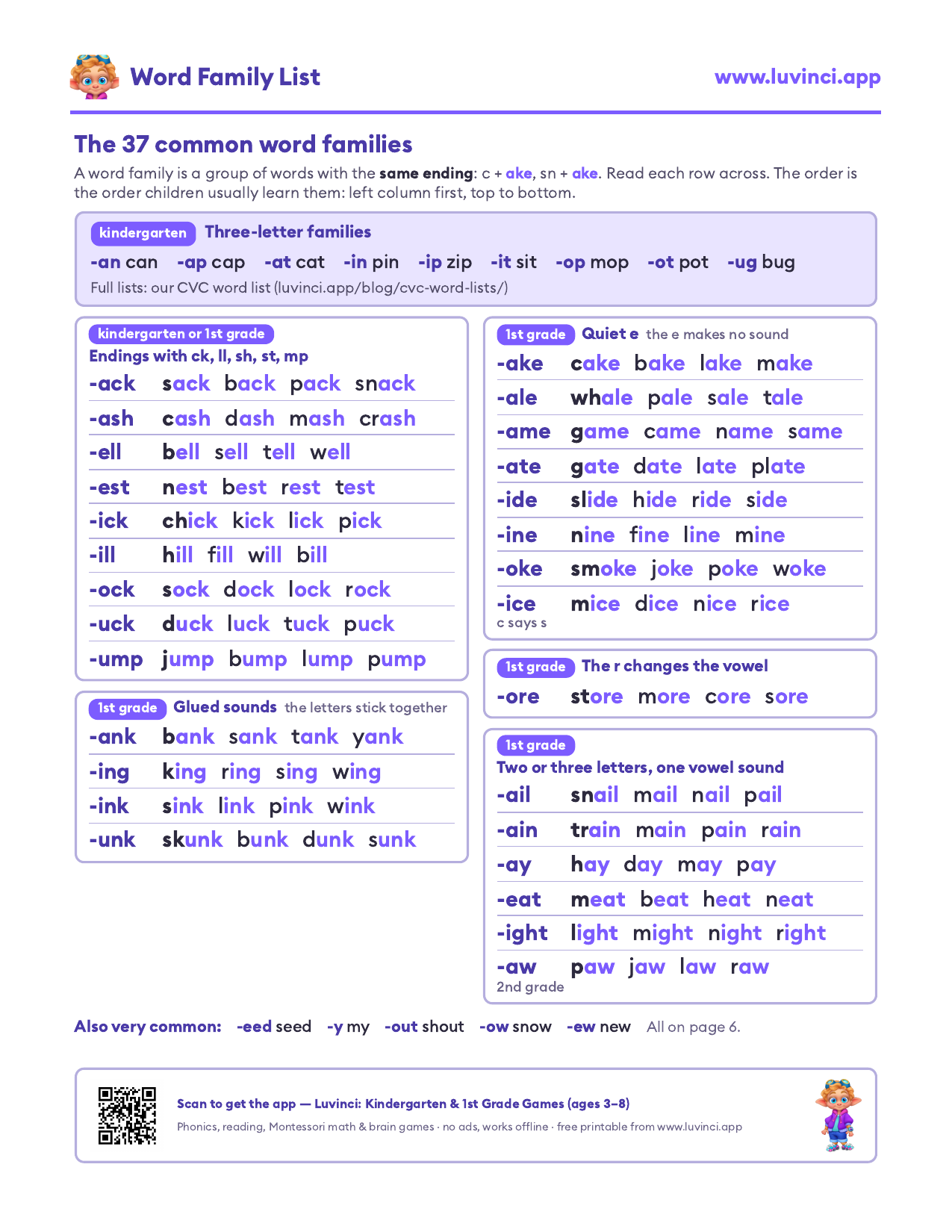
Page 5 of the free PDF. The 37 common word families, in the order children usually learn them.
What is a word family?
A word family is a set of words that share a rime, the same vowel and ending, spelled the same and said the same. Look at snake. The onset is sn, the rime is ake. Some words have no onset at all. Ice is just the rime. Some books call the rime a chunk or a phonogram.
A family needs both the same spelling and the same sound. Rain and plane rhyme, but they’re two families (-ain and -ane). Snow and cow look like one family, but they don’t sound alike (more on that in same spelling, two sounds).
Children practice hearing c + ake out loud before they start reading. Word families are the printed side of that skill.
In vocabulary lessons, “word family” can also mean words built from one root, like help, helper, helpful. This page is about the reading kind.
When to teach word families, and what comes first
Once your child can sound out short words like cat and pin, letter by letter, start word families. The three-letter families come first, and they have their own page: our CVC word list, family by family has 139 words in 31 families.
These four plain rules keep a word family list working for reading, not guessing:
- Sound out every letter first (b-a-ck), then notice the chunk -ack.
- Mix two families with the same vowel letter, like -ake and -ack, so your child looks at the whole word.
- Change the middle and the end too, not only the start: cake, lake, like, line, fine.
- Glued sounds are the exception. There, learning the chunk as one piece is the point.
Programs differ. Go by the sounds your child knows. This is the usual teaching order:
| Stage | Families | Grade |
|---|---|---|
| Three-letter families | -an -ap -at -in -ip -it -op -ot -ug (full lists linked above; -an is also glued) | kindergarten |
| Glued -am and -an | -am -an (the a sounds a little different before m and n) | kindergarten |
| Endings with ck, ll, sh, st, mp | -ack -ash -ell -est -ick -ill -ock -uck -ump | kindergarten or 1st grade |
| Glued -all | -all | kindergarten or 1st grade |
| Glued ng and nk | -ang -ing -ong -ung, then -ank -ink -unk | 1st grade |
| Quiet e | -ake -ale -ame -ate -ide -ine -oke -ice | 1st grade |
| Cold, find, wild (and y) | -ind -ild -old -olt -ost, -y | 1st grade |
| The r changes the o | -ore | 1st grade |
| Two or three letters, one vowel sound | -ail -ain -ay -eat -eed -ew -ight -igh -ow -out | 1st grade |
| Two or three letters: -aw (paw, saw) | -aw | 2nd grade |
The 37 common word families
Reading researchers counted 37 endings that show up in about 500 words children meet in early books. 28 of them go past cat-and-pin words. Here they are by stage, each with a key word.
| Stage | Family and key word |
|---|---|
| Three-letter (kindergarten) | -an can, -ap cap, -at cat, -in pin, -ip zip, -it sit, -op mop, -ot pot, -ug bug (full lists linked above) |
| Endings with ck, ll, sh, st, mp | -ack sack, -ash cash, -ell bell, -est nest, -ick chick, -ill hill, -ock sock, -uck duck, -ump jump |
| Glued sounds | -ank bank, -ing king, -ink sink, -unk skunk |
| Quiet e | -ake cake, -ale whale, -ame game, -ate gate, -ide slide, -ine nine, -oke smoke, -ice mice (c says s) |
| The r changes the o | -ore store |
| Two or three letters, one vowel sound | -ail snail, -ain train, -ay hay, -eat meat, -ight light, -aw paw (2nd grade) |
Another well-known list of the most common endings also has -eed, -y, -out, -ow (snow) and -ew. They’re in the list below too.
The list below also has -all, -ang, -ong and -ung. They aren’t in the 37, but programs teach them together with the other glued sounds.
The word family list, stage by stage
The chunk stays the same in each row. You change the start. Read across a row, then mix two rows. Single letters come first in each row, then two-letter starts like sn and tr.
Endings with ck, ll, sh, st and mp (kindergarten or 1st grade)
These keep the short vowel of cat and pin and end in two letters, where ck, ll and sh make one sound and st and mp make two.
- -ack: back, pack, sack, snack, black, track, stack, quack
- -ash: cash, dash, mash, crash, flash, splash, trash
- -ell: bell, sell, tell, well, yell, shell, smell, spell
- -est: best, nest, rest, test, vest, west, chest
- -ick: kick, lick, pick, sick, brick, chick, click, stick
- -ill: fill, hill, will, bill, chill, drill, grill, spill
- -ock: dock, lock, rock, sock, block, clock, flock
- -uck: duck, luck, tuck, puck, truck, stuck, cluck
- -ump: bump, jump, lump, pump, stump, thump, plump, grump
Wash looks like -ash but says “wosh”: after w, a often says “ah” (want, swan, watch). The -ell and -ill rows double their l because of the floss rule. More words with each vowel: short a, e, i, o and u.
Next come the glued sounds (-all, -ing, -ank). They have their own section below.
Endings with a quiet e: cake, slide, smoke (1st grade)
The e at the end makes no sound. The vowel before it says its name.
- -ake: bake, cake, lake, make, rake, take, wake, snake
- -ale: pale, sale, tale, whale, scale, stale
- -ame: came, game, name, same, tame, blame, flame, frame
- -ate: date, gate, late, plate, skate, crate
- -ide: hide, ride, side, tide, wide, bride, pride, slide
- -ine: fine, line, mine, nine, pine, vine, shine, spine
- -oke: joke, poke, woke, broke, smoke, spoke
- -ice: dice, mice, nice, rice, price, slice, spice, twice
In -ice the c says /s/, a soft c.
More of these (-ave, -ape, -ade, -ane, -ike, -ite, -ime, -ive, -ope, -ose, -one, -ole) are in the PDF and on our long a and long i lists. Words like cube and flute are on our long u list. For the rule itself, see magic e words.
Have, give, live, come, some, one and done look like these families but say a different vowel, so children learn them as heart words. None, gone and love don’t follow their family’s sound either.
Cold, find, wild: long sounds without an e (1st grade)
These endings look short. The vowel still says its name.
- -ind: find, kind, mind, bind, blind
- -ild: mild, wild, child
- -old: old, bold, cold, fold, gold, hold, sold, told
- -olt: bolt, colt, jolt
- -ost: host, most, post
Once your child knows -ind, find stops being a heart word. Watch for three look-alikes: wind (the wind blows) is short, build says “bild”, and lost and cost say short o. More in our lists for kind and wild and cold, bolt and most.
A y alone at the end of a short word says long i: my, fly, sky (y at the end).
- -y: by, my, why, fly, cry, dry, try, sky
Store, more, shore: the r changes the o (1st grade)
- -ore: more, core, sore, store, chore, score, shore, snore
The r changes the o, so store is not stoe plus r. See bossy r words for ar, or, er, ir and ur.
Two or three letters, one vowel sound: rain, play, light (1st grade)
Two or three letters work together here to make one vowel sound.
- -ail: mail, nail, pail, sail, tail, rail, snail, trail
- -ain: rain, pain, main, brain, chain, drain, grain, train
- -ay: day, hay, may, pay, say, way, play, clay
- -eat: beat, heat, meat, neat, seat, treat, wheat
- -eed: feed, need, seed, speed
- -ew: new, few, chew, blew, crew, drew, flew, grew
- -ight: light, might, night, right, sight, tight, bright, flight
- -igh: high, sigh
- -ow: low, mow, tow, blow, crow, grow, show, snow
- -out: out, pout, shout, spout, scout, snout, trout
- -aw (2nd grade): jaw, law, paw, raw, saw, claw, draw, straw
In -ight, the igh says long i, so keep it together: l-ight. -ew says “oo” in new and “yoo” in few. -ow can also say “ow” as in cow (see below). Great and sweat look like -eat but don’t sound like it, and eight and weight say long a.
Our vowel teams explained guide covers these letter pairs. More words: ai and ay, ee, igh and ow at the end.
Glued sounds (welded sounds)
A few endings stick together so tightly that children learn them as one chunk. Teachers call them glued sounds, and some programs say welded sounds.
The first ones are -am and -an, in kindergarten. The a sounds a little different before m and n (ham, fan). Two free -am and -an worksheets are in the box at the top of this post. Next is -all, then the ng and nk families, which come at separate times in 1st grade.
- -all (kindergarten or 1st grade): ball, call, fall, hall, tall, wall, mall, small
- -ang: bang, hang, rang, sang, fang, clang
- -ing: king, ring, sing, wing, bring, sting, swing, thing
- -ong: long, song, gong, strong
- -ung: hung, lung, rung, sung, stung, swung
- -ank: bank, sank, tank, yank, blank, drank, plank, thank
- -ink: link, pink, sink, wink, blink, drink, stink, think
- -unk: bunk, dunk, sunk, chunk, skunk, trunk
Once your child knows -all, all stops being a heart word.
The vowel shifts. Before ng and nk, a slides toward “ay” (bank, sang) and i toward “ee” (king, pink) in most American speech. -all says “awl” or “ahl” depending on where you live. Sounding out b-a-l-l gives the wrong a. That’s why the chunk is learned whole.
ng is two letters for one sound. In -nk you hear that sound plus k. More in ng and nk and digraphs. -onk has few words kids use; honk is the main one. (Monk says “munk”.)
Ball, roll and full double their l, but each vowel says something new (see doll, ball and roll). Shall keeps a short a.
Practice sheets for -all, -oll, -ull, -am and -an are on our glued sounds printables, and our decodable stories for lessons 42-44 and lessons 50-53 use these endings.
Same spelling, two sounds
Some endings are spelled the same and still say two different things. Try one sound. If it isn’t a word, try the other.
- -ow: snow, grow / cow, how
- -own: grown, shown / down, town
- -ost: most, post / lost, cost
- -ind: find, kind / wind
- -oll: roll / doll, and -ull: bull, full / dull, gull
- -ood: food / good, wood (blood says “uh”)
- -oot: boot / foot
- -ead: bead / head, bread
- -ear: hear, near / bear, pear (bossy r, 2nd grade)
- -ove: stove / love / move
The list prints one sound per row (snow, not cow) and flags the other.
Word family games (5 minutes)
Five minutes with the PDF will do.
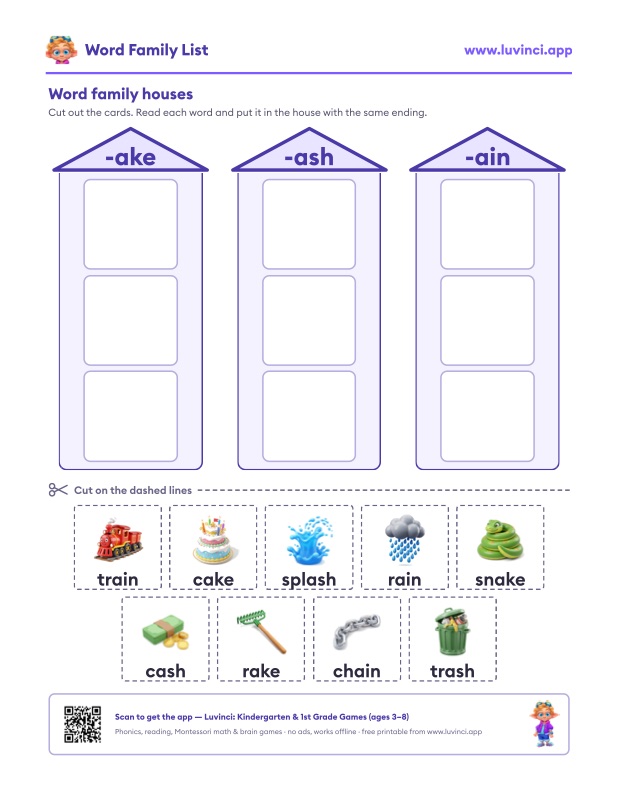
- House sort. Cut out the cards on pages 1 and 2 ahead of time. Your child reads each one and puts it in the house with the same ending.
- Write the ending. On page 3, your child says the picture name and writes its ending from the box.
- Slider. Make the sliders ahead of time from page 4 of the PDF: cut out the card and the strip, and a grown-up cuts the two slits. Then your child slides and reads. No glue needed.
- Chart read. On page 5, read one row across, then mix two rows.
- Word chain. cake, lake, like, line, fine. Change one letter each time, anywhere in the word.
- Same-letter sort. snake / snack, bake / back, rake / rack. Your child reads each pair and says which one has the long a.
- Made-up word check. Can your child read zake or jight? Then they’re using the chunk, not memory. More in nonsense words.
- Build it. Make cake with letter tiles, then swap the c for l, m and sn.
Sentences to read aloud
Once your child has read a line, point to one word and ask, “Which family is it in?”
- The snake sat on a rock in the light.
- Bring the ball to the king.
- The skunk will drink from the pink sink.
- We play with a train in the rain.
- Mice ride on a bike at night.
- Can you sell me a bell and a shell?
Free word families PDF: chart, list and sliders
The PDF has 7 pages, activities first: two word family house sorts, a write-the-ending page and sliders to cut out. Then you’ll get a chart of the 37, the list by stage, and more word families with the two-sounds box. Page 7 adds 36 families like bike, boat, moon and star.
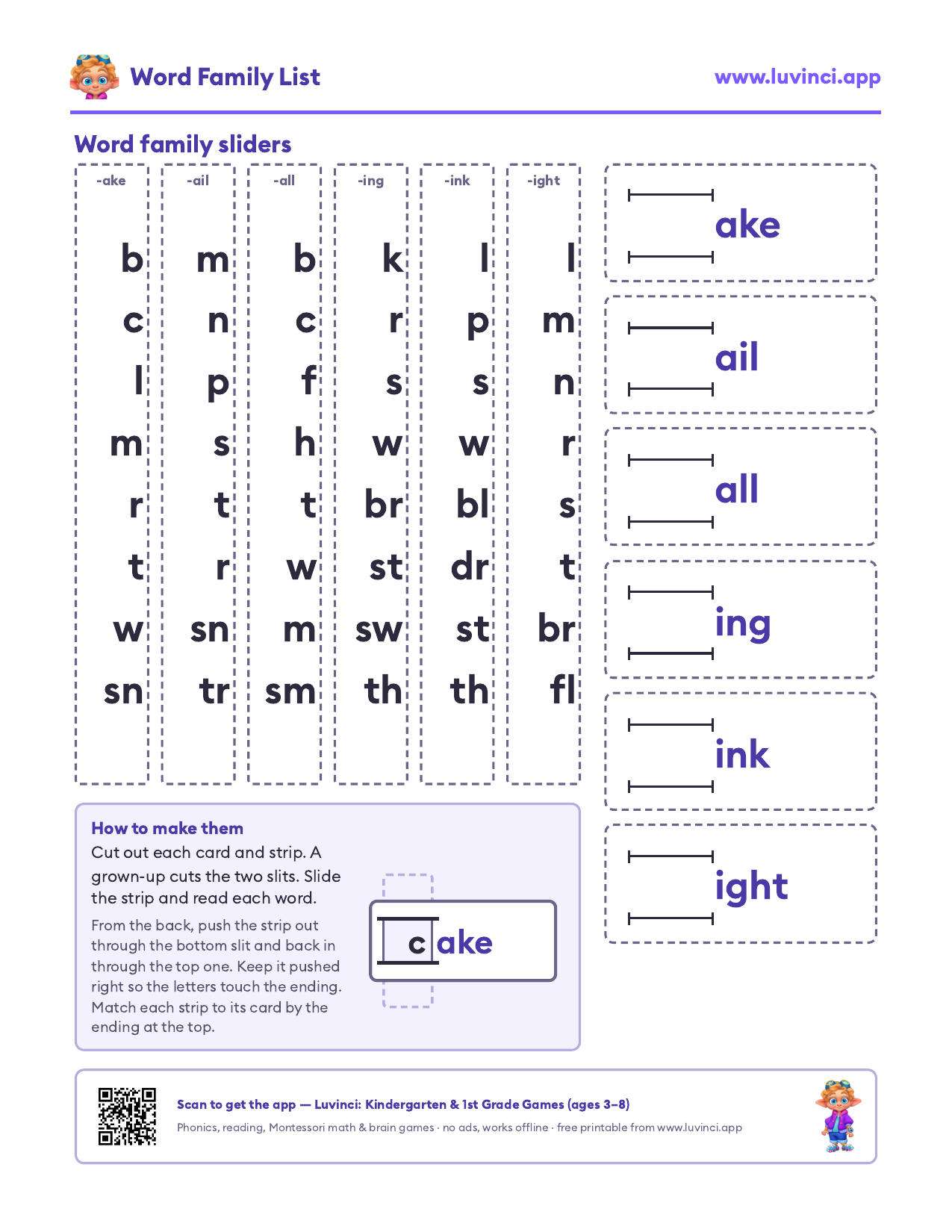
Page 4 of the free PDF.
Put page 5 on the fridge as a chart. Pages 1 to 3 work as free word family worksheets. Download the free word families PDF. No signup, no email. The three-letter families have their own list and PDF: see our CVC word list. More sheets: word family printables and glued sounds printables.
Questions parents ask
What grade level is the word family? Kindergarten for three-letter families like -at; kindergarten or 1st grade for -ack, -ell, -ill and -all; 1st grade for glued sounds like -ing and -ank, and for -ake, -old, -ore, -ain and -ight; 2nd grade for -aw. Programs differ, so go by the sounds your child knows.
What needs to be taught before teaching word families? Letter sounds and blending. A child should be able to sound out cat letter by letter before an -at list helps.
What are the 37 word families? -ack, -ail, -ain, -ake, -ale, -ame, -an, -ank, -ap, -ash, -at, -ate, -aw, -ay, -eat, -ell, -est, -ice, -ick, -ide, -ight, -ill, -in, -ine, -ing, -ink, -ip, -it, -ock, -oke, -op, -ore, -ot, -uck, -ug, -ump, -unk.
What are some examples of word families in English? -ake (cake, lake, snake), -ight (light, night, bright), -ing (king, ring, swing), -ay (day, play, stay).
What are rhyming word families? Rhymes only need the same ending sound (rain, plane). A word family needs the same spelling too, so every word in a family rhymes, but not every rhyme is in the same family.
What are glued sounds? Endings like -all, -ing and -ank where the letters stick together and the vowel shifts a little, so children learn them as one chunk.
Where can I find a free PDF list of word families? Our free word families PDF: 7 pages, no signup. The three-letter families are in our CVC word list.
UFLI Foundations teaches -all, -oll and -ull in lesson 43, ng in lesson 51, nk in lesson 52, magic e from lesson 54 and igh in lesson 87 (see our worksheets in UFLI order).
Our reading games sound out every letter and have your child pick the missing letter, ages 3 to 8, no ads, offline. From here: long vowel words.
Created to align with UFLI Foundations’ scope and sequence; lesson numbers are cited for alignment only. This post and its PDF are our own original work, not created by nor endorsed by UFLI or the University of Florida.
Sources
- Wylie, R. E. and Durrell, D. D. (1970). Teaching vowels through phonograms. Elementary English 47, 787-791. ERIC EJ024641.
- Frank, M. (2016). Teaching Analogy Phonics. ATLAS, Hamline University, p.4 and pp.13-17.
- Fry, E. (1998). The most common phonograms. The Reading Teacher. ERIC EJ562457.
- Ehri, L. C. and Robbins, C. (1992). Beginners need some decoding skill to read words by analogy. Reading Research Quarterly 27(1), 12-26. ERIC EJ437489.
- Christensen, C. A. and Bowey, J. A. (2005). The efficacy of orthographic rime, grapheme-phoneme correspondence, and implicit phonics approaches to teaching decoding skills. Scientific Studies of Reading. ERIC EJ717979.
- Ku, C. G. (2026). What about word families? Ask AIM, AIM Institute.
- Reading Universe. Overview of glued sounds and When to teach glued sounds.
- UFLI Foundations. Scope and Sequence at a Glance (K-2).
